Tamarisk
The plant genus Tamarix derives its name from the Latin word tamarix, which refers to the tamarisk tree. The etymology of the common name "tamarisk" traces…
What is the origin and meaning of the name ‘Tamarix’ for this plant genus?
The plant genus Tamarix derives its name from the Latin word tamarix, which refers to the tamarisk tree. The etymology of the common name “tamarisk” traces back to the Middle English tamarisc, which originated from the Late Latin tamariscus and ultimately the Latin tamarix.12
This genus serves as the type genus for the family Tamaricaceae, a group of shrubs and trees often found in salt deserts and semiarid regions across the Mediterranean and Asia. These plants are well-adapted to harsh environments, possessing deep roots and the unique ability to excrete salt through their leaves. While some species are valued as windbreaks or ornamentals, others are considered invasive pests in parts of North America due to their high water consumption and displacement of native vegetation.1342
Are there any beneficial uses of tamarisk plants in modern agriculture or industry?
While some Tamarix species are considered invasive pests in North America due to their high water consumption, they offer several practical applications in agriculture and landscaping:
- Windbreaks: The Athel tree (T. aphylla) is frequently utilized as a windbreak in desert environments to protect crops and soil from erosion.2
- Coastal Protection: The salt cedar (T. gallica) is planted along seacoasts to provide shelter, as it is highly resilient to salt-water spray and soil salinity.2
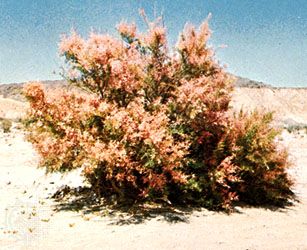
- Ornamental Use: Species such as T. ramosissima and T. chinensis are cultivated for their aesthetic value, prized for their feathery appearance and dense clusters of pink flowers.2
- Environmental Resilience: Their ability to thrive in drought-prone, saline, and semiarid conditions makes them useful for stabilizing difficult soils where other vegetation might struggle to survive.2
What are the key characteristics of plants in the Tamarix genus?
The Tamarix genus consists of approximately 54 species of deciduous shrubs and small trees within the Tamaricaceae family. These plants are native to regions ranging from the Mediterranean to central Asia and northern China, though many have been introduced to North America.23
Key characteristics include:
- Physical Structure: They feature long, slender branches with tiny, gray-green, scalelike leaves, giving the plants a distinct feathery appearance.23
- Flowers: They produce clusters of small, white to pink flowers that hang from the ends of branches or trunks. Each flower typically has 4 or 5 sepals and petals, with 4 to 10 separate stamens arising from a fleshy disk.23
- Reproduction: The fruit is a capsule containing numerous seeds, each equipped with a long tuft of hairs to aid in dispersal.2
- Environmental Adaptations: These plants are highly resilient, capable of surviving in drought, high soil salinity, and salt-water spray. They possess deep-ranging roots and can excrete salt through their leaves to thrive in saline groundwater.23
What are some traditional uses of tamarisk plants in different cultures?
The provided search results do not contain information regarding the traditional uses of tamarisk plants in different cultures beyond their roles as windbreaks, coastal shelter, and ornamental plants in modern contexts.
Sorry, the Britannica knowledge base does not contain this information.
Sources
- tamarix — Merriam-Webster
- Tamarisk — Encyclopædia Britannica
- tamarisk — Merriam-Webster
- Tamaricaceae — Merriam-Webster
- tamarisk family — Merriam-Webster
Published on · 2 min read