Tasmania
Tasmania became a state of Australia in 1901 upon the federation of the Australian colonies.
How did Tasmania become a state of Australia and when?
Tasmania became a state of Australia in 1901 upon the federation of the Australian colonies.1
Prior to this, the island underwent a long process of political development:
- Early Colonization: Initially settled by the British in 1803, the island was part of the colony of New South Wales.23
- Separation: It became a separate colony, then known as Van Diemen’s Land, in 1825.23
- Self-Government: The colony achieved self-governing status in 1855–56, at which time it officially adopted the name Tasmania.345
Most Tasmanians supported the federation of the Australian colonies, hoping that joining the new nation would provide a significant boost to the island’s economy.4
How has Tasmania’s indigenous population, the Aboriginal Tasmanians, influenced the island’s history and culture?
The Tasmanian Aboriginal people have profoundly shaped the island’s history, though their influence was long obscured by colonial violence and a persistent, erroneous myth of extinction.8910
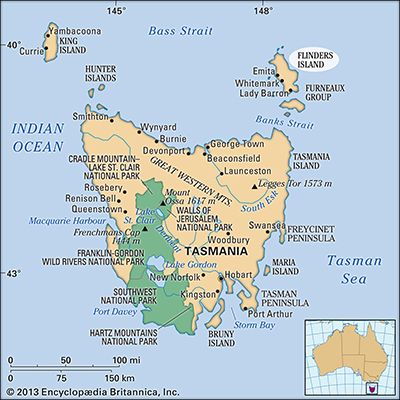
For thousands of years prior to European arrival, the Aboriginal population maintained a sophisticated culture, moving seasonally between the coast and the interior while utilizing specialized tools, basketry, and bark canoes. The onset of British colonization in 1803 initiated the Black War, a period of intense conflict driven by the seizure of hunting grounds and the depletion of food sources. This era resulted in the near-extermination of the Indigenous population and their forced relocation to Flinders Island8.811109
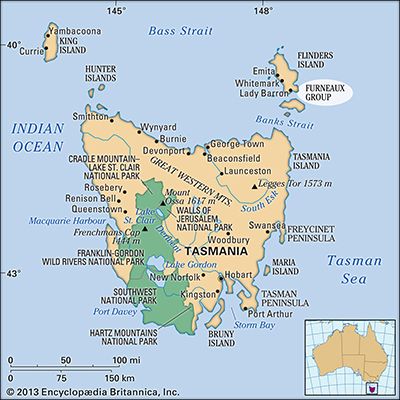
Despite these efforts to destroy their social organization, Aboriginal identity persisted through the descendants of Aboriginal women and European sealers in the Furneaux Group. By the 1970s, a powerful movement for rights and recognition emerged, leading to the Aboriginal Lands Act of 1995, which returned significant territories to the community. Today, the Aboriginal population is a vital, recognized presence in Tasmania, actively reclaiming their heritage and land rights.811
How has Tasmania’s convict history shaped its culture and heritage sites?
Tasmania’s convict history is a foundational element of its cultural identity and heritage landscape. Between 1803 and 1853, the arrival of approximately 68,000 convicts from Britain provided the labor force that built the colony’s public works, infrastructure, and many of its historic buildings.1213
This era left a lasting legacy through several significant heritage sites, many of which are now recognized as part of the Australian Convict Sites World Heritage listing:
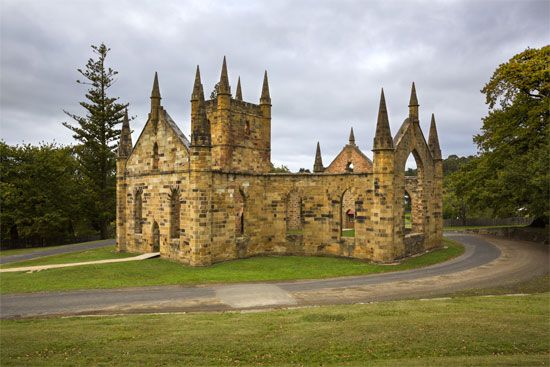
- Port Arthur Historic Site: Once a major penal colony for repeat offenders, it is now a primary tourist destination featuring restored ruins, a convict-built church, and the “Isle of the Dead”.14
- Cascades Female Factory: Located in Hobart, this site highlights the specific experiences of female convicts.15
- Coal Mines Historic Site and Darlington Probation Station: These locations preserve the history of convict labor and discipline.15
Beyond these sites, the influence of the convict era persists in Tasmania’s historic architecture and the ongoing preservation of early 19th-century townhouses, such as Narryna in Hobart.1
What is the geographical location and size of Tasmania?
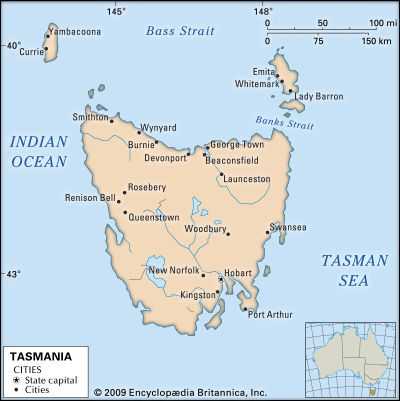
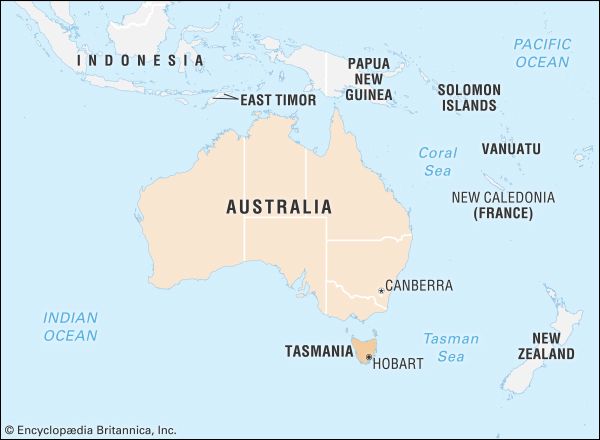
Tasmania is an island state of Australia located approximately 150 miles (240 km) south of the state of Victoria, from which it is separated by the Bass Strait. Structurally, the island serves as a southern extension of the Great Dividing Range.2
The state encompasses the main, heart-shaped island of Tasmania, along with several surrounding islands—including Bruny Island, King Island, and Flinders Island—as well as the subantarctic Macquarie Island.2
Regarding its size, Tasmania covers a total area of 26,410 square miles (68,401 square km), making it the smallest of Australia’s states. The main island itself has a maximum length and width of approximately 200 miles (320 km).52
Sources
- Colonization of Australia - Tasmania — Encyclopædia Britannica
- Tasmania: Country Facts — Encyclopædia Britannica
- Van Diemen’s Land — Encyclopædia Britannica
- Tasmania - Self-government and federation — Encyclopædia Britannica
- Tasmania — Encyclopædia Britannica
- South Australia: Country Facts — Encyclopædia Britannica
- Queensland: Country Facts — Encyclopædia Britannica
- Tasmanian Aboriginal people — Encyclopædia Britannica
- Colonization of Australia: Top Questions — Encyclopædia Britannica
- Black War — Encyclopædia Britannica
- Tasmania - The arts — Encyclopædia Britannica
- Port Arthur — Encyclopædia Britannica
- Tasmania - Prehistory and European exploration — Encyclopædia Britannica
- Tasmania - Cultural institutions — Encyclopædia Britannica
- list of World Heritage sites - Australia — Encyclopædia Britannica
- Tasmania - Relief — Encyclopædia Britannica
Published on · 3 min read