Atlantic Meridional Overturning Circulation
The Atlantic Meridional Overturning Circulation (AMOC) is a vital system of surface and deep ocean currents in the Atlantic Ocean that functions as the…
What is Atlantic Meridional Overturning Circulation?
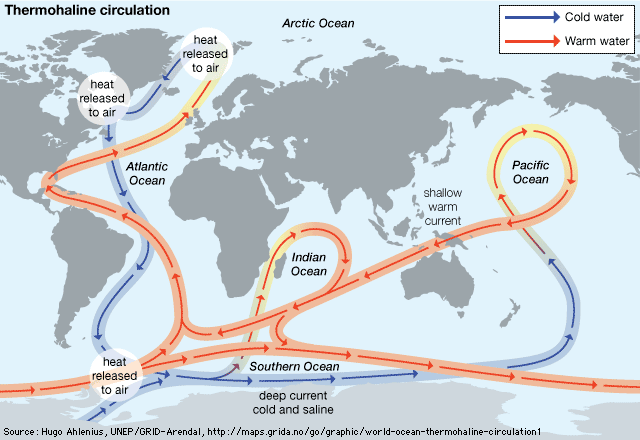
The Atlantic Meridional Overturning Circulation (AMOC) is a vital system of surface and deep ocean currents in the Atlantic Ocean that functions as the Atlantic component of thermohaline circulation.1
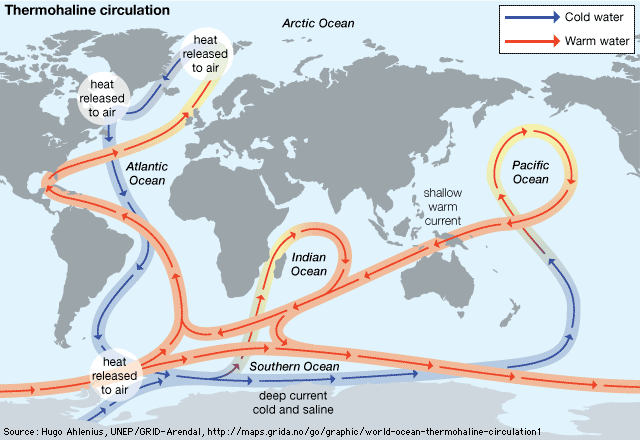
It acts as a global conveyor belt, transporting warm surface water northward and cold, dense deep water southward, while also circulating nutrients essential for marine ecosystems. This process is crucial for regulating Earth’s surface heat, significantly warming northwestern Europe and influencing global temperature and precipitation patternsscience/temperature) and precipitation patterns.1
Currently, the AMOC is weakening, a trend attributed to global warming and increased freshwater input from melting glaciers, particularly in Greenland. This fresh water reduces surface salinity and density, inhibiting the water’s ability to sink and drive the circulation. While some models predict a potential collapse, others suggest the system may remain stable or be influenced by complex interactions with the Southern Ocean.21
How does the Gulf Stream contribute to the AMOC?
The Gulf Stream serves as a critical surface component of the Atlantic Meridional Overturning Circulation (AMOC). It functions by transporting warm, saline surface water from the tropics northward along the coast of eastern North America toward northwestern Europe.3
This northward movement is essential to the AMOC’s “conveyor belt” mechanism in the following ways:
- Heat Transport: The Gulf Stream carries significant amounts of heat from low latitudes toward the North Atlantic, which helps regulate global and regional temperatures.32
- Preparation for Sinking: As the Gulf Stream and its extension, the North Atlantic Current, flow northward, the water loses heat to the atmosphere and undergoes evaporation. This process increases the water’s salinity and [density].3
- Driving Deep Circulation: By the time this water reaches the Arctic Ocean, it has become sufficiently cold and dense to sink. This sinking water forms the North Atlantic Deep Water (NADW), which then flows southward, completing the overturning loop of the AMOC.3
Essentially, the Gulf Stream provides the warm, saline “fuel” that, upon cooling and densifying in the north, drives the deep-ocean return flow of the AMOC.3
What is thermohaline circulation and how does it work?
Thermohaline circulation is a slow, global system of deep-ocean currents driven by horizontal differences in water temperature and salinity, which together determine water density.78
How It Works
While wind-driven circulation dominates the ocean’s surface, thermohaline circulation operates throughout the entire water column, extending to the seafloor. The process functions as follows:7
- Sinking: In polar regions—specifically the North Atlantic and near Antarctica—surface water loses heat to the atmosphere and, in some cases, increases in salinity through evaporation or the formation of sea ice. This makes the water cold and dense enough to sink.789
- Deep Flow: Once the water sinks, it spreads slowly across the ocean floor as deep-water masses, such as the North Atlantic Deep Water.89
- Upwelling and Return: To replace the sinking surface water, deep water eventually rises (upwells) in other parts of the ocean, warming as it is exposed to sunlight and circulating back toward the polar regions to repeat the cycle.79
This “conveyor belt” is essential for transporting heat, nutrients, and dissolved materials across the globe, playing a critical role in regulating Earth’s climate.79
What happened to the climate when the AMOC last shut down?
The last time the Atlantic Meridional Overturning Circulation (AMOC) is thought to have shut down fully was approximately 14,500 years ago, as Earth’s climate warmed following the last glacial period.10
When the AMOC slows or shuts down, it disrupts the global distribution of heat, leading to significant climatic shifts. Historically, such disruptions have been linked to abrupt cooling in the Northern Hemisphere, most notably during the Younger Dryas (roughly 12,900 to 11,600 years ago). During this period, the influx of fresh water into the North Atlantic—likely from glacial melt—inhibited the sinking of dense, saline water, effectively stalling the circulation.2
The climatic consequences of such a shutdown include:
- Dramatic Cooling: Parts of Europe and North America experienced a return to near-ice-age conditions, with sea surface temperatures in eastern Canada dropping by 5–10 °C (9–18 °F).2
- Regional Disparities: While the North Atlantic region cooled, many parts of the tropics and the Southern Hemisphere actually became warmer and wetter.2
- Ecosystem Shifts: Forests were replaced by tundra vegetation in many areas, and alpine glaciers expanded significantly.2
Sources
- Atlantic Meridional Overturning Circulation: Top Questions — Encyclopædia Britannica
- Atlantic Meridional Overturning Circulation — Encyclopædia Britannica
- Climate - The Gulf Stream — Encyclopædia Britannica
- Atlantic Ocean - Salinity — Encyclopædia Britannica
- Gulf Stream — Encyclopædia Britannica
- subtropical gyre — Encyclopædia Britannica
- ocean current - Distribution of ocean currents — Encyclopædia Britannica
- thermohaline circulation — Encyclopædia Britannica
- hydrologic sciences - The physical properties of seawater — Encyclopædia Britannica
- Younger Dryas — Encyclopædia Britannica
- Climate change - Centennial-scale variation — Encyclopædia Britannica
Published on · 3 min read