Threadworm
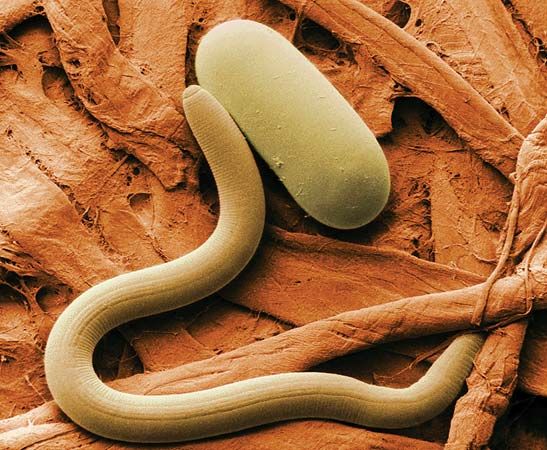
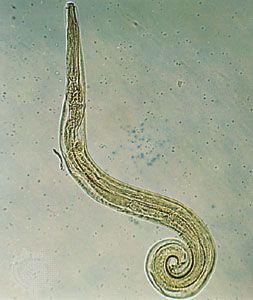
The term "threadworm" is often used to refer to Strongyloides stercoralis, a nematode that is parasitic in the human intestine but can also live and breed…
What is threadworm?
The term “threadworm” is often used to refer to Strongyloides stercoralis, a nematode that is parasitic in the human intestine but can also live and breed freely in soil, particularly in moist tropical regions.1
It is important to note that the name “threadworm” is sometimes inaccurately applied to other threadlike nematodes, including the pinworm (Enterobius vermicularis). While both are intestinal parasites, they have distinct life cycles. Unlike the pinworm, which is typically transmitted via the fecal-oral route, Strongyloides stercoralis larvae are passed in feces and typically reenter a human host by penetrating the skin of the feet. Once inside, they migrate through the bloodstream to the lungs, eventually reaching the digestive tract to mature in the large intestine.12
In contrast, pinworms are common human parasites that reside in the large intestine and cause itching when females deposit eggs on the skin near the anus.32
How do parasitic worms differ from other types of worms?
Parasitic worms differ from free-living worms primarily in their life strategies, ecological adaptations, and dependence on other organisms for survival. While “worm” is a broad term applied to various unrelated invertebrate groups with soft, elongated bodies, the distinction between parasitic and free-living forms is significant.4
Key Differences
- Life Cycles: Free-living worms, such as earthworms, typically have relatively simple life cycles and thrive independently in environments like soil or water. In contrast, parasitic worms often possess complex life cycles that may involve multiple hosts—including intermediate hosts like snails, fish, or crustaceans—to complete their development.567
- Adaptations: Parasites have evolved specialized structures for survival within a host, such as hooks or suckers for attachment. Many also exhibit physiological adaptations to the host’s internal environment, such as the ability to trigger maturation based on the host’s body temperature.7
- Host Specificity: Parasitic worms often demonstrate a high degree of parasite specificity, meaning they are closely adapted to one particular host species.8
- Ecological Role: While free-living worms often act as soil conditioners or essential links in food chains, parasitic worms derive their nourishment directly from a host, which can lead to disease or harm to the host organism.74
What are some common ways to prevent parasitic infections?
Preventing parasitic infections primarily relies on maintaining high standards of sanitation and hygiene to break the transmission cycle. Because many parasitic diseases thrive in environments with poor water quality or inadequate waste management, adhering to basic sanitary practices is the most effective defense.1112
Recommended Preventive Measures
- Hand Hygiene: Regularly washing hands is a fundamental step in preventing the spread of parasites.11
- Food Safety: Thoroughly cooking meat is essential to eliminate parasites that may be present in food supplies.11
- Waste Management: Keeping human waste strictly separated from food sources, water supplies, livestock, and pets is critical to preventing environmental contamination.11
- Sanitation Infrastructure: Access to clean water and proper administrative resources for sanitation are vital, as these measures significantly reduce the risk of infection in a population.12
While these practices are highly effective, they can be challenging to implement in areas lacking the necessary infrastructure or in cultures where close contact with livestock is common. In such cases, breaking the infection cycle often requires broader access to medical relief and public health initiatives.12
How does the human immune system react to intestinal parasites?
The human immune system employs specialized mechanisms to combat intestinal parasites, primarily utilizing IgE antibodies and eosinophil granulocytes to target large, multicellular organisms.1314
Immune Defense Mechanisms
- IgE-Mediated Response: When antigens from a parasite bind to IgE antibodies on mast cells and basophils, these cells release chemical contents that trigger a physiological reaction. This includes increased blood vessel permeability, platelet activation, and the contraction of smooth muscle in the gut. These actions collectively work to dislodge parasites like hookworms from the intestinal lining.13
- Eosinophil Action: Eosinophils are particularly effective against parasites such as the flatworms responsible for schistosomiasis. These white blood cells bind to the IgE-coated parasites and release toxic chemicals from their granules, which break down the parasite’s tough protective skin.1314
- Mucosal Protection: In addition to these specific responses, IgA antibodies found in the gut lining help prevent microbes from entering cells, facilitating their removal from the body.13
While these defenses are vital, persistent infestations can lead to significant health issues, such as chronic anemia caused by nutrient depletion. anemia caused by nutrient depletion.16
Sources
- pinworm — Encyclopædia Britannica
- threadworm — Encyclopædia Britannica
- digestive system disease - Pinworms — Encyclopædia Britannica
- flatworm - Development — Encyclopædia Britannica
- Uninvited Guests: The 7 Worst Parasitic Worms — Encyclopædia Britannica
- flatworm - Annotated classification — Encyclopædia Britannica
- flatworm - Ecology — Encyclopædia Britannica
- disease - Parasite specificity — Encyclopædia Britannica
- earthworm — Encyclopædia Britannica
- worm — Encyclopædia Britannica
- parasitic disease - Prevention and treatment — Encyclopædia Britannica
- parasitic disease - Challenges in the reduction of parasitic disease — Encyclopædia Britannica
- immune system - Other antibody-mediated mechanisms — Encyclopædia Britannica
- eosinophil — Encyclopædia Britannica
- digestive system disease - Parasitic infections — Encyclopædia Britannica
- digestive system disease - Hookworms — Encyclopædia Britannica
Published on · 3 min read