Tiger Shark
Yes, there are documented interactions between tiger sharks (Galeocerdo cuvier) and humans. The tiger shark is recognized as a large, potentially dangerous…

Are there any documented interactions between tiger sharks and humans?
Yes, there are documented interactions between tiger sharks (Galeocerdo cuvier) and humans. The tiger shark is recognized as a large, potentially dangerous species that is known to be involved in attacks on humans.123
While not all encounters are classified as attacks, interactions are categorized by researchers into sightings, non-biting encounters (such as contact with surfboards or kayaks), nonfatal bites, and fatal bites. Attacks on humans by tiger sharks can occur when the animals are hungry, defending territory, or feeling harassed. In many cases, these interactions are believed to be instances of mistaken identity, where human movements or vibrations in the water resemble those of wounded fish.2
It is important to note that shark attacks are statistically rare compared to other aquatic mishaps. To manage risks in areas where these sharks are present, coastal regions often employ safety measures such as lookout towers and protective netting.2
Where are tiger sharks typically found, and what types of habitats do they prefer?
Tiger sharks (Galeocerdo cuvier) are found worldwide in warm oceans. Regarding their preferred habitats, they are highly adaptable and occupy a broad range of environments, extending from the shoreline to the open sea.1
Unlike some other shark species that may be restricted to specific depths or coastal zones, the tiger shark is known for its wide-ranging distribution and its ability to inhabit diverse marine settings. They are opportunistic, omnivorous feeders, which contributes to their presence in various locations where they scavenge for fishes, sea turtles, and other marine life.1
How do tiger sharks compare to other shark species in terms of size and behavior?
Tiger sharks (Galeocerdo cuvier) and other shark species exhibit significant variations in size, feeding habits, and social behavior.
Size and Physical Characteristics
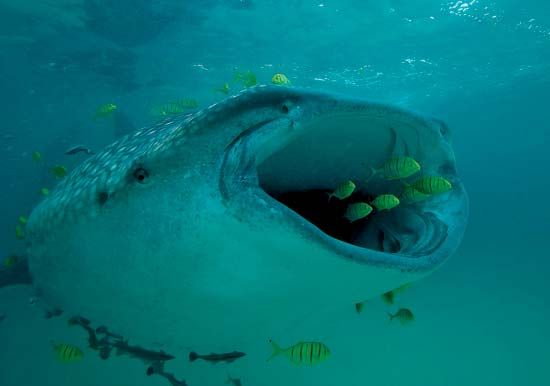
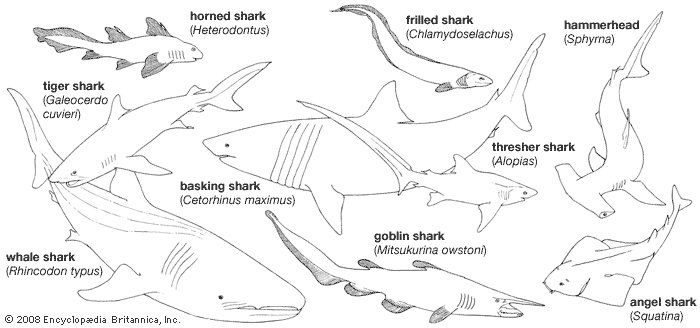
The tiger shark can reach a maximum length of approximately 5.5 meters (18 feet). In comparison, sand tiger sharks (Carcharias and Odontaspis genera) are generally smaller, ranging from about 2.2 to 4.5 meters (7.2 to 14.8 feet) depending on the species. While tiger sharks are known for their saw-edged teeth designed for shearing, sand tiger sharks possess long, slim, daggerlike teeth. The largest shark species, such as the whale shark, basking shark, and megamouth shark, are significantly larger and feed exclusively on plankton using specialized straining apparatuses.1564
Behavior and Feeding
- Dietary Habits: Tiger sharks are noted for their voracity and omnivorous scavenging, consuming everything from fishes and sea turtles to garbage and carrion. In contrast, sand tiger sharks are predatory but generally sluggish, feeding primarily on fish, squid, and crustaceans.1456
- Social Structure: Most sharks are solitary, coming together only for mating or feeding. Some species exhibit dominance structures based on size or form sex-segregated schools.4
- Unique Adaptations: The sand tiger shark is unique for its ability to swallow air to achieve neutral buoyancy, allowing it to hover motionless. Meanwhile, thresher sharks use their exceptionally long tail lobes to herd or stun prey.64
What is the conservation status of tiger sharks, and what threats do they face?
The International Union for Conservation of Nature and Natural Resources (IUCN) currently classifies the tiger shark (Galeocerdo cuvier) as a near threatened species.4
While the provided search results do not detail the specific threats facing the tiger shark beyond its general commercial value as a source of leather and liver oil, the species is known for its wide-ranging distribution in warm oceans and its role as an opportunistic, omnivorous scavenger.4
Please note that the “near threatened” status of the tiger shark is distinct from the conservation status of other shark species mentioned in the literature, such as the sand tiger shark, which the IUCN lists as critically endangered due to factors like slow reproductive rates, targeted fishing, and bycatch.1
Sources
- tiger shark — Encyclopædia Britannica
- shark - Hazards to humans — Encyclopædia Britannica
- tiger shark — Merriam-Webster
- sand tiger shark — Encyclopædia Britannica
- chondrichthyan - Sharks — Encyclopædia Britannica
- sand shark — Encyclopædia Britannica
Published on · 3 min read