Whale Shark
The whale shark (Rhincodon typus) is currently listed as endangered by the International Union for Conservation of Nature (IUCN), a status it has held since…
What is the conservation status of whale sharks, and what threats do they face?
The whale shark (Rhincodon typus) is currently listed as endangered by the International Union for Conservation of Nature (IUCN), a status it has held since 2016.1
Despite their status, these animals face several significant threats:
- Commercial Fishing and Bycatch: While whale sharks are not a primary target for most commercial fisheries, they are frequently caught accidentally as bycatch in nets and on longline hooks intended for other species.12
- Direct Harvesting: In certain regions, including parts of Asia, they have been hunted for food, where they are consumed fresh or dried and salted.1
- Collisions: Because they often swim at or near the surface, whale sharks are susceptible to being struck by boats.1
- Trade: Although international trade is regulated under CITES (Appendix II), the historical demand for shark products has contributed to the broader decline of shark populations globally.2
Conservation efforts, such as the establishment of marine protected areas, aim to reduce these encounters and protect critical habitats.2
How large can whale sharks grow, and how does this compare to other fish species?
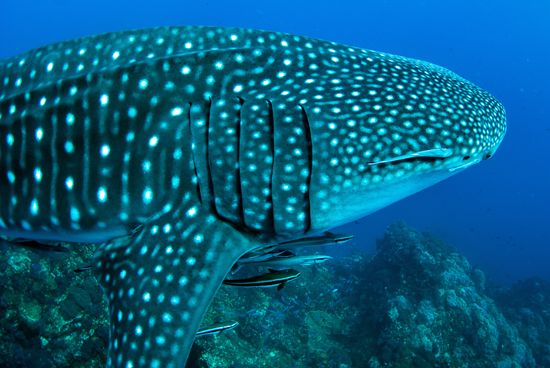
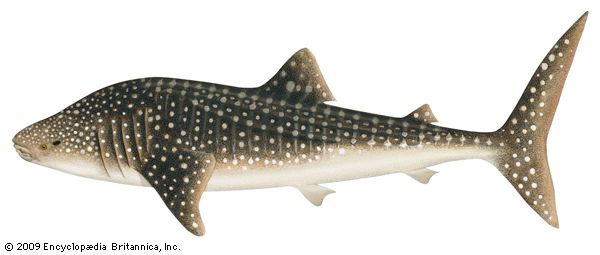
The whale shark (Rhincodon typus) is the largest known fish in the world, capable of reaching a maximum length of approximately 18 to 18.3 meters (59 to 60 feet). While they can reach these impressive sizes, most studied specimens average about 12 meters (39 feet) in length and weigh around 15 tons.61
In comparison to other fish species, the whale shark stands alone in scale. For instance, the beluga (Huso huso), which is considered the largest freshwater fish, reaches a maximum length of about 8 meters (26.2 feet) and weighs up to 3.2 metric tons. Other large filter-feeding sharks, such as the basking shark and the megamouth shark, are also significantly smaller than the whale shark.71
What role do whale sharks play in marine ecosystems?
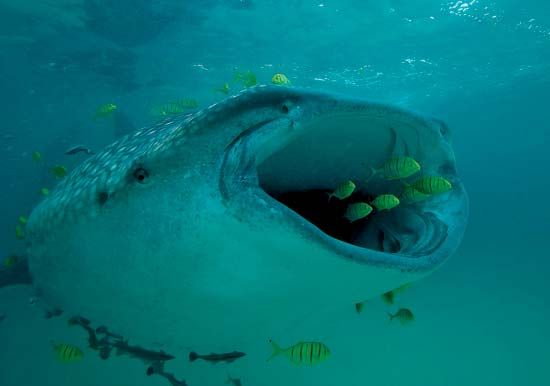
Whale sharks (Rhincodon typus) play a vital role in marine ecosystems primarily as large-scale filter feeders. By foraging at or near the surface, they consume vast quantities of plankton, including both zooplankton—such as copepods and shrimp—and phytoplankton, such as algae.1
By straining these organisms through their specialized internal gill structures, whale sharks help regulate the abundance of small marine life in tropical oceans worldwide. In addition to plankton, they also consume small fish, mollusks, and squid, positioning them as significant consumers within the marine food chain.18
Unlike top predators that maintain balance by hunting larger prey, the whale shark’s ecological contribution is defined by its efficiency in processing lower-trophic-level biomass, which supports the overall health and nutrient cycling of their expansive oceanic habitats.18
How do whale sharks reproduce, and what is known about their life cycle?
The reproductive biology of the whale shark (Rhincodon typus) remains a subject of ongoing scientific study, though researchers have established key insights into their life cycle.
Reproduction
While the specific mating behaviors of whale sharks are not fully documented, they are presumed to follow the general pattern of internal fertilization common among sharks, involving the use of male copulatory organs called claspers.910
Whale sharks are believed to be ovoviviparous, meaning the eggs hatch within the mother, and she gives birth to fully formed live young. Evidence for this includes the discovery of a female in the mid-1990s carrying nearly 300 developing young in her uterus. While an egg case found in the Gulf of Mexico measured 30 cm long, this is considered an exception or a unique developmental stage, as the species primarily produces live offspring. Newborns are approximately 55 cm (1.8 feet) in length at birth.910
Life Cycle and Longevity
Whale sharks are long-lived animals, with scientists estimating their life span to range between 60 and 100 years. Despite their massive size, they are solitary by nature, though they occasionally congregate in large groups.10
Sources
- whale shark — Encyclopædia Britannica
- white shark - Conservation — Encyclopædia Britannica
- Saving Sharks in the 2020s — Encyclopædia Britannica
- plastic pollution - Plastic pollution in oceans and on land — Encyclopædia Britannica
- water pollution: Top Questions — Encyclopædia Britannica
- whale shark — Merriam-Webster
- chondrostean - Size range — Encyclopædia Britannica
- shark - Description and habits — Encyclopædia Britannica
- white shark - Reproduction — Encyclopædia Britannica
- chondrichthyan - Reproduction and development — Encyclopædia Britannica
Published on · 3 min read