Topi
Topis (Damaliscus lunatus) are widely distributed across the African continent, where they are primarily found in savanna environments. Their preferred…
Where are topis typically found in the wild?
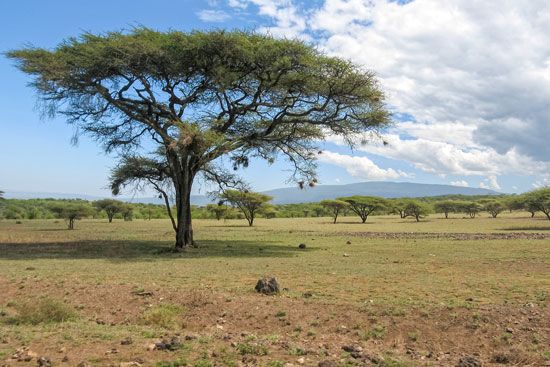
Topis (Damaliscus lunatus) are widely distributed across the African continent, where they are primarily found in savanna environments. Their preferred habitats include vast floodplains and adjacent arid zones.1
Key details regarding their distribution and habitat include:
- Regional Presence: They are known as the topi in East Africa and as the tsessebe or sassaby in southern Africa.1
- Specific Environments: Large populations inhabit open grasslands and wooded savannas. In regions like South Sudan, they are known to occupy expansive floodplains.1
- Mobility: Their presence in specific areas is often dictated by their need for green pastures. In wide-open plains, they may form large, migratory aggregations, moving between wet-season and dry-season feeding grounds. In more patchy, wooded savanna environments, they tend to maintain more stable, long-term territories.1
How do topis compare to other antelopes in terms of speed and agility?
The topi (Damaliscus lunatus) is a lean, sleek animal specifically built for sustained speed. While the provided information does not offer a direct comparative ranking against every other species, it highlights that the topi’s physical structure—characterized by higher forequarters that slope down to lower hindquarters—is an adaptation optimized for endurance and consistent running rather than short bursts of explosive agility.1
As a member of the tribe Alcelaphini, the topi shares evolutionary traits with other notable antelopes such as the hartebeest and wildebeest, which are also known for their stamina in open savanna environments. Their reliance on sustained speed allows them to navigate vast floodplains and participate in long-distance migrations in search of seasonal vegetation.1
How do topis behave socially and what is their herd structure like?
The topi (Damaliscus lunatus) exhibits one of the most diverse social and mating systems among all antelopes. Their social structure is highly flexible, ranging from small, resident herds to massive, mobile aggregations, all centered around a territorial theme where males must own property to reproduce.1
Herd Structure and Social Organization
- Resident Herds: In wooded savannas where open grassland is patchy, males maintain stable territories of 50–400 hectares (125–1,000 acres) year-round. Within these areas, small herds consisting of 2–10 females and their offspring live in traditional home ranges.1
- Migratory Aggregations: On wide plains, topis often gather in groups of hundreds. These populations are highly mobile, migrating between wet-season and dry-season feeding grounds. In these environments, males cannot maintain permanent territories and instead join the migration, reestablishing a territorial network whenever the herd settles.1
Mating Behavior
Topis are one of only three antelope species known to form leks—breeding arenas where males congregate to compete for females.12
- Lekking: During a three-month mating season, males crowd into high-density arenas on wide plains. As many as 100 males may gather, with central males positioned as close as 25 meters (80 feet) apart.1
- Monopolization: A small number of central males typically monopolize matings. Females visit these specific sites to mate, potentially guided by the scent of previous generations.1
What is a topi and what family of animals does it belong to?
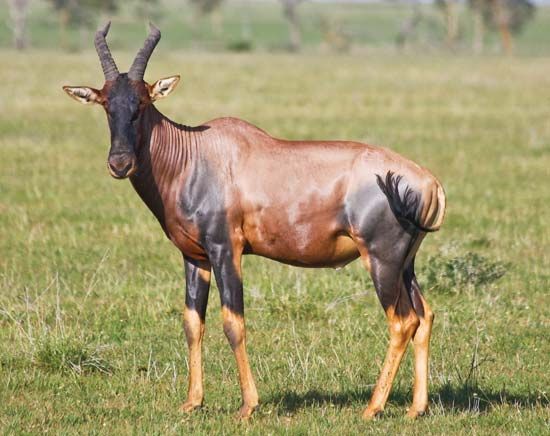
The topi (Damaliscus lunatus) is one of Africa’s most widespread antelopes. It belongs to the tribe Alcelaphini within the family Bovidae, a group that also includes the hartebeest, wildebeest, and blesbok.1
Physically, the topi is a lean, sleek animal adapted for sustained speed, characterized by higher forequarters that slope down to lower hindquarters. While it resembles a smaller, darker hartebeest, it possesses a less-elongated head and horns that are similar in both sexes. Depending on the region, the species is known by different names: it is called the topi in East Africa and the sassaby or tsessebe in southern Africa.1
Sources
- topi — Encyclopædia Britannica
- bovid - Social organization — Encyclopædia Britannica
- artiodactyl - Social behaviour — Encyclopædia Britannica
- antelope — Encyclopædia Britannica
- Chemoreception - Territorial behavior — Encyclopædia Britannica
- lechwe — Encyclopædia Britannica
Published on · 3 min read