Gnu
A gnu, also known as a wildebeest, is a large African antelope belonging to the family Bovidae. There are two primary species: the common wildebeest…
What is a gnu?
A gnu, also known as a wildebeest, is a large African antelope belonging to the family Bovidae. There are two primary species: the common wildebeest (Connochaetes taurinus) and the black wildebeest (Connochaetes gnou).1
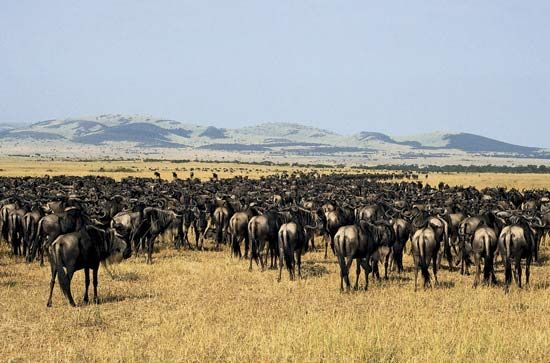
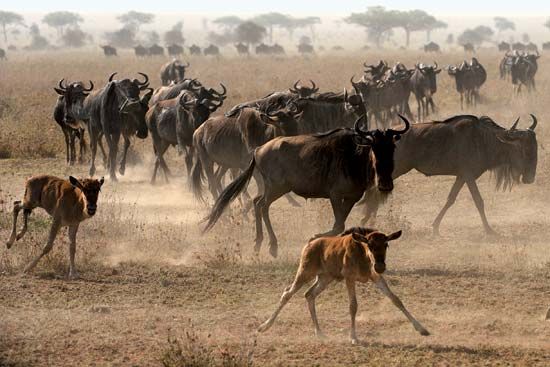
These animals are highly specialized herbivores and are dominant in African plains and savanna ecosystems. The common wildebeest is a keystone species known for its migratory behavior, moving in search of water and fresh grass. They are remarkably precocious; unlike most other antelopes, their calves can accompany their mothers almost immediately after birth, an essential adaptation for their migratory lifestyle.1
The black wildebeest, or white-tailed gnu, is smaller and was once nearly hunted to extinction in the 19th century, though its population has since recovered on private lands. The term “gnu” originates from the Khoikhoi word t’gnu.12
Where do gnus live?
Gnus, or wildebeests, are native to various regions across Africa, where they thrive in plains and acacia savanna ecosystems.1
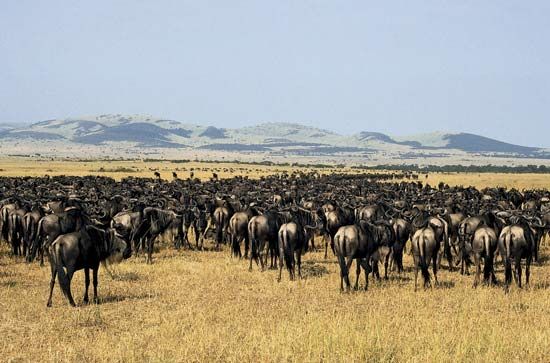
- Common Wildebeest (Connochaetes taurinus): This species has a broad range extending from southeastern Africa to central Kenya. A significant population, numbering over one million, inhabits the Serengeti Plains and surrounding acacia savannas in northwestern Tanzania and adjacent areas of Kenya. These animals are migratory, moving between plains and woodlands in search of water and fresh grass.13
- Black Wildebeest (Connochaetes gnou): Historically, this species was a dominant herbivore of the South African Highveld and Karoo. Following a period of near-extinction in the 19th century, the remaining population is now primarily found on private ranches.1
What do gnus look like?
Gnus, or wildebeests, are large antelopes with distinct physical characteristics adapted for their life on the African plains. Their appearance varies between the two primary species:1
Common Wildebeest (Connochaetes taurinus)
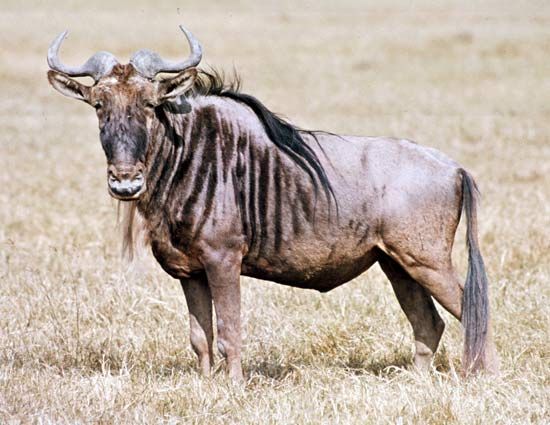
This species is characterized by a robust build with high shoulders that slope down to lower hindquarters, a deep chest, a short neck, and thin legs. Their coat ranges from slate gray to dark brown and features reverse counter-shading, meaning they are lighter on top and darker below. They have black vertical stripes on their forequarters, as well as black markings on their forehead, mane, and long tail. Their horns are cowlike and similar in both sexes.1
Black Wildebeest (Connochaetes gnou)
Also known as the white-tailed gnu, this species is smaller and darker, ranging from dark brown to black. It is easily identified by its conspicuous white tail, a prominent beard, facial tufts, and an upright mane. Its horns are distinct from the common wildebeest, as they curve forward and are exceptionally dangerous.1
Both species possess a blunt muzzle and a wide row of incisor teeth, which allow them to graze efficiently on short grasses.1
What do gnus eat in their natural habitat?
Gnus, also known as wildebeests, are specialized herbivores that have evolved to thrive on the grasses of African plains and savanna ecosystems.1
Their feeding habits are highly adapted to their environment:
- Grazing Strategy: Equipped with a blunt muzzle and a wide row of incisor teeth, gnus are efficient at grazing on short grasses that carpet the plains during the rainy season.1
- Seasonal Diet: Because they are water-dependent, they follow the availability of fresh vegetation. During the dry season, they migrate to acacia savannas where they consume taller grasses that remain green for longer periods, as well as new flushes of grass that emerge following local thunderstorms or fires.1
- Grazing Succession: Gnus play a specific role in the ecosystem’s grazing succession. On the Serengeti plains, they often graze on areas previously cropped by zebras, leaving the vegetation in a condition suitable for smaller grazers like the Thomson’s gazelle.4
Sources
- gnu — Encyclopædia Britannica
- gnu — Merriam-Webster
- Serengeti National Park — Encyclopædia Britannica
- artiodactyl - Food habits — Encyclopædia Britannica
Published on · 4 min read