Treecreeper
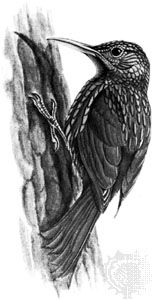
A treecreeper is any of more than a dozen species of small, slender birds characterized by their downcurved bills and habit of spiraling up tree trunks to…
What is Treecreeper?
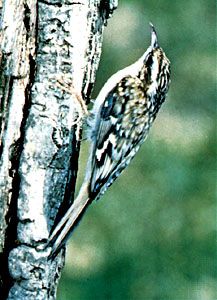
A treecreeper is any of more than a dozen species of small, slender birds characterized by their downcurved bills and habit of spiraling up tree trunks to forage for insects. They are primarily classified into two families:1
- Certhiidae: This family includes the genus Certhia, such as the Eurasian treecreeper (C. familiaris) and the American treecreeper (C. americana). These birds typically possess stiffened tail feathers that act as a prop while climbing.1
- Climacteridae: Known as Australian treecreepers, these five species are largely confined to Australia and New Guinea. Unlike certhiids, they have brush-tipped tongues and lack stiffened tail feathers.1
While treecreepers are known for their vertical, upward-climbing locomotion, they are distinct from woodcreepers, which are tropical American birds belonging to the family Furnariidae.123
How do stiffened tail feathers help birds climb?
For birds that are specialized for climbing, such as woodpeckers and treecreepers, stiffened tail feathers serve as a critical structural support mechanism.5
When these birds move vertically upward on tree trunks, they utilize their strong, clawed feet to cling to the surface while simultaneously bracing themselves against the tree using their stiffened tail feathers. This arrangement creates a tripod-like effect, providing the necessary stability to maintain their position and balance as they ascend in short, vertical hops. By acting as a prop, the tail feathers help the bird keep its center of gravity close to the surface being climbed, which is a fundamental requirement for efficient arboreal locomotion.56
What are the main differences between nuthatches and treecreepers?
Nuthatches and treecreepers exhibit distinct differences in their movement, anatomy, and foraging behaviors:
Locomotion and Anatomy
- Direction of Movement: Treecreepers (specifically the family Certhiidae) are specialized for climbing vertically upward in short hops and cannot descend headfirst. In contrast, nuthatches are unique in their ability to climb both up and down trunks and branches with equal ease, often moving obliquely.18
- Tail Structure: Most treecreepers possess stiffened tail feathers that act as a prop against the tree to support their upward climb. Nuthatches have short tails that are not stiffened, as they do not rely on them for support.18
- Climbing Technique: While treecreepers use their feet and tail to create a tripod-like support, nuthatches climb by using their upper foot for clinging and their lower foot as a brace.8
Foraging and Behavior
- Feeding Habits: Nuthatches are known for their ability to hang upside down on the undersides of limbs. They often wedge seeds into bark crevices to “hack” them open using the force of their bodies. Treecreepers primarily forage for insects by spiraling up tree trunks.12
Why do some treecreepers have brush-tipped tongues?
Some treecreepers, specifically the Australian treecreepers of the family Climacteridae and the Philippine creepers of the genus Rhabdornis, possess brush-tipped tongues as an adaptation for their specific feeding behaviors.13
In the case of the Australian treecreepers, these birds behave similarly to honeyeaters, and their brush-tipped tongues are an evolutionary feature that assists them in accessing nectar from flowers. Similarly, the Philippine creepers often visit flowers to feed, utilizing their brush-tipped tongues to facilitate this process. This anatomical trait allows these birds to exploit food sources beyond the insects typically sought by other tree-climbing species.13
Sources
- Treecreeper — Encyclopædia Britannica
- Locomotion - Climbing birds and mammals — Encyclopædia Britannica
- Creeper — Encyclopædia Britannica
- Woodcreeper — Encyclopædia Britannica
- Bird - Skeleton — Encyclopædia Britannica
- Locomotion - Climbing — Encyclopædia Britannica
- Locomotion - Arboreal amphibians and reptiles — Encyclopædia Britannica
- Nuthatch — Encyclopædia Britannica
- Piciform - Form and function — Encyclopædia Britannica
- Piciform - Annotated classification — Encyclopædia Britannica
Published on · 2 min read