Umbrellabird
Umbrellabirds are found in the tropical forests of Central and South America. These birds are highly specialized, spending the vast majority of their lives…
Where are umbrellabirds found in the wild, and what type of habitat do they prefer?
Umbrellabirds are found in the tropical forests of Central and South America. These birds are highly specialized, spending the vast majority of their lives within the canopies of tall trees.12
Their specific geographic distribution varies by species:
- The ornate umbrellabird (Cephalopterus ornatus) inhabits the Amazon basin.1
- The long-wattled umbrellabird (Cephalopterus penduliger) is found west of the Andes in Ecuador and Colombia.1
- The bare-necked umbrellabird (Cephalopterus glabricollis) is native to Panama and Costa Ricaollis*) is native to Panama and Costa Rica.1
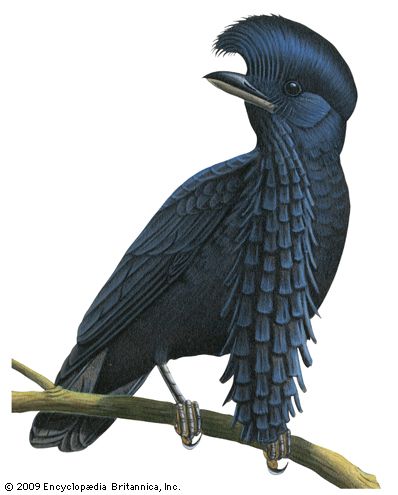
These birds are members of the Cotingidae family and are easily identified by their unique, umbrella-like crests and inflatable throat wattles, which males use during display rituals.1
How do male umbrellabirds attract mates, and what role does their appearance play in courtship?
Male umbrellabirds attract mates through specialized courtship displays that highlight their unique physical features. During these rituals, the male spreads his distinctive, umbrella-like crest to cover his head while simultaneously producing rumbling noises to capture the attention of females.1
The male’s appearance plays a central role in these interactions. Umbrellabirds are characterized by their crests and inflatable throat wattles, which vary by species—ranging from the short, triangular wattle of the ornate umbrellabird to the long, feather-covered wattle of the long-wattled umbrellabird or the bright red, unfeathered wattle of the bare-necked umbrellabird. These elaborate ornaments serve as visual signals that are often subject to female choice.1
In many bird species, such conspicuous displays are considered “honest indicators” of male quality, as they can be costly or dangerous to produce. Over generations, this preference for specific physical traits can lead to the rapid evolution of extreme ornamentation, a process described by the runaway selection hypothesis, where females consistently select for the most exaggerated versions of these features.45
How many species of umbrellabirds exist, and what are their conservation statuses?
There are three recognized species of umbrellabirds, all belonging to the genus Cephalopterus within the family Cotingidae:
- Ornate umbrellabird (Cephalopterus ornatus): Found in the Amazon basin.
- Long-wattled umbrellabird (Cephalopterus penduliger): Native to the regions west of the Andes in Ecuador and Colombia.
- Bare-necked umbrellabird (Cephalopterus glabricollis): Inhabits areas of Panama and Costa Rica.1
It is important to note that while these three are commonly identified as distinct species, some authorities classify the long-wattled and bare-necked umbrellabirds as subspecies of the ornate umbrellabird.1
Regarding their conservation status, the provided information does not contain data on the current population trends or specific threat levels for these birds. Therefore, I cannot provide details on their conservation status at this time.
How do umbrellabirds compare to other members of the cotinga family?
Umbrellabirds belong to the family Cotingidae, a diverse group of approximately 90 species of tropical American birds. While they share several fundamental anatomical traits with other cotingas, they are distinguished by their unique physical ornaments.
Shared Characteristics
Like other members of the Cotingidae family, umbrellabirds possess:
- A broad bill with a slightly hooked tip.
- Rounded wings and short legs.
- A lifestyle centered in the forest canopy, where they primarily feed on fruit or insects.
Distinguishing Features
Umbrellabirds are among the most notable examples of the extreme male ornamentation for which the Cotingidae family is famous. While other cotingas—such as the bellbird, cock-of-the-rock, and various chatterers—are known for their bizarre calls and vivid plumage, umbrellabirds are specifically defined by:
- The Crest: A unique, umbrella-like structure that covers the head during courtship displays.
- The Wattle: An inflatable, pendant-like throat wattle that varies significantly in shape, size, and feathering depending on the species.
While many cotingas are elusive and remain understudied, the umbrellabird’s combination of specialized vocalizations and dramatic physical displays serves as a hallmark of the family’s evolutionary diversity.
Sources
- Umbrellabird — Encyclopædia Britannica
- umbrella bird — Merriam-Webster
- cephalopod - Ecology — Encyclopædia Britannica
- Reproductive behaviour - Birds — Encyclopædia Britannica
- Animal social behavior - Social interactions involving sex — Encyclopædia Britannica
- Runaway selection hypothesis — Encyclopædia Britannica
- Reproductive behaviour - Visual clues — Encyclopædia Britannica
- Cephalopterus — Merriam-Webster
- Cotingidae — Encyclopædia Britannica
- scorpaeniform - Annotated classification — Encyclopædia Britannica
- Cuculiform - Nesting — Encyclopædia Britannica
Published on · 3 min read