Velvet-purple Coronet
The velvet-purple coronet (Boissonneaua jardini) is a nonmigratory hummingbird species native to the Pacific slope of the Andes Mountains, ranging from…
What is Velvet-purple coronet?
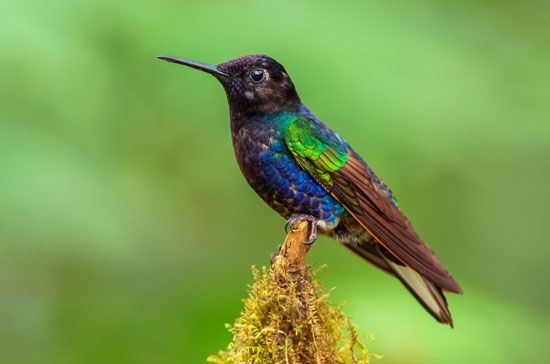
The velvet-purple coronet (Boissonneaua jardini) is a nonmigratory hummingbird species native to the Pacific slope of the Andes Mountains, ranging from southwestern Colombia to northwestern Ecuador.12
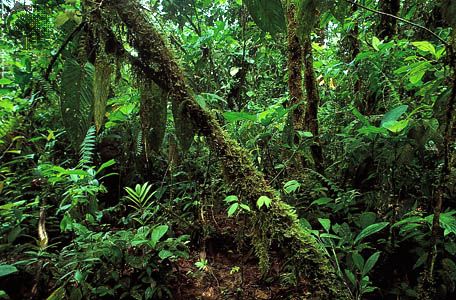
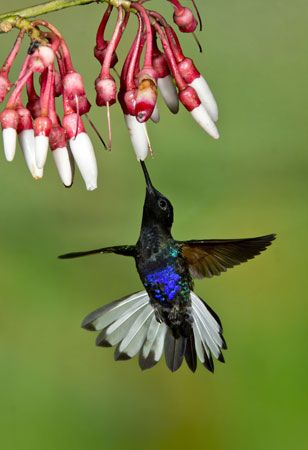
Known for its resplendent coloration, this medium-sized bird appears black in the shade but reveals iridescent green, blue, and purple hues in sunlight. It inhabits mossy, humid rainforests and forest edges, where it feeds as a nectarivore, playing a vital role as a pollinator.21
The IUCN lists the species as of least concern, though its population is believed to be declining due to habitat loss and fragmentation caused by logging, agriculture, and climate change. Fortunately, significant portions of its range are protected within national parks and reserves.12
How do hummingbirds act as pollinators for plants?
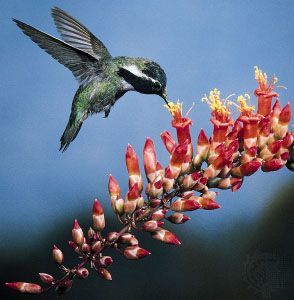
Hummingbirds serve as vital pollinators by visiting flowers to feed on nectar, which they require in large quantities due to their high metabolic rates. Because they lack a strong sense of smell, they rely on their keen vision, particularly their sensitivity to the red part of the light spectrum, to locate food.45
Plants adapted for hummingbird pollination, known as ornithophilous flowers, have evolved specific traits to facilitate this interaction:
- Visual Cues: They are often brightly colored, frequently in shades of red, to attract the birds.45
- Structure: These flowers are typically tubular with wide openings and are often pendulous, allowing hummingbirds to feed while hovering on the wing.45
- Rewards: They produce copious amounts of nectar to satisfy the birds’ high energy needs.45
- Pollen Transfer: The flowers are sturdily constructed with protruding stamens that touch the bird’s head or breast as it feeds. The pollen often sticks together in clumps or chains, ensuring efficient transfer during a single visit.45
What are some other unique species of hummingbirds found in the Andes?
The Andes Mountains are home to a remarkable diversity of hummingbird species, many of which exhibit extreme physical adaptations. Some notable species found in this region include:
- Giant Hummingbird (Patagona gigas): As the largest of all hummingbirds, this species reaches about 20 cm (8 inches) in length. It is found along the western slopes of the Andes, ranging from Ecuador to Chile.78
- Sword-billed Hummingbird (Ensifera ensifera): This species is famous for its exceptionally long bill, which accounts for more than half of its 21-cm (8.3-inch) total length, an adaptation that allows it to access nectar from deep, tubular flowers.7
- Thornbills (Ramphomicron and Chalcostigma): In contrast to the sword-billed hummingbird, these species are characterized by their very short, specialized bills.7
- Violet-ears (Colibri): Unlike many other hummingbirds that do not form pair bonds, violet-ears are known for forming them, with both sexes participating in parental duties.7
These birds demonstrate the incredible evolutionary variety within the family Trochilidae, ranging from minute, rapid-winged species to larger, highly specialized forms.78
Why do hummingbirds have such high metabolic rates?
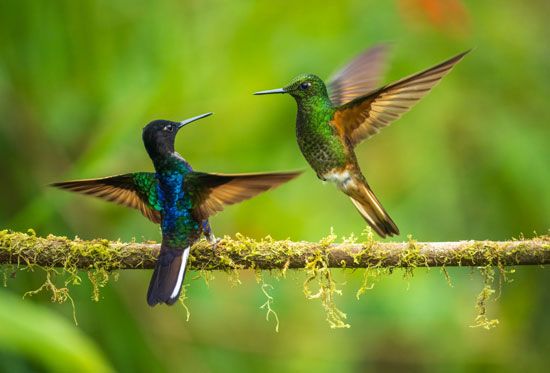
Hummingbirds possess the highest metabolic rate and the greatest metabolic range of any vertebrate, a necessity driven by their unique flight mechanics and high-energy lifestyle.9
Their ability to perform signature hovering flight requires immense energy, as they must beat their wings at rapid rates—up to 80 times per second in some species—to maintain stability while extracting nectar from flowers stability while extracting nectar from flowers. Unlike other birds, their wings connect to the body only at the shoulder joint, allowing for a full range of motion that enables them to fly forward, backward, and vertically.9107
To sustain this high-octane activity, hummingbirds require constant fuel. To manage their energy reserves, they exhibit circadian torpor, a state of dormancy where their metabolic rate drops significantly at night to conserve energy when they are not actively feeding. This physiological flexibility allows them to survive despite their extreme daily energy expenditures.9
Sources
- Velvet-purple coronet: Top Questions — Encyclopædia Britannica
- purple wreath — Merriam-Webster
- Velvet-purple coronet — Encyclopædia Britannica
- Pollination - Birds — Encyclopædia Britannica
- Major types of pollinators - Birds — Encyclopædia Britannica
- community ecology - The study of coevolution — Encyclopædia Britannica
- Hummingbird — Encyclopædia Britannica
- Apodiform - Distribution and abundance — Encyclopædia Britannica
- How fast do hummingbirds fly? — Encyclopædia Britannica
- Dormancy - Energy conservation — Encyclopædia Britannica
Published on · 3 min read