Walking Stick
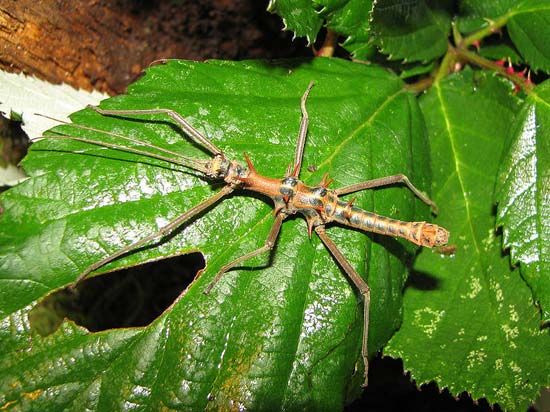
Walking stick insects (order Phasmatodea) utilize camouflage as a primary survival strategy, primarily through a form of protective coloration known as…
How do walking stick insects use camouflage for survival?
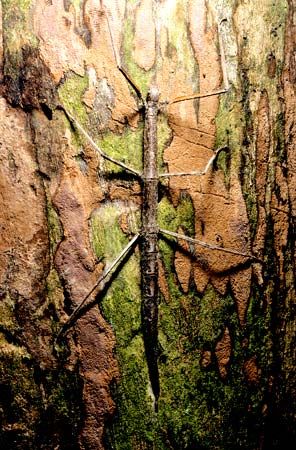
Walking stick insects (order Phasmatodea) utilize camouflage as a primary survival strategy, primarily through a form of protective coloration known as mimesis. By closely resembling twigs or leaves in both form and color, these insects effectively blend into their environment to avoid detection by predators.12
Their survival mechanisms include:
- Morphological Resemblance: Many species possess a long, narrow body structure that mimics the appearance of tree twigs, while others resemble leaves.1
- Color Adaptation: Some species can actively adjust their color to match their background by shifting pigment granules within their epidermal cells.1
- Behavioral Integration: Their slow-moving nature complements their physical appearance, helping them remain inconspicuous to insect-eating predators like birds.12
- Supplementary Defenses: Beyond camouflage, some walking sticks possess secondary protective traits, such as sharp spines, offensive odors, or the ability to eject toxic, distasteful chemicals from their joints.1
This deceptive resemblance is a classic example of how natural selection favors traits that prevent predators from identifying prey. Would you like to explore how other insects use mimicry to survive in the wild?2
How have walking stick insects adapted to different environments over time?
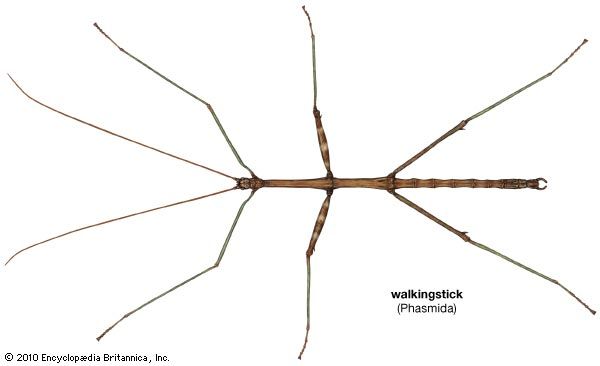
Walking stick insects (order Phasmatodea) have evolved highly specialized adaptations to survive in diverse environments, primarily through mimicry and physiological flexibility. Their survival strategy is rooted in their ability to blend into their surroundings to avoid predation.14
Key evolutionary adaptations include:
- Morphological Specialization: These insects have evolved body shapes that mimic twigs or leaves with extraordinary detail, allowing them to remain inconspicuous in their specific habitats.14
- Active Color Change: Some species have developed the ability to adjust their body color to match their background by moving pigment granules within their epidermal cells, a dynamic response to environmental changes.14
- Reproductive Strategies: To survive in varying climates, some species have adapted their life cycles. For example, some eggs can remain dormant through multiple winters or dry seasons before hatching, ensuring that offspring emerge when environmental conditions are favorable.1
- Chemical Defenses: Beyond camouflage, some species have evolved the ability to eject toxic, distasteful chemicals from joints in their exoskeleton as a secondary defense mechanism.1
- Parthenogenesis: Certain genera have adapted to environments where males are scarce by reproducing through parthenogenesis, allowing populations to persist without fertilization.1
How do walking stick insects reproduce and what is unique about their reproduction?
Walking stick insects (order Phasmatodea) primarily reproduce sexually, involving internal fertilization where sperm is transferred to the female and stored in a seminal receptacle until eggs are ready to be laid.17
What makes their reproduction unique is the prevalence of parthenogenesis in certain genera, such as Carausius. In these species, males are rare or absent, and females produce eggs that develop into offspring without being fertilized.81
Other notable aspects of their reproductive cycle include:
- Egg Deposition: Most species drop their eggs loosely on the ground, where they often resemble seeds to avoid predation. Some species, however, attach eggs to foliage, while others, like the southern two-striped walking stick (Anisomorpha buprestoides), bury them in sandy soil.8
- Delayed Development: Some species exhibit life cycles spanning two or more years. Their eggs may remain dormant through one or more winters or dry seasons before hatching, ensuring that the next generation emerges under favorable environmental conditions.8
- Regenerative Ability: While not a reproductive trait, walking sticks are unusual among insects for their ability to regenerate lost legs and antennae, which can aid in their survival to reach reproductive maturity.8
What is the geographic distribution of walking stick insects?
Walking stick insects (order Phasmatodea) are found globally, though they are most abundant and reach their largest sizes in tropical regions.15
Their distribution is characterized by significant regional variation:
- The Americas: There are approximately 600 species identified in Central and South America, making these regions major centers of diversity. In contrast, the southern regions of the United States are home to about 27 species.1
- Tropical Regions: These areas host the largest and most abundant populations of walking sticks. For instance, species such as Phobaeticus chani and Phobaeticus kirbyi are native to Borneo.1
- North America: Specific species, such as the northern walking stick (Diapheromera femorata), are well-documented in the United States, while the southern two-striped walking stick (Anisomorpha buprestoides) is found in the southeastern U.S.1
Sources
- walking stick — Encyclopædia Britannica
- mimicry - The importance of the signal receiver — Encyclopædia Britannica
- mimicry - The reconstruction of evolutionary pathways — Encyclopædia Britannica
- thrips - Evolution, paleontology, and classification — Encyclopædia Britannica
- Phasmatodea — Merriam-Webster
- insect - Protection from enemies — Encyclopædia Britannica
- insect - Reproduction — Encyclopædia Britannica
- Hymenoptera - Reproduction — Encyclopædia Britannica
- Parthenogenesis — Encyclopædia Britannica
- Animal reproductive system - Arthropods — Encyclopædia Britannica
- Phasmatidae — Merriam-Webster
Published on · 4 min read