Leaf Insect
While some sources may categorize leaf insects under the order Orthoptera, modern scientific classification places them within the order Phasmatodea (or…
What is the scientific classification of leaf insects?
While some sources may categorize leaf insects under the order Orthoptera, modern scientific classification places them within the order Phasmatodea (or Phasmida), which also includes stick insects.12
The scientific classification of the leaf insect (family Phylliidae) is as follows:
- Kingdom: Animalia
- Phylum: Arthropoda
- Class: Insecta
- Order: Phasmatodea
- Family: Phylliidae
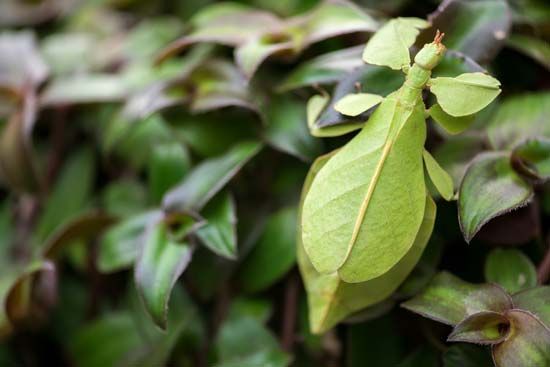
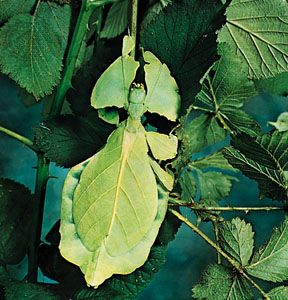
These insects are renowned for their remarkable mimicry, as their bodies and wings have evolved to resemble the color and form of leaves, providing an effective defense against predators.1
How do leaf insects differ from other similar-looking insects like stick insects?
Leaf insects and stick insects are closely related, both belonging to the order Phasmatodea, which comprises insects known for their plant-eating habits and remarkable camouflage. While they share this taxonomic classification, they differ significantly in their physical appearance and defensive strategies.13
Key Differences
- Body Shape: Stick insects are typically characterized by their long, cylindrical, twig-like bodies, which allow them to blend into branches and stems. In contrast, leaf insects (family Phylliidae) are distinctly flat and broad, evolved to mimic the appearance of leaves.361
- Mimicry Details: Leaf insects exhibit highly specialized mimicry. Their wings and legs are shaped and colored to imitate the form of a leaf, often including vein patterns that resemble a leaf’s midrib and even markings that look like spots of disease or physical damage. While stick insects also use camouflage to blend into their surroundings—sometimes even changing color to match their background—their mimicry is focused on replicating twigs or bark rather than foliage.16
- Wing Structure: In leaf insects, females often possess large forewings that lie edge to edge on the abdomen, while they typically lack hind wings and are flightless. Males, however, have smaller forewings and functional, sometimes transparent, hind wings.1
Both groups rely on these specialized physical traits to remain concealed from predators in their natural habitats.16
How do leaf insects use mimicry for survival in their natural habitats?
Leaf insects (family Phylliidae) utilize highly elaborate mimicry as a primary defense mechanism to survive in their natural habitats. By closely imitating the color and form of foliage, they effectively camouflage themselves from potential predators.19
Key aspects of their survival strategy include:
- Visual Camouflage: The wings and legs of leaf insects are evolved to replicate the appearance of leaves. Female elytra (forewings) feature vein patterns that mimic a leaf’s midrib and veins. Some species even display markings that imitate physical damage, such as spots of disease or holes, further enhancing their disguise.1
- Behavioral Mimicry: Nymphs often sway side to side, a behavior thought to mimic the movement of a leaf rustling in the wind, which helps them blend into their surroundings.1
- Acoustic Defense: Some species possess rows of tubercles on their antennae. When these are rubbed together, they produce sounds that may serve to ward off predators.1
This specialized adaptation allows these insects to remain hidden in plain sight within the densely vegetated areas they inhabit.19
What do leaf insects typically eat and how do they obtain their food?
Leaf insects (family Phylliidae) are herbivorous insects that feed on plants. They typically inhabit densely vegetated areas where they can easily access their food sources.
After hatching, the young nymphs climb onto food plants to begin feeding, a process that also contributes to their development; for instance, they typically turn green only after they have consumed leaves. As members of the order Phasmatodea, they are specialized to live and feed within the foliage they mimic, allowing them to remain camouflaged while they eat.
Sources
- leaf insect — Encyclopædia Britannica
- leaf insect — Merriam-Webster
- Phasmatodea — Merriam-Webster
- Phyllidae — Merriam-Webster
- Phyllodocidae — Merriam-Webster
- caddisfly - Annotated classification — Encyclopædia Britannica
- List of insects - order Phasmatodea — Encyclopædia Britannica
- insect - Protection from enemies — Encyclopædia Britannica
- 9 Animals That Look Like Leaves — Encyclopædia Britannica
- leafhopper — Encyclopædia Britannica
- Eating the rainforest — Encyclopædia Britannica
- Lepidoptera - Feeding habits — Encyclopædia Britannica
- Orthoptera - Food — Encyclopædia Britannica
- leaf beetle — Encyclopædia Britannica
Published on · 3 min read