Weigela
Weigela is a genus consisting of approximately 10 species of flowering shrubs native to East Asia, belonging to the family Diervillaceae. These plants are…
What is Weigela?
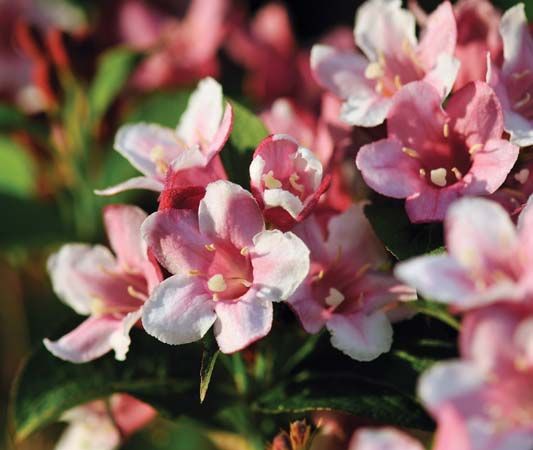
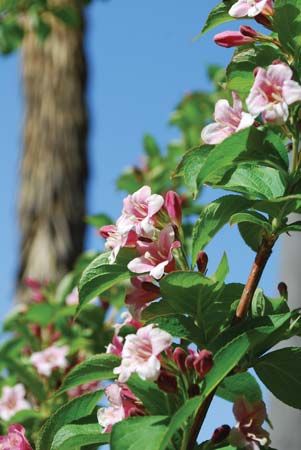
Weigela is a genus consisting of approximately 10 species of flowering shrubs native to East Asia, belonging to the family Diervillaceae. These plants are frequently cultivated as ornamentals for their vibrant spring and summer blossoms.1
The shrubs typically grow up to 4 meters (13 feet) tall and feature upright branches with narrowly oval leaves. Their flowers are tubular or funnel-shaped, ranging in color from white to red, and generally measure about 3.5 cm (1.5 inches) in length. Following the flowering period, the plants produce long, narrow seed pods that split into two parts. The genus is named after the German physician Christian E. Weigel.12
What other plants belong to the honeysuckle family?
The Caprifoliaceae family, commonly known as the honeysuckle family, is a diverse group comprising approximately 42 genera and 890 species of trees, shrubs, vines, and herbs. While the genus Lonicera (honeysuckles) is the largest, the family includes many other notable plants often grown for their ornamental value.345
Key genera within the family include:
- Diervilla: Known as bush honeysuckles, these are shrubs native to North America.34
- Weigela: A genus of East Asian shrubs widely cultivated for their colorful, tubular flowers.461
- Symphoricarpos: Commonly known as snowberries, these deciduous shrubs include species like the common snowberry and coralberry.34
- Abelia: A genus of about 30 species native to East Asia and Mexico, including the popular ornamental glossy abelia.34
- Scabiosa: Known as the pincushion flower, this genus includes several ornamental species.34
- Valeriana and Valerianella: These herbs are known for the rank odor of their dried stems and leaves; Valeriana officinalis is notably used in herbal medicine.34
- Kolkwitzia amabilis: Commonly called beauty bush, it is prized for its showy flowers.3
- Leycesteria formosa: Known as the Himalaya honeysuckle, it produces drooping spikes of purple flowers.3
- Dipsacus: The teasel genus, which includes species historically used in the textile process known as fulling.34
How do pollinators interact with tubular flowers?
Pollinators interact with tubular flowers through specialized adaptations that allow them to access nectar hidden deep within the floral structure. Because these flowers often conceal their rewards at the base of a tube, they require pollinators with specific physical traits, such as elongated mouthparts or beaks, to reach the nectar.789
- Bees: Many bee-pollinated flowers feature a zygomorphic (bilaterally symmetrical) corolla with a lower lip that serves as a landing platform. Bees partially enter the corolla mouth, using their long tongues to reach nectar produced at the base. As they feed, they deposit and collect pollen.710
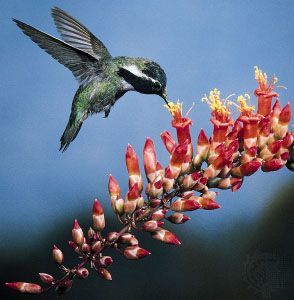
- Birds: Flowers adapted for bird pollination, particularly those visited by hummingbirds, are typically bright red, tubular, and lack odor, as birds have a poor sense of smell. These flowers often contain a callus or hump inside the tube that forces the bird’s beak against the reproductive parts of the flower to ensure pollen transfer.811
- Moths and Flies: Flowers with long, thin perianth tubes are often pollinated by insects with long proboscises, such as hawk moths or specialized flies. These flowers often produce strong, sweet scents to attract their specific pollinators at night or during the day.81213
What are the best conditions for growing ornamental shrubs?
To maintain healthy and visually appealing ornamental shrubs, proper care involves a combination of training and pruning. While the provided search results do not specify soil or climate conditions, they emphasize that horticultural management is essential for growth and flowering potential.114
Training and Pruning Techniques
Training directs the size, shape, and direction of a plant, often using supports to guide growth. Pruning is the judicious removal of plant parts to contain size, remove dead growth, or improve appearance.14
- Heading Back: This involves cutting the terminal portion of a branch to a bud. It stimulates lateral budbreak, resulting in a compact, bushy plant that is ideal for hedges or rejuvenating shrubs that have become too large or flower poorly.14
- Thinning Out: This is the complete removal of a branch to a main trunk or lateral. It reduces lateral branches to encourage longer growth in the remaining terminals, which opens up the plant structure.14
Best Practices
- Early Intervention: Start pruning when the plant is young to avoid the need for drastic, risky remedial pruning on large or misshapen specimens later.14
- Proper Cuts: When removing branches, make cuts just above the collar—the protective swelling at the base of the branch—rather than flush with the limb.1
- Maintenance: Regular pruning helps prevent plants from becoming lanky or misshapen and ensures better air circulation and light exposure, which can reduce disease.114
Sources
- Weigela — Encyclopædia Britannica
- weigela — Merriam-Webster
- Caprifoliaceae — Encyclopædia Britannica
- Caprifoliaceae — Merriam-Webster
- Honeysuckle — Encyclopædia Britannica
- Dipsacales — Encyclopædia Britannica
- Angiosperm - Pollination — Encyclopædia Britannica
- Asparagales - Pollination — Encyclopædia Britannica
- Pollination - Beetles and flies — Encyclopædia Britannica
- Pollination - Evolution of insect pollination — Encyclopædia Britannica
- orchid - Bee pollination — Encyclopædia Britannica
- Major types of pollinators - Beetles and flies — Encyclopædia Britannica
- orchid - Bird pollination — Encyclopædia Britannica
- pruning — Encyclopædia Britannica
- gardening - Training and pruning — Encyclopædia Britannica
- horticulture - Shrubs — Encyclopædia Britannica
Published on · 4 min read