What’s the Difference Between Bison and Buffalo?
While often confused, bison and buffalo are distinct animals. You can easily tell them apart by focusing on three key features, often called the "three H’s":
What’s the Difference Between Bison and Buffalo?
While often confused, bison and buffalo are distinct animals. You can easily tell them apart by focusing on three key features, often called the “three H’s”:
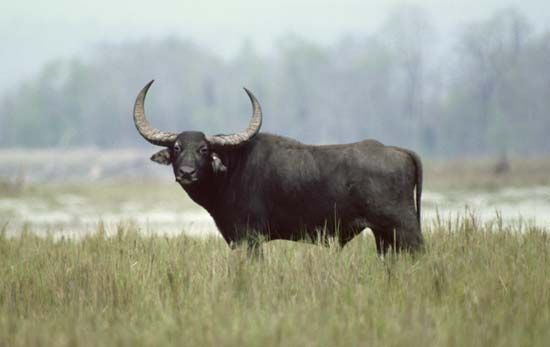
- Home: Buffalo are indigenous to South Asia (water buffalo) and Africa (Cape buffalo). Bison are found in North America and Europe.
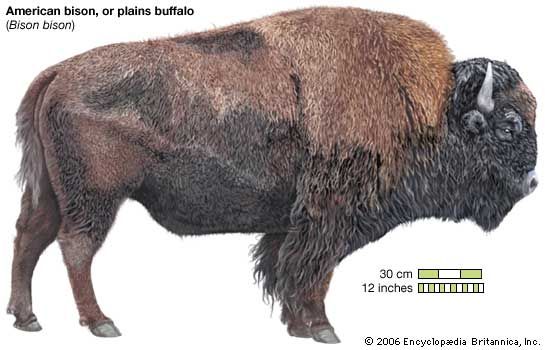
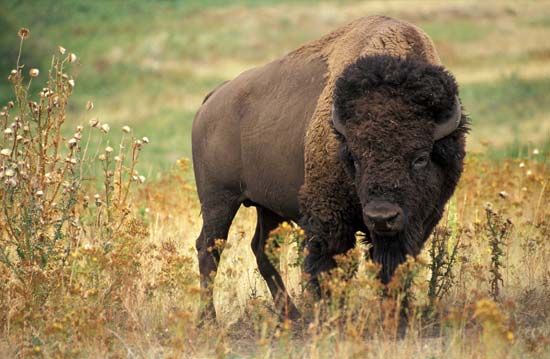
- Hump: Bison possess a pronounced hump at their shoulders, which helps them plow through snow. Buffalo do not have this feature.
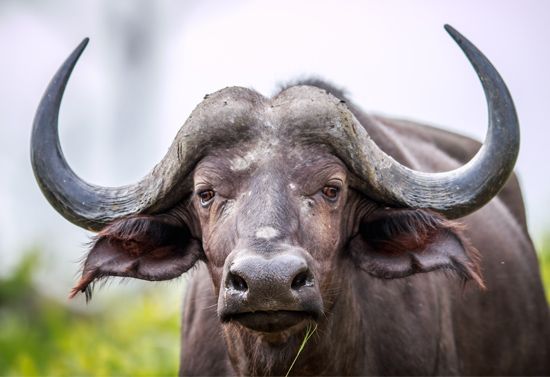
- Horns: Buffalo horns are typically large, sometimes exceeding 6 feet, with pronounced arcs. Bison horns are much shorter and sharper.
Additionally, bison are easily identified by their thick beards, whereas buffalo are beardless. Although the term “buffalo” is frequently used to describe the American bison, this is a misnomer stemming from historical confusion among early explorers.12
How did the near-extinction of the American bison impact Indigenous cultures?
The near-extinction of the American bison in the 19th century was a catastrophic event that fundamentally dismantled the way of life for Indigenous peoples of the Great Plains. For these nomadic societies, the bison was the essential foundation of their economy, providing meat for food, hides for clothing and tepees, and materials for tools.23
The destruction of the herds was not merely an environmental tragedy but a deliberate political strategy employed by the United States government. By facilitating the slaughter of the bison, policymakers aimed to deprive Indigenous nations of their primary means of subsistence, thereby forcing them to abandon their nomadic traditions and submit to confinement on reservations.24
This forced transition had profound consequences:
- Economic Collapse: The loss of the bison destroyed the economic independence of Plains tribes, leaving them reliant on government support and vulnerable to starvation.24
- Cultural Disruption: The bison held a central place in the spiritual and ritual life of these cultures, including the Sun Dance and various religious ceremonies. The disappearance of the animal severed a vital link to their traditional belief systems and social structures.53
- Forced Assimilation: With their traditional livelihoods eradicated, many tribes were compelled to adopt settled agricultural practices and assimilate into Euro-American society, a process that often involved the loss of tribal sovereignty and cultural identity.264
What are the main physical differences between plains bison and wood bison?
The American bison (Bison bison) is categorized into two subspecies: the plains bison (B. bison bison) and the wood bison (B. bison athabascae).
While they share the defining characteristics of the species—such as a heavy head, a pronounced shoulder hump, and a shaggy dark brown coat—the physical differences between the two are considered minor. The primary distinction is size: the wood bison is slightly larger than the plains bison.92
Historically, their ranges also differed, with the plains bison inhabiting the central United States and the Great Plains provinces of Canada, while the wood bison was native to the more northern regions of Canada and Alaska. Today, both subspecies are maintained in conservation herds to ensure the survival of the species.9
How do water buffalo and Cape buffalo differ in their behavior and habitats?
Water buffalo and Cape buffalo are distinct species with different environmental adaptations and social behaviors.
Habitat and Environmental Adaptations
- Water Buffalo: These animals are native to the swamps and forests of Southeast Asia. They are highly adapted to aquatic environments, possessing splayed hooves and flexible joints that allow them to navigate deep mud. They spend much of their day submerged in water or wallowing in mud to regulate their body temperature and escape insects.10
- Cape Buffalo: Native to sub-Saharan Africa, these animals thrive in diverse grassland habitats, including savannas, floodplains, and forests. While they require access to water within a 20-km range, they are not as strictly tied to aquatic environments as water buffalo. They are highly successful ruminants capable of grazing on tall, coarse grasses that other species cannot digest.11
Behavioral Differences
- Social Structure: Water buffalo typically live in small groups of five to eight related cows and their offspring, while young males form separate bachelor groups. In contrast, Cape buffalo are extremely gregarious, often forming massive herds of over 1,000 individuals. They exhibit complex social behaviors, such as lying in physical contact with one another and cooperatively defending the herd against predators like lions.1011
- Activity Patterns: Wild water buffalo are primarily nocturnal feeders, whereas Cape buffalo are active in various grassland settings throughout the day.1011
Sources
- What’s the Difference Between Bison and Buffalo? — Encyclopædia Britannica
- bison — Encyclopædia Britannica
- Oceti Sakowin - Precontact way of life and culture — Encyclopædia Britannica
- Primitive culture - The Plains Indians — Encyclopædia Britannica
- Columbian Exchange - Animals — Encyclopædia Britannica
- Indigenous peoples of the American Southwest - The 20th and 21st centuries — Encyclopædia Britannica
- Northeast Indian - Cultural continuity and change — Encyclopædia Britannica
- Indigenous peoples of the Great Plains - The Plains Wars — Encyclopædia Britannica
- American bison — Merriam-Webster
- Water buffalo — Encyclopædia Britannica
- Cape buffalo — Encyclopædia Britannica
Published on · 3 min read