Where Do Honeybees Go in the Winter?
In temperate climates, honeybees do not migrate or hibernate; instead, they remain in their hive throughout the winter. When temperatures drop below…
Where Do Honeybees Go in the Winter?
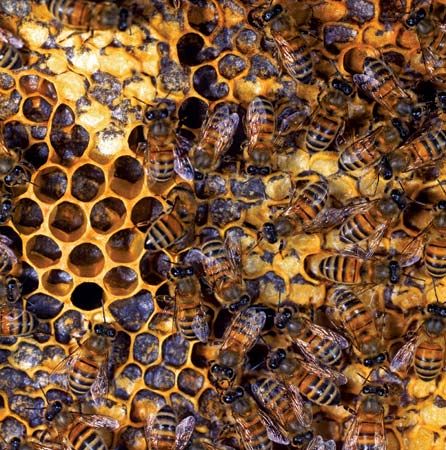
In temperate climates, honeybees do not migrate or hibernate; instead, they remain in their hive throughout the winter. When temperatures drop below approximately 50–57 °F (10–14 °C), the bees cease flying and form a tight, all-female “winter cluster” to conserve heat.12
Within this cluster, the queen bee stays in the warmest core, while worker bees shiver and vibrate their muscles to maintain a survivable temperature, which can reach 90–100 °F (32–37 °C) at the center. To survive the season, the colony relies on stored honey, which serves as their primary energy source. The cluster moves slowly through the hive to access these food reserves. Male drones die off before winter, leaving only the queen and workers to sustain the colony until warmer weather returns. In regions where temperatures rarely drop below 50 °F, colonies may remain active year-round.13
What roles do worker bees play in the hive during the summer?
During the active summer season, worker bees—which are sexually undeveloped females—perform nearly all tasks necessary for the colony’s survival, excluding egg-laying. Their roles are diverse and essential to the hive’s function:456
- Foraging: Workers collect nectar to convert into honey for energy, as well as pollen to provide the protein required for rearing young. They also gather water for hive air-conditioning and propolis to seal cracks.57
- Brood Care: Workers produce royal jelly to feed larvae and tend to the developing brood.56
- Construction: They secrete beeswax to build and repair the honeycomb cells used for storage and egg-laying.5
- Communication and Defense: Workers use dancelike movements to share information about food sources. They also defend the nest and maintain precise internal temperatures through muscle vibration or by carrying water to cool the hive.576
These tasks are often divided among individuals, with some bees acting as inside workers, nest builders, or foragers.6
How do honeybees communicate the location of food sources to the rest of the colony?
Honeybees communicate the location, distance, and quality of food sources to their colony members through specialized rhythmic movements known as dances, a discovery famously studied by zoologist Karl von Frisch.
These communications generally take two forms:
- Round Dance: This movement is used when a food source is located relatively close to the hive, typically within 75 meters (about 250 feet).10
- Waggle Dance: When a food source is at a greater distance, the bee performs a waggle dance. This involves a figure-eight pattern consisting of a straight “walk” accompanied by a sporadic fluttering of wings. The angle and duration of this dance inform other bees of the direction and distance of the nectar or pollen.510
To navigate accurately, bees use the Sun as a compass, even when it is not directly visible, by perceiving polarized light and remembering landmarks. These dancelike movements allow the colony to efficiently exploit resources, ensuring the survival of the hive.1011
What are the primary differences between queen bees, worker bees, and drones?
Honeybee colonies are organized into three distinct forms, each with specialized roles and anatomical differences essential to the survival of the hive.1314
Queen Bee
The queen is the only sexually mature female in the colony and is responsible for reproduction. She is larger than worker bees and possesses a stinger, though she rarely leaves the hive except to swarm or mate. A queen can live up to five years, laying thousands of eggs daily. Her development is unique; while all larvae are initially fed royal jelly, only future queens are fed this substance exclusively throughout their development, which takes 16 days.135151416
Worker Bees
Workers are sexually undeveloped females and are the most abundant members of the colony. They perform all hive maintenance, including foraging for nectar and pollen, building honeycomb with beeswax, and caring for the brood. Anatomically, they are distinguished by specialized structures like pollen baskets on their hind legs, which queens lack. They emerge as adults in about 21 days.1316145
Drones
Drones are the male members of the colony and are present primarily in early summer. They are larger than workers but smaller than the queen and are stingless. Their sole function is to mate with a queen; they die immediately after the act. Drones develop from unfertilized eggs in 24 days, a process known as parthenogenesis.1416171513
Sources
- Where Do Honeybees Go in the Winter? — Encyclopædia Britannica
- How is honey made? — Encyclopædia Britannica
- Beekeeping - Honeybees — Encyclopædia Britannica
- Beekeeping - Worker bees — Encyclopædia Britannica
- western honeybee - Colony and life cycle — Encyclopædia Britannica
- Hymenoptera - Social forms — Encyclopædia Britannica
- Beekeeping - Predators — Encyclopædia Britannica
- bee: Top Questions — Encyclopædia Britannica
- Pollination - Bees — Encyclopædia Britannica
- waggle dance — Merriam-Webster
- Karl von Frisch — Encyclopædia Britannica
- Hymenoptera - Chemical — Encyclopædia Britannica
- Beekeeping - Drones — Encyclopædia Britannica
- Beekeeping - Queen bee — Encyclopædia Britannica
- honeybee — Encyclopædia Britannica
- western honeybee - Physical description — Encyclopædia Britannica
- Caste — Encyclopædia Britannica
Published on · 3 min read