Wood Frog
The wood frog (Lithobates sylvatica) possesses remarkable adaptations that allow it to survive in freezing environments, even as 65–70 percent of its total…
What are the unique adaptations that allow wood frogs to survive freezing temperatures?
The wood frog (Lithobates sylvatica) possesses remarkable adaptations that allow it to survive in freezing environments, even as 65–70 percent of its total body water turns to ice.12
As an ectotherm, the wood frog manages these extreme conditions through a biochemical strategy involving cryoprotectants. Specifically, the frog converts glycogen stored in its body into high concentrations of glucose. This surge of glucose acts as a natural antifreeze, flooding the frog’s cellular fluids and tissues to protect them from damage while the surrounding water freezes. This process effectively lowers the freezing point of the fluids within its cells, allowing the frog to endure temperatures as low as 23 °F (−5 °C) for several weeks at a time.12
How does the wood frog’s habitat and distribution differ from other amphibian species?
The wood frog is uniquely adapted to cool climates, distinguishing it from many other amphibian species that thrive in warmer or more temperate environments. While many frogs and toads show the greatest diversity in humid tropical regions, the wood frog occupies a range that extends through the northeastern United States, most of Canada, and into central and southern Alaska.324
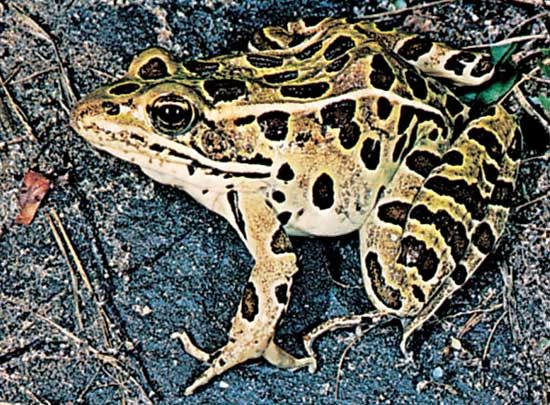
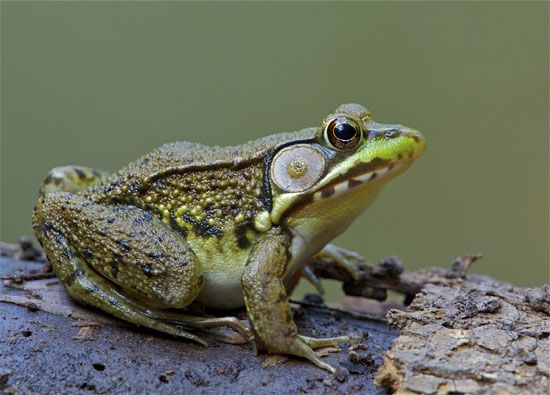
Unlike species such as the northern leopard frog, which typically overwinters at the bottom of ponds or lakes, the wood frog is a terrestrial species that survives freezing temperatures by remaining on land and utilizing internal cryoprotectants. Other species, such as the mink frog or the Columbia spotted frog, are more strictly aquatic, often relying on specific water bodies or vegetation like lily pads for protection.32
Furthermore, while many amphibians are highly sensitive to habitat destruction and environmental changes, the wood frog’s ability to endure extreme cold allows it to inhabit northern latitudes where few other amphibians can survive.24
What is the life cycle of a wood frog, from egg to adult?
The life cycle of the wood frog (Lithobates sylvatica) follows a classic amphibian pattern, transitioning from an aquatic egg and larval stage to a terrestrial adult form.35
- Breeding and Eggs: As an early spring breeder, the wood frog utilizes vernal pools formed by meltwater and late winter rains. Between early March and early May, females deposit a globular mass containing several hundred to a few thousand eggs.3
- Larval Stage: After hatching, the wood frog exists as a free-swimming tadpole. During this phase, the tadpole possesses a cartilaginous skeleton, gills, and a long, coiled intestine, allowing it to feed on vegetation such as algae.36
- Metamorphosis: Over the course of two to three months, the tadpole undergoes metamorphosis, a process regulated by hormones like thyroxine. During this transformation, the tadpole loses its tail and gills, develops limbs, and undergoes significant internal changes, including the development of lungs and a modified digestive system suitable for an adult diet.376
- Adulthood: Once metamorphosis is complete, the wood frog emerges as a terrestrial adult, characterized by its tan-to-brown coloration and distinct dark facial mask.3
What physical characteristics distinguish wood frogs from other frog species?
The wood frog (Lithobates sylvatica) possesses several distinct physical characteristics that help differentiate it from other frog species:
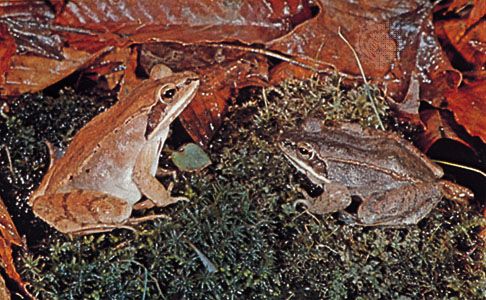
- Facial Markings: The most prominent identifying feature of the wood frog is a dark, distinct “robber’s mask” that extends across its eyes.31
- Coloration: While they exhibit a wide range of shades, wood frogs are generally tan, brown, yellowish-brown, or pinkish in color.39
- Size: They are relatively small amphibians, reaching a maximum length of approximately 8.25 cm (3.25 inches) and a maximum weight of about 8 grams (0.3 ounce).3
- Physiological Adaptations: Unlike many other frogs, the wood frog is uniquely adapted to survive freezing temperatures. It functions as an ectotherm that can withstand having a significant portion of its body water turn to ice by producing glucose as a natural cryoprotectant, which protects its cells and tissues from damage.101
These features, combined with their preference for moist woodlands rather than strictly aquatic environments, help distinguish them from other common North American species like the northern leopard frog or the pickerel frog, which are typically identified by their distinct spotting patterns.1
Sources
- Ectotherm — Encyclopædia Britannica
- 7 Awesome Frog Species of Canada and the United States — Encyclopædia Britannica
- wood frog — Encyclopædia Britannica
- amphibian - Distribution and abundance — Encyclopædia Britannica
- Animal development - Metamorphosis — Encyclopædia Britannica
- frog and toad - Egg laying and hatching — Encyclopædia Britannica
- amphibian - Life cycle — Encyclopædia Britannica
- frog and toad - From tadpole to adult — Encyclopædia Britannica
- What’s the Difference Between a Frog and a Toad? — Encyclopædia Britannica
- wood frog — Merriam-Webster
Published on · 3 min read