Aseismic Ridge
Aseismic ridges are long, linear, mountainous structures on the ocean floor that differ fundamentally from active oceanic ridges where seafloor spreading…
What role do aseismic ridges play in plate tectonics and seafloor spreading?
Aseismic ridges are long, linear, mountainous structures on the ocean floor that differ fundamentally from active oceanic ridges where seafloor spreading occurs2. While oceanic ridges are characterized by volcanic activity, frequent earthquakes, and the creation of new crust, aseismic ridges are defined by their lack of seismic activity.123
Instead of forming at spreading centers, most aseismic ridges are constructed by volcanism from a hot spot as a tectonic plate moves over it. These ridges are composed of coalescing volcanoes and often serve as indicators of past plate motion. For example, changes in the trend of the Hawaiian-Emperor chain provide evidence for shifts in the direction of the Pacific Plate over millions of years.2
While they do not drive seafloor spreading, some aseismic ridges, such as the Walvis Ridge and Rio Grande Rise, originated near spreading centers during the early stages of ocean basin opening. Over time, these structures subside as they move away from the heat source and cool.2
What is an aseismic ridge and how does it differ from other oceanic features?
An aseismic ridge is a long, linear, mountainous structure found on the ocean floor that is distinguished by a lack of seismic activity. Unlike active oceanic ridges, which serve as spreading centres where new crust is created, aseismic ridges are typically constructed by volcanism from a hot spot as a tectonic plate moves over it.52
Key Differences from Other Oceanic Features
- Seismic Activity: While oceanic ridges are sites of frequent earthquakes due to plate divergence, aseismic ridges are characterized by their inactivity.56
- Origin: Oceanic ridges are formed by the upwelling of mantle material at divergent plate boundaries. In contrast, most aseismic ridges are composed of coalescing volcanoes created by hot spots.25
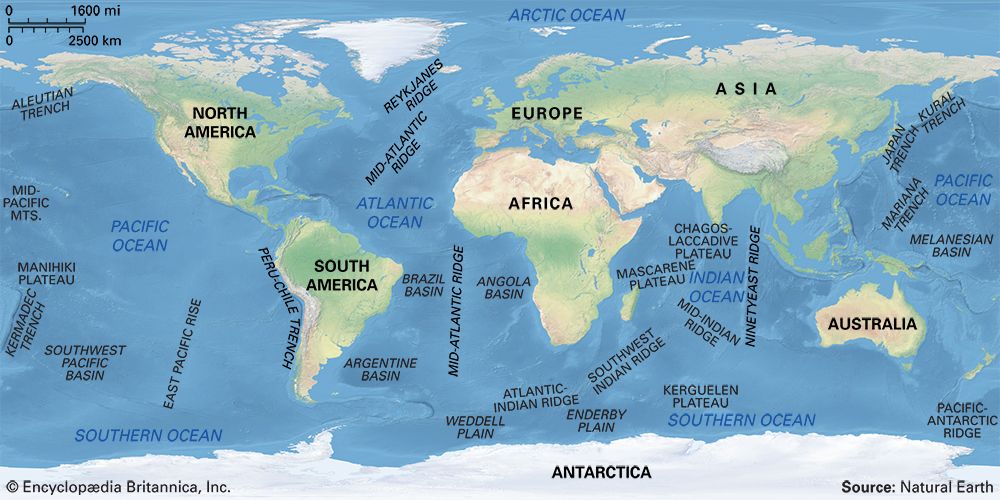
- Topography: Oceanic ridges form a continuous, global system of elevated crust. Aseismic ridges appear as distinct, linear chains of seamounts or plateaus, such as the Hawaiian-Emperor chain, the Ninetyeast Ridge, or the Walvis Ridge.785
- Thermal Profile: Oceanic ridges exhibit high heat flow and thermal expansion, whereas aseismic ridges generally subside as they cool and move away from their volcanic source.526
What is the relationship between aseismic ridges and seamount chains?
Aseismic ridges and seamount chains are closely related, as both are often surface expressions of the same geological process: the movement of a lithospheric plate over a stationary hot spot.29
The Relationship
- Common Origin: Most aseismic ridges are constructed by volcanism from hot spots, resulting in long, linear chains of coalescing volcanoes and seamounts.2
- Age Progression: Both features record the history of plate motion. As a plate moves over a hot spot, a volcano forms; as the plate continues to move, that volcano is separated from its magma source and becomes extinct. This creates a chain where the age of the volcanic structures increases with distance from the active hot spot.109
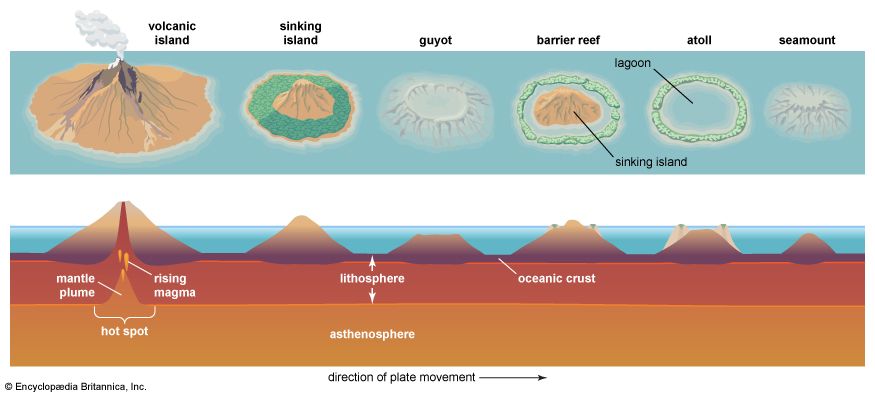
- Structural Evolution: A seamount chain often represents the fragmented or individual volcanic components of what is collectively termed an aseismic ridge. Over time, these volcanoes cool, subside, and may transition from volcanic islands to atolls and eventually to submerged seamounts.210
While some seamount chains may form along linear rifts, the most prominent aseismic ridges, such as the Hawaiian-Emperor chain, serve as definitive records of these hot spot tracks.211
How are aseismic ridges formed in the ocean?
Aseismic ridges are long, linear, mountainous structures on the ocean floor that are primarily formed through volcanism associated with hot spots.2
Formation Process
- Hot Spot Volcanism: As a tectonic plate moves over a stationary mantle plume (a hot spot), magma rises to the surface, creating a series of volcanoes and seamounts.212
- Coalescence: These individual volcanic structures eventually coalesce to form a continuous, linear ridge.2
- Plate Motion: Because the hot spot remains relatively stationary while the tectonic plate moves above it, the ridge acts as a chronological record of the plate’s path. The age of the volcanic material typically increases with distance from the active hot spot.212
- Subsidence: As the volcanic structures move away from the heat source, they cool and undergo subsidence, sinking deeper into the ocean basin over time.24
Unlike oceanic ridges, which are formed by plate divergence and are characterized by high seismic activity, aseismic ridges are defined by their lack of earthquakes along their length.24
Sources
- Mid-Atlantic Ridge — Encyclopædia Britannica
- aseismic ridge — Encyclopædia Britannica
- plate tectonics - Seafloor spreading — Encyclopædia Britannica
- oceanic ridge - Principal characteristics — Encyclopædia Britannica
- oceanic ridge — Encyclopædia Britannica
- deep-sea trench - Structure — Encyclopædia Britannica
- plate tectonics - Discovery of ocean basin features — Encyclopædia Britannica
- ocean basin - General features — Encyclopædia Britannica
- plate tectonics - Hotspots — Encyclopædia Britannica
- seamount — Encyclopædia Britannica
- hotspot — Encyclopædia Britannica
- igneous rock - Divergent plate boundaries — Encyclopædia Britannica
- subsidence — Encyclopædia Britannica
- mass movement — Encyclopædia Britannica
- plate tectonics - Seismic tomography — Encyclopædia Britannica
- mountain - Mid- ocean ridges and rises — Encyclopædia Britannica
Published on · 3 min read