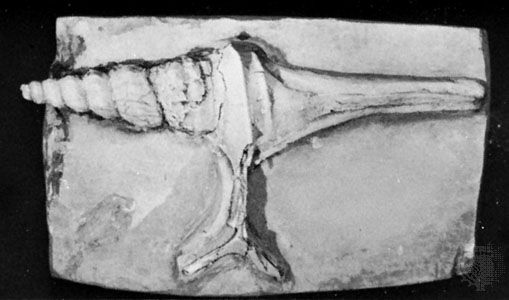
Byssonychia
Byssonychia is an extinct genus of pelecypods (clams) that lived during the Ordovician Period, approximately 488.3 million to 443.7 million years ago.
What is Byssonychia?
Byssonychia is an extinct genus of pelecypods (clams) that lived during the Ordovician Period, approximately 488.3 million to 443.7 million years ago.1
As one of the earliest known clam genera, it is recognized as a valuable index fossil for dating geological strata from that era. The shell of Byssonychia is characterized by a roughly triangular shape that tapers to a prominent beak, featuring distinct linear ribbing on its surface and a single muscle scar on the interior.1
What are index fossils and why are they important?
An index fossil is a plant or animal remain preserved in the Earth’s rock record that serves as a diagnostic marker for a specific span of geologic time or a particular environment.2
Characteristics of an Ideal Index Fossil
To be considered a useful index fossil, a specimen should ideally possess the following traits:
- Short temporal range: The species existed for only a brief moment in geologic history, allowing for precise dating.23
- Wide geographic distribution: It was cosmopolitan, meaning it can be found across large areas, facilitating global correlation.23
- Abundance: The fossilized population is sufficiently common to make discovery highly probable.23
- Distinctive appearance: It is easily recognizable, which helps prevent misidentification.23
Importance in Geology
Index fossils are fundamental to stratigraphy and the geologic time scale. They allow geologists to perform stratigraphic correlation—the process of piecing together separated rock outcrops to determine if they formed contemporaneously. By applying the principle of faunal succession, scientists can use these fossils to define the relative ages of rock layers, a method that has been consistently validated by modern radiometric dating.23
What other types of life existed during the Ordovician Period?
The Ordovician Period (485.4 million to 443.8 million years ago) was a time of remarkable biological diversification known as the Ordovician radiation, which saw the emergence of nearly every modern phylum of marine invertebrate.45
Marine Life
The seas were dominated by a complex array of invertebrates, including:
- Brachiopods and Bryozoans: These were dominant components of many marine assemblages.65
- Mollusks: Common forms included gastropods, bivalves, cephalopods, and tusk shells.6
- Echinoderms: This group reached a peak diversity of 20 classes, featuring crinoids, starfishes, and cystoids.6
- Arthropods: While trilobites remained diverse, other arthropods like ostracods and rare sea scorpions were present.6
- Other Invertebrates: Sponges, corals, graptolites, and annelids were also significant5.
- Vertebrates: The period marked the rise of early fish and the presence of conodonts, which were primitive chordates.65
Terrestrial Life
The Ordovician also witnessed the first appearance of plants on land, as well as the potential first invasion of terrestrial arthropods.45
How do scientists determine the age of a fossil?
Scientists determine the age of a fossil using two primary approaches: relative dating and absolute dating.9
Relative Dating
Relative dating establishes the chronological order of events without providing a specific numerical age. This method relies on stratigraphy, specifically the law of superposition, which states that in undisturbed sedimentary deposits, the oldest layers are found at the bottom and the youngest at the top. Geologists also use index fossils—distinctive, widespread, and short-lived species—to correlate rock layers across different geographic locations and determine their relative ages.2109
Absolute Dating
Absolute dating provides a specific numerical age by measuring the decay of radioactive isotopes within rocks or minerals. This process, known as geochronology, relies on the constant rate of radioactive decay, where a “parent” isotope transforms into a stable “daughter” isotope over time. By measuring the ratio of parent to daughter atoms in a sample, scientists can calculate the time elapsed since the mineral or rock formed. Common methods include:11912
Sources
- Byssonychia — Encyclopædia Britannica
- index fossil — Encyclopædia Britannica
- dating - Principles and techniques — Encyclopædia Britannica
- A Journey Through Time Since the Precambrian - Ordovician Period: 485.4 million to 443.4 million years ago — Encyclopædia Britannica
- Ordovician Period - Invertebrates — Encyclopædia Britannica
- Ordovician Period - Mass extinction at the end of the Ordovician — Encyclopædia Britannica
- Ordovician Period - Exploitation of habitats — Encyclopædia Britannica
- Ordovician Period — Encyclopædia Britannica
- dating: Top Questions — Encyclopædia Britannica
- stratigraphy — Encyclopædia Britannica
- dating - Principles of isotopic dating — Encyclopædia Britannica
- dating - Distinctions between relative-age and absolute-age measurements — Encyclopædia Britannica
- dating - Origin of radioactive elements used — Encyclopædia Britannica
Published on · 3 min read