Anchura
Anchura is a genus of extinct marine gastropods, or snails, known exclusively from fossils found in marine deposits dating to the Cretaceous Period…
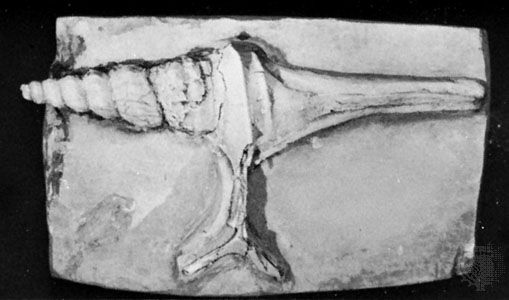
What is Anchura?
Anchura is a genus of extinct marine gastropods, or snails, known exclusively from fossils found in marine deposits dating to the Cretaceous Period (approximately 145.5 million to 65.5 million years ago).1
Because these snails are easily identifiable, they serve as a valuable index fossil for geologists and paleontologists. Their shells are characterized by globular whorls featuring raised, decorative crenulations, a sharply pointed spire, and a distinctively extended outer lip on the final, largest body whorl.1
What are index fossils and why are they important?
An index fossil is any plant or animal preserved in the Earth’s rock record that serves as a marker for a specific span of geologic time or a particular environment.2
To be considered a useful index fossil, a specimen must meet several criteria:
- Distinctiveness: It must be easily recognizable.
- Abundance: It should be found in large numbers.
- Distribution: It must have a wide geographic range.
- Temporal Range: It must have existed for a relatively short period of time.2
These fossils are essential because they provide the foundation for defining boundaries within the geologic time scale and for the correlation of strata across different regions. By identifying these specific organisms—such as Protista with hard shells or certain mammals—scientists can establish a framework for biostratigraphy, which is now often integrated with radioisotopic dating and magnetostratigraphy to create a precise historical record of our planet.23
What defines the Cretaceous period?
The Cretaceous Period was the final and longest period of the Mesozoic Era, spanning 79 million years from approximately 145 million to 66 million years ago. Its name is derived from creta, the Latin word for “chalk,” reflecting the thick limestone deposits formed by coccolithophores during this time.45
Key characteristics of the period include:
- Paleogeography: The era began with the continents of Laurasia and Gondwana rifting apart. By the end of the period, most modern continents were separated by expanding oceans.45
- Climate: The global climate was generally warmer and more humid than today, with no continental ice sheets at the poles. High rates of seafloor spreading and active volcanism contributed to these conditions.465
- Life: Dinosaurs remained the dominant land animals, while angiosperms (flowering plants) first appeared and diversified.475
- Extinction: The period concluded with one of Earth’s greatest mass extinctions, which eliminated the dinosaurs and many marine reptiles, likely triggered by a combination of asteroid impact and terrestrial volcanic activity.458
How do marine gastropods differ from land snails?
Marine gastropods and land snails differ primarily in their respiratory systems, reproductive strategies, and adaptations for moisture retention, reflecting their evolutionary transition from aquatic to terrestrial environments.10
Respiratory Adaptations
- Marine Gastropods: Most marine species utilize gills located within the mantle cavity to extract oxygen from water.1112
- Land Snails: These have evolved a “lung,” or a highly vascularized mantle cavity, which pumps air through a small respiratory pore. This allows them to breathe atmospheric oxygen.1112
Moisture and Desiccation Control
- Marine Gastropods: Being surrounded by water, they do not face the same risk of drying out. Many possess an operculum, a calcified disk that seals the shell opening.1013
- Land Snails: To prevent desiccation, land snails have developed behavioral and physical adaptations. Many retreat into damp niches or burrow into soil during dry periods. While some retain an operculum, others (like many pulmonates) secrete mucous coverings or calcium-impregnated seals (epiphragms) to close their shells.10
Reproduction and Dispersal
- Marine Gastropods: Often rely on a veliger larval stage that is passively transported by ocean currents.10
- Land Snails: Because they lack a free-swimming larval stage, they have adapted by brooding young or attaching egg capsules to surfaces. Many are hermaphrodites, which facilitates population establishment in new, isolated environments.10
Sources
- Anchura — Encyclopædia Britannica
- index fossil — Encyclopædia Britannica
- Tertiary Period - Correlation of Tertiary strata — Encyclopædia Britannica
- A Journey Through Time Since the Precambrian - Cretaceous Period: 145 million to 66 million years ago — Encyclopædia Britannica
- Cretaceous Period - Cretaceous life — Encyclopædia Britannica
- Cretaceous Period - Paleoclimate — Encyclopædia Britannica
- Cretaceous Period — Encyclopædia Britannica
- Cretaceous Period - Mass extinction — Encyclopædia Britannica
- Cretaceous Period - Correlation — Encyclopædia Britannica
- gastropod - Ecology and habitats — Encyclopædia Britannica
- gastropod - Size range and diversity of structure — Encyclopædia Britannica
- gastropod - Respiration — Encyclopædia Britannica
- Respiratory system - Gills of invertebrates — Encyclopædia Britannica
- mollusk - Habitats, feeding habits, and associations — Encyclopædia Britannica
- mollusk - Distribution and abundance — Encyclopædia Britannica
Published on · 3 min read