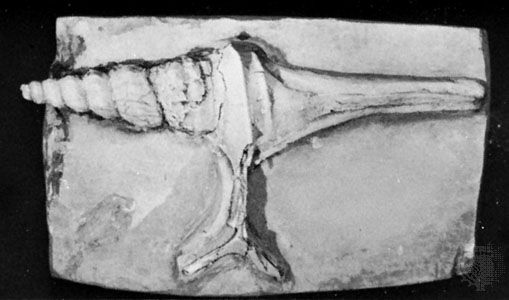
Aucella
Aucella is a genus of extinct clams primarily identified through fossils found in marine sedimentary rocks dating to the Jurassic Period, which occurred…
What is Aucella?
Aucella is a genus of extinct clams primarily identified through fossils found in marine sedimentary rocks dating to the Jurassic Period, which occurred approximately 176 million to 146 million years ago.1
These bivalves are characterized by a distinct teardrop-shaped shell featuring a pattern of concentric ribs. Additionally, the apex of one valve is typically curved over the other. A well-known species within this genus is Aucella piochii.1
What are index fossils and why are they important?
An index fossil is any plant or animal preserved in the Earth’s rock record that serves as a marker for a specific span of geologic time or a particular environment.2
To be considered a useful index fossil, a specimen should ideally possess the following characteristics:
- Short temporal range: The species existed for a relatively brief period, ensuring its presence indicates a specific moment in history.23
- Wide geographic distribution: It is found globally, allowing for the correlation of separated rock layers.23
- Abundance: The fossil is common enough to be easily discovered.23
- Distinctiveness: It is easily recognizable, which helps prevent misidentification.23
These fossils are essential to stratigraphy because they provide the basis for defining boundaries in the geologic time scale and for the correlation of rock strata across different regions. By applying the principle of faunal succession, geologists can determine the relative age of fossiliferous rocks based on the unique assemblages of life forms they contain.23
How do scientists determine the age of fossils like Aucella?
Scientists determine the age of fossils like Aucella using two primary methods: relative dating and absolute dating.
Relative Dating
Through biostratigraphy, scientists identify fossils within sedimentary rock layers to determine their relative age. By using index fossils—which are abundant, widespread, and existed for a short, well-defined period—geologists can correlate rock strata across different regions. Because Aucella is characteristic of the Jurassic Period, its presence in a rock layer helps place that layer within a specific window of geologic time.2415
Absolute Dating
To calibrate the fossil record and determine a precise age in years, scientists use isotopic dating. This method measures the ratio of radioactive parent atoms to stable daughter atoms within minerals. Because radioactive decay occurs at a constant, known rate, geochronologists can calculate the time elapsed since a rock or mineral formed. While fossils themselves are found in sedimentary rocks, absolute ages are typically obtained from igneous minerals that cool and crystallize, providing a “clock” that calibrates the relative timeline established by fossils.61
What other types of marine life lived during the Jurassic Period?
Marine life during the Jurassic Period was characterized by significant recovery and diversification following the Triassic-Jurassic mass extinction. The era saw the rise of modern marine ecosystems and the beginning of the “Mesozoic Marine Revolution,” an evolutionary arms race between predators and prey.
Plankton and Invertebrates
- Plankton: Significant groups like coccolithophores and foraminifera radiated rapidly, fundamentally changing ocean geochemistry and deep-sea sediments.8
- Mollusks: These became dominant in both the water column and on the seafloor. Common forms included ammonites, squidlike belemnites, bivalves (such as oysters and scallops), and gastropods.8
- Echinoderms: Crinoids, sea urchins, and starfish were common. Notably, irregular echinoids evolved the ability to burrow into sediment.8
- Arthropods: The first true crabs and lobsters appeared during this period.8
Vertebrates
- Fish: Both cartilaginous and bony fishes were abundant. The largest bony fish to ever live, Leedsichthys, inhabited Jurassic seas.910
- Marine Reptiles: Large reptiles were common, including ichthyosaurs, long-necked plesiosaurs, and massive carnivorous pliosaurs.910
Sources
- Aucella — Encyclopædia Britannica
- index fossil — Encyclopædia Britannica
- dating - Principles and techniques — Encyclopædia Britannica
- Ordovician Period - Correlation of Ordovician strata — Encyclopædia Britannica
- dating - Principles of isotopic dating — Encyclopædia Britannica
- biostratigraphy — Merriam-Webster
- dating - Distinctions between relative-age and absolute-age measurements — Encyclopædia Britannica
- Jurassic Period - Marine life — Encyclopædia Britannica
- Jurassic Period - Protists and invertebrates — Encyclopædia Britannica
- Jurassic Period - Vertebrates — Encyclopædia Britannica
Published on · 3 min read