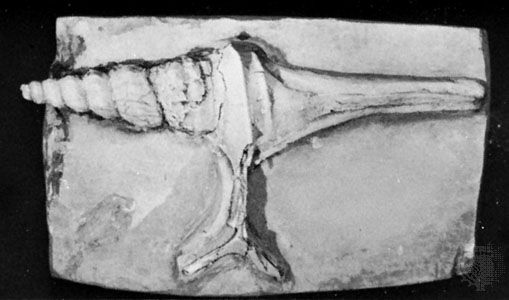
Daonella
Daonella is a genus of extinct pelecypods, or clams, that serves as a valuable index fossil for identifying Triassic rock layers.
What is Daonella?
Daonella is a genus of extinct pelecypods, or clams, that serves as a valuable index fossil for identifying Triassic rock layers.1
These organisms are distinguished by their circular shells, which feature a wide dorsal region and fine, radiating, riblike lineations. They may also exhibit delicate growth lines across their structure.1
What are index fossils and why are they important?
An index fossil is any plant or animal preserved in the Earth’s rock record that is characteristic of a specific span of geologic time or a particular environment.2
To be considered a useful index fossil, a specimen should ideally possess the following characteristics:
- Distinctiveness: It must be easily recognizable to avoid misidentification.23
- Abundance: The population should be sufficiently common to make discovery highly probable.23
- Wide Distribution: It should have a broad geographic range, allowing for correlation across different regions.23
- Short Temporal Range: The species must have existed for a relatively brief period in geologic history, ensuring that its presence in two separated rock layers indicates they were formed at the same time.23
Index fossils are essential because they serve as the foundation for defining boundaries in the geologic time scale and for the correlation of rock strata. By applying the principle of faunal succession, geologists can use these fossils to determine the relative age of fossiliferous rocks.23
What characterizes the Triassic period?
The Triassic Period (252.2 to 201.3 million years ago) was the first period of the Mesozoic Era, following the largest mass extinction in Earth’s history.45
Geography and Climate
At the start of the period, nearly all landmasses were joined into the supercontinent of Pangea. The climate was generally warm and dry, characterized by widespread aridity and a lack of polar ice. However, a monsoonal climate developed over large areas, bringing seasonal precipitation. By the end of the period, plate tectonic activity increased, initiating continental rifting.456
Life and Evolution
The Triassic was a time of biological recovery and radiation:
- Marine Life: As sea levels rose, continental shelves were colonized by large marine reptiles and modern-style reef-building corals.45
- Terrestrial Life: Reptiles diversified, leading to the appearance of the first dinosaurs and, by the end of the period, the first mammals.45
- Flora: Gymnosperms like cycads and ginkgoes dominated, while conifers formed the upper forest canopy.7
The period concluded with another mass extinction, which significantly reduced populations of ammonoids, important index fossils for the era.45
How do scientists classify extinct mollusks?
Scientists classify extinct mollusks primarily by analyzing their physical remains, as the soft tissues of these organisms are rarely preserved in the fossil record. Because mollusks are often characterized by their shells, paleontologists rely on specific morphological features to determine their taxonomic placement.8910
Key Methods of Classification
- Shell Morphology: For groups like bivalves, researchers examine shell structure, the arrangement of hinge teeth, and the overall body form as interpreted from internal muscle scars.8
- Microstructure and Mineralogy: The composition and microscopic structure of the shell provide evidence that helps confirm evolutionary relationships and define subclasses.8
- Comparative Anatomy: When possible, paleontologists compare fossilized features with those of living relatives to infer biological functions, such as feeding habits or locomotion.89
- Stratigraphic Correlation: Extinct mollusks, particularly ammonoids, are often used as index fossils. Their rapid evolution and wide geographic distribution allow scientists to date rock layers and correlate them across different regions.112
Taxonomic Challenges
Classification remains an evolving field. Because the basic molluscan body plan is highly plastic, different lineages have frequently undergone parallel evolution, resulting in similar shell shapes that can complicate the identification of higher taxonomic categories. Consequently, modern specialists continue to refine these systems as new fossil evidence emerges.891213
Sources
- Daonella — Encyclopædia Britannica
- index fossil — Encyclopædia Britannica
- dating - Principles and techniques — Encyclopædia Britannica
- A Journey Through Time Since the Precambrian - Triassic Period: 252.2 million to 201.3 million years ago — Encyclopædia Britannica
- Triassic Period - Plants — Encyclopædia Britannica
- Triassic Period — Encyclopædia Britannica
- Triassic Period - Paleoclimate — Encyclopædia Britannica
- bivalve - Classification — Encyclopædia Britannica
- mollusk - Annotated classification — Encyclopædia Britannica
- list of mollusks — Encyclopædia Britannica
- cephalopod - Annotated classification — Encyclopædia Britannica
- mollusk - Critical appraisal — Encyclopædia Britannica
- bivalve - Evolution and paleontology — Encyclopædia Britannica
- index fossil — Merriam-Webster
Published on · 3 min read