Baculites
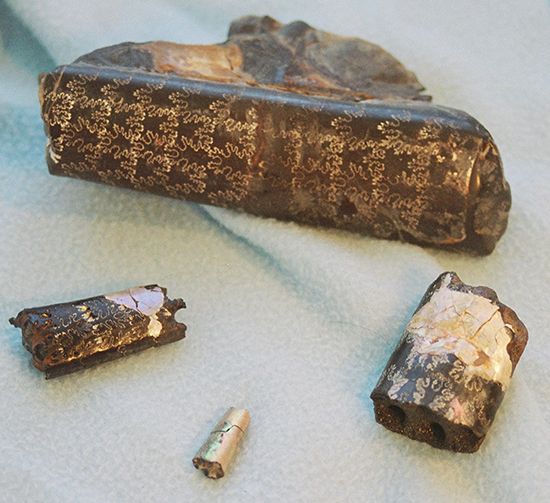
Baculites is a genus of extinct cephalopods that lived during the Late Cretaceous period, approximately 99.6 million to 65.5 million years ago. These…
What is Baculites?
Baculites is a genus of extinct cephalopods that lived during the Late Cretaceous period, approximately 99.6 million to 65.5 million years ago. These creatures are related to modern animals such as the squid, octopus, and nautilus.1
Characterized by a shell that begins with a tightly coiled portion before extending into a straight, tapering rod, Baculites also features a complex ammonite sutural pattern. Because they were restricted to a specific geological timeframe, they serve as an excellent index fossil for identifying and dating Late Cretaceous marine rocks.12
What are index fossils and why are they important?
An index fossil is any plant or animal preserved in the Earth’s rock record that serves as a marker for a specific environment or span of geologic time. To be considered a useful index fossil, a specimen must meet several criteria: it must be easily recognizable, abundant, widely distributed geographically, and possess a short range through time due to rapid evolution.3
These fossils are essential to geology because they provide the foundation for defining boundaries within the geologic time scale and allow scientists to perform stratigraphic correlation—the process of matching rock layers from different locations based on their fossil content.34
Common examples include:
- Marine organisms: Single-celled Protista and ammonoids.
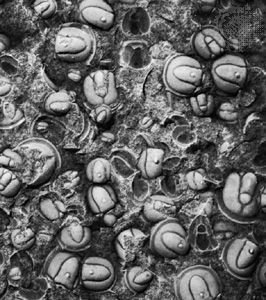
- Trilobites: Specifically the order Agnostida, which are valued for their intercontinental distribution.34
- Conodonts: Excellent for global biostratigraphy in rocks ranging from the uppermost Cambrian to the Triassic4.
How do ammonites differ from modern cephalopods like the nautilus?
Ammonoids and modern cephalopods differ significantly in their evolutionary history, anatomy, and lifestyle. While the modern nautilus is a distant relative, it is the only living cephalopod that retains an external shell similar to the extinct ammonoids.
Key Differences
- Shell and Suture Patterns: Ammonoids are distinguished from nautiloids by the highly complex, crenulated suture patterns where their internal partitioning walls meet the outer shell. In contrast, the nautilus has a simpler structure. Furthermore, while ammonoids and nautiloids relied on external shells for protection, most modern cephalopods—such as squids, octopuses, and cuttlefishes—have evolved internal, degenerate shells or lost them entirely to support a more active, predatory lifestyle.567
- Lifestyle and Physiology: Ammonoids were generally sluggish, shallow-water bottom dwellers. Modern coleoids (squids, octopuses, and cuttlefishes) have developed vigorous, active lifestyles, featuring complex nervous systems, efficient eyes with lenses, and closed circulatory systems with three hearts.6
- Defense Mechanisms: Unlike the nautilus and the extinct ammonoids, most modern cephalopods possess an ink sac used to eject fluid as a defensive measure.6
What was the marine environment like during the Late Cretaceous period?
During the Late Cretaceous, the marine environment was defined by significantly higher sea levels—roughly 200 to 250 meters higher than today—which caused widespread flooding of continental margins and the creation of shallow epicontinental seas across much of the globe.8
The world’s oceans were characterized by three distinct geographic subdivisions: the northern boreal, the southern boreal, and the warmer Tethyan region. The Tethyan region was notable for its rudist bivalve reefs, colonial corals, and specific ammonites. In contrast, cooler boreal waters were home to belemnites and various reclining bivalves.89
Marine life was highly productive, particularly regarding plankton. The massive accumulation of coccolithophores during this time resulted in the deposition of thick chalk beds. Predators were diverse, including large teleost fishes and marine reptiles such as mosasaurs, plesiosaurs, and ichthyosaurs. Due to constricted ocean basins and minimal temperature gradients between the poles and the Equator, bottom waters often experienced anoxic conditions, leading to the formation of black shales.9108
Sources
- Baculites — Encyclopædia Britannica
- Baculites — Merriam-Webster
- index fossil — Encyclopædia Britannica
- Cambrian Period - Correlation of Cambrian strata — Encyclopædia Britannica
- ammonoid — Encyclopædia Britannica
- cephalopod - Form and function — Encyclopædia Britannica
- cephalopod - Evolution and paleontology — Encyclopædia Britannica
- Cretaceous Period - Paleogeography — Encyclopædia Britannica
- Cretaceous Period - Marine life — Encyclopædia Britannica
- Cretaceous Period — Encyclopædia Britannica
- Cretaceous Period - Mass extinction — Encyclopædia Britannica
Published on · 3 min read