Ben Lomond
The name Ben Lomond refers to two distinct geographical features:
What is Ben Lomond?
The name Ben Lomond refers to two distinct geographical features:
- In Scotland: It is a mountain standing 3,192 feet (973 meters) high in south-central Scotland, located on the eastern shore of Loch Lomond.1
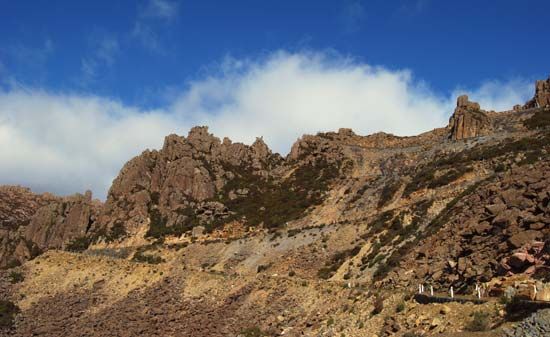
- In Australia: It is a mountain mass and plateau in northeastern Tasmania. Composed of igneous rock, it contains the highest land in the state, reaching 5,161 feet (1,573 meters) at Legge Peak. The area is protected within a national park and serves as a prominent winter-sports destination.2
The Australian mountain was named in 1804 by Lieutenant Colonel William Paterson in honor of the Scottish peak.2
What is the difference between a mountain and a plateau?
While both mountains and plateaus are tectonic landforms created by similar geological processes—such as volcanism, crustal shortening, and thermal expansion—they are distinguished primarily by their surface topography and relief.45
Mountains
A mountain is a landform that rises prominently above its surroundings. Key characteristics include:6
- Topography: They generally exhibit steep slopes and a relatively confined, narrow summit area.6
- Relief: They are defined by considerable local relief, meaning there is a significant difference in elevation between the base and the peak.6
- Distribution: Mountains rarely occur in isolation; they are typically found in elongated ranges or chains.6
Plateaus
A plateau is an extensive area of flat upland. Key characteristics include:7
- Topography: Unlike the rugged, peaked nature of mountains, plateaus are characterized by being remarkably flat.7
- Relief: The essential criterion for a plateau is low relative relief, even though it stands at a higher elevation than the surrounding terrain.7
- Boundaries: They are usually bounded by an escarpment (a steep slope) on all sides, though they can sometimes be enclosed by mountain ranges.7
While both features can be formed by the same tectonic forces, mountains are defined by their vertical prominence, whereas plateaus are defined by their broad, elevated, and level surfaces.47
How are igneous rocks formed?
Igneous rocks are formed through the cooling and solidification of molten or partially molten earth material known as magma. This process occurs in two primary environments, which determine the rock’s texture and classification:1112
- Intrusive (Plutonic) Rocks: These form when magma cools slowly deep within the Earth’s crust. Because of the high temperatures and pressures at these depths, the magma crystallizes completely, allowing mineral grains to grow large enough to be seen with the unaided eye, a texture known as phaneritic.1213
- Extrusive (Volcanic) Rocks: These form when magma erupts at the surface as lava or is ejected as pyroclastic material. Because the material is chilled rapidly upon exposure to the surface, individual minerals have little time to grow, resulting in a fine-grained aphanitic texture or a glassy, non-crystalline structure.1213
Some intrusive rocks, called hypabyssal, form closer to the surface where cooler temperatures lead to more rapid cooling and finer grain sizes.12
What are some famous national parks in Australia?
Australia is home to a diverse array of national parks, many of which are recognized as UNESCO World Heritage sites for their immense aesthetic, historical, and scientific significance.15
Some of the most notable national parks in Australia include:
- Kakadu National Park: Located in the Northern Territory, this vast region is renowned for its rich biodiversity, ancient rock art sites, and diverse landforms, including escarpments and floodplains.1516
- Uluru–Kata Tjuta National Park: Also in the Northern Territory, this park is home to the iconic monolith Uluru/Ayers Rock and the rock formations known as the Olgas, both of which hold deep cultural significance for Aboriginal peoples.1517
- Blue Mountains National Park: Situated in New South Wales, this park protects a rugged sandstone plateau within the Great Dividing Range, famous for its scenic beauty and eucalyptus forests.1518
- Franklin-Gordon Wild Rivers National Park and Southwest National Park: These parks are key components of the Tasmanian Wilderness, known for their pristine, rugged landscapes.1519
- Morton National Park and New England National Park: These are additional examples of protected areas that showcase the topographical diversity found across the Australian continent.19
Sources
- Lomond, Ben — Merriam-Webster
- Ben Lomond — Encyclopædia Britannica
- Ben Lomond — Merriam-Webster
- list of mountains — Encyclopædia Britannica
- plateau — Merriam-Webster
- mountain - Residual mountain ranges and thermally uplifted belts — Encyclopædia Britannica
- mountain — Merriam-Webster
- tectonic landform — Encyclopædia Britannica
- plateau — Encyclopædia Britannica
- plateau - Formative processes — Encyclopædia Britannica
- rock: Top Questions — Encyclopædia Britannica
- igneous rock — Encyclopædia Britannica
- igneous rock - Classification of volcanic and hypabyssal rocks — Encyclopædia Britannica
- igneous rock - Crystallinity — Encyclopædia Britannica
- Australia - Land of Australia — Encyclopædia Britannica
- Kakadu National Park — Encyclopædia Britannica
- Uluru/Ayers Rock — Encyclopædia Britannica
- List of national parks - Australia — Encyclopædia Britannica
- Blue Mountains — Encyclopædia Britannica
Published on · 3 min read