Biogenic Landform
Climate change significantly influences the formation and preservation of biogenic landforms, which are topographic features created by the activities of…
How do climate changes affect the formation and preservation of biogenic landforms?
Climate change significantly influences the formation and preservation of biogenic landforms, which are topographic features created by the activities of organisms.1
Impacts on Marine Biogenic Landforms
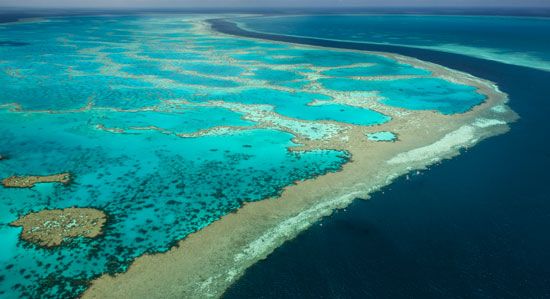
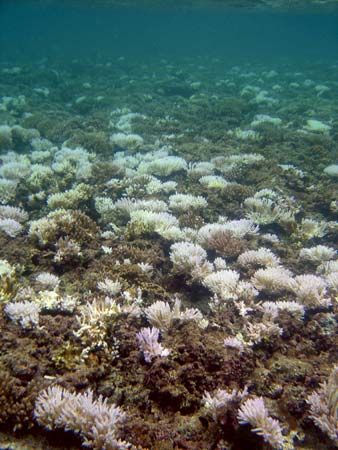
Coral reefs are highly sensitive to climatic shifts. Rising seawater temperatures are a primary driver of coral bleaching, a process where corals expel their symbiotic algae, often leading to reef degradation. Furthermore, ocean acidification—caused by the absorption of atmospheric carbon dioxide—reduces the availability of carbonate ions. This hinders the ability of corals and other calcifying organisms to build and maintain their skeletons, threatening the structural integrity of reefs.23
Impacts on Terrestrial and Wetland Landforms
Climate change alters the distribution and stability of wetlands, which are often shaped by biological and geological interactions.45
- Permafrost: In polar and high-altitude regions, permafrost sustains vast peatlands and bogs. Warming temperatures threaten these landforms by causing the ground to thaw, which can lead to the decomposition of stored carbon and the release of greenhouse gases.45
- Hydrology: Changes in precipitation patterns affect wetlands fed by surface water or groundwater. Drier climates can cause wetlands to shrink or disappear, while wetter conditions may allow for expansion, provided topography permits.4
How do biogenic landforms impact local ecosystems and biodiversity?
Biogenic landforms—topographic features created by the activities of organisms—play a fundamental role in shaping local ecosystems and supporting biodiversity by providing essential habitats and modifying environmental conditions.1
Habitat Creation and Structural Complexity
Biogenic landforms often serve as the physical foundation for diverse biological communities. For instance, coral reefs are built by the interaction of corals, algae, and bryozoa, creating a complex calcium carbonate matrix that supports some of the most complex ecosystems on Earth. Similarly, in aquatic environments, beaver activity alters landscapes by impounding stream water, which creates new wetland habitats that support a variety of species.1910
Environmental Modification
These landforms significantly influence local environmental dynamics:
- Oxygenation and Nutrient Cycling: Burrowing animals, such as those found in marine sediments, create respiratory currents that “irrigate” their burrows. This process oxygenates the sediment and stimulates the production of benthic producers like diatoms.9
- Soil Development: Organisms contribute to soil structure and chemistry. The presence of specific vegetation can alter soil acidity and humus content, creating distinct “biosequences” that dictate the local flora and fauna that can thrive in a given area.11
- Micro-topography: Features like termite mounds or crayfish burrows create micro-topography that provides specialized niches, allowing for greater species diversity within a localized area.1
What is the difference between biogenic and abiogenic landforms?
The primary difference between biogenic and abiogenic landforms lies in their origin and the processes responsible for their creation.
Biogenic Landforms
Biogenic landforms are topographic features directly attributed to the activity of organisms. These range in scale from micro-topography, such as crayfish burrows or termite mounds, to massive structures like organic reefs formed by the interaction of corals, algae, and bryozoa. In modern times, human activity has become a dominant force in creating biogenic landforms, including the construction of superhighways, dams, and open-pit mines, as well as indirect effects like land subsidence caused by groundwater extraction.115
Abiogenic Landforms
In contrast, most landforms are the result of physical and chemical processes that occur independently of biological activity. These are typically categorized into two groups:
- Tectonic Landforms: Created by the vertical movement and subsidence of the Earth’s crust or the extrusion of magma. Examples include mountains, plateaus, and volcanic cones.15
- Structural (Denudational) Landforms: Formed by the erosional and depositional actions of external agents such as wind, water, ice, and gravity. Familiar examples include sand dunes, fjords, beaches, and river valleys.15
While biological processes can play an auxiliary role in rock weathering—such as through root wedging or the production of humic acid—the fundamental classification of a landform as biogenic depends on whether its existence is primarily a consequence of organic activity.1
What are some examples of biogenic landforms created by microorganisms?
Microorganisms play a significant role in creating biogenic landforms, most notably through the formation of stromatolites.
Stromatolites
Stromatolites are layered, sedimentary structures—typically composed of limestone—that are formed by the growth of cyanobacteria (primitive, one-celled organisms often referred to as blue-green algae). These structures are characterized by thin, alternating light and dark layers that can be flat, dome-shaped, or hummocky. The layers are created through two primary processes:
- Sediment Trapping: The trapping of sediment washed up during storm events.1
- Mineral Precipitation: The active precipitation of limestone by the cyanobacteria themselves.1
While these structures were common during the Precambrian period (more than 542 million years ago) and represent some of the earliest life on Earth, they still form today in specific environments, such as Shark Bay in Western Australia, where high salt concentrations protect the microbial mats from grazers.1
Beyond these specific structures, microorganisms also contribute to broader topographic changes by facilitating rock weathering, such as through the production of humic acid during organic decay, which contributes to the formation of karst landscapes.18
Sources
- biogenic landform — Encyclopædia Britannica
- Wetland - Effects of climate change — Encyclopædia Britannica
- Wetland - Origin of wetlands — Encyclopædia Britannica
- ocean acidification — Encyclopædia Britannica
- coral reef - Winds , currents, temperature, and salinity — Encyclopædia Britannica
- valley - Role of climatic change — Encyclopædia Britannica
- Climate change - Climate change through geologic time — Encyclopædia Britannica
- coral reef - Coral bleaching — Encyclopædia Britannica
- Wetland - Natural disturbances — Encyclopædia Britannica
- coastal landforms — Encyclopædia Britannica
- soil - Biological phenomena — Encyclopædia Britannica
- Inland water ecosystem - Biological productivity — Encyclopædia Britannica
- soil - Organisms — Encyclopædia Britannica
- Marine ecosystem - Benthos — Encyclopædia Britannica
- landform — Encyclopædia Britannica
- geology - Geomorphology — Encyclopædia Britannica
- geology — Encyclopædia Britannica
- stromatolite — Encyclopædia Britannica
- stromatolite — Merriam-Webster
Published on · 4 min read