Coral Reef
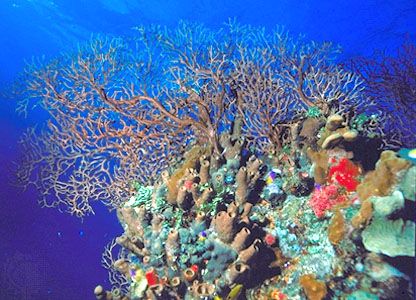
Coral reefs are complex structures primarily built by colonial stony corals that secrete rigid skeletons of calcium carbonate. These polyps grow in colonies…
How do coral reefs form and what geological conditions are necessary for their growth?
Coral reefs are complex structures primarily built by colonial stony corals that secrete rigid skeletons of calcium carbonate. These polyps grow in colonies, with their skeletons accumulating over time to form a limestone framework, supplemented by calcareous algae, mollusks, and other organisms that bind the structure together.1
Necessary Geological and Environmental Conditions
Reef-building corals require specific conditions to thrive:
- Temperature: They flourish in waters with annual mean temperatures between 23–25 °C (73–77 °F), generally avoiding areas where temperatures drop below 18 °C (64 °F).2
- Light and Depth: Corals require shallow, sunlit water, typically growing best between the low-water mark and 11 metres (36 feet), though they can exist down to 55 metres. Light is essential for the symbiotic zooxanthellae that support coral growth.13
- Water Quality: They require clear, well-circulating water with normal oceanic salinity (30–40 parts per thousand).12
Development Processes
Reefs often develop through the subsidence of land or volcanic islands, allowing corals to grow upward to maintain their position in the sunlit zone. Plate-tectonic theory also explains how the ocean floor subsides as it spreads, facilitating reef development.4
What are the main types of coral reefs and how do they differ geologically?
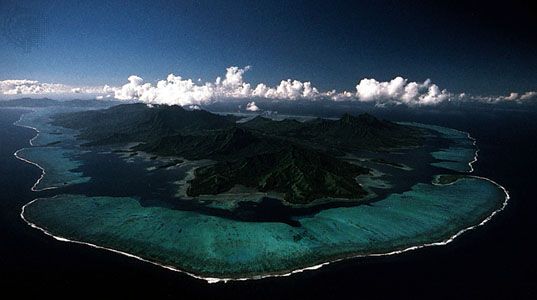
Coral reefs are categorized into four primary types based on their structure and their relationship to adjacent landmasses. These formations are often linked by the process of subsidence, where the upward growth of coral keeps pace with the sinking of a volcanic island or a rise in sea level.52
Main Types of Coral Reefs
- Fringing reefs: These reefs grow directly from the shoreline of a mainland or a volcanic island, forming a flat reef area that skirts the landmass.6
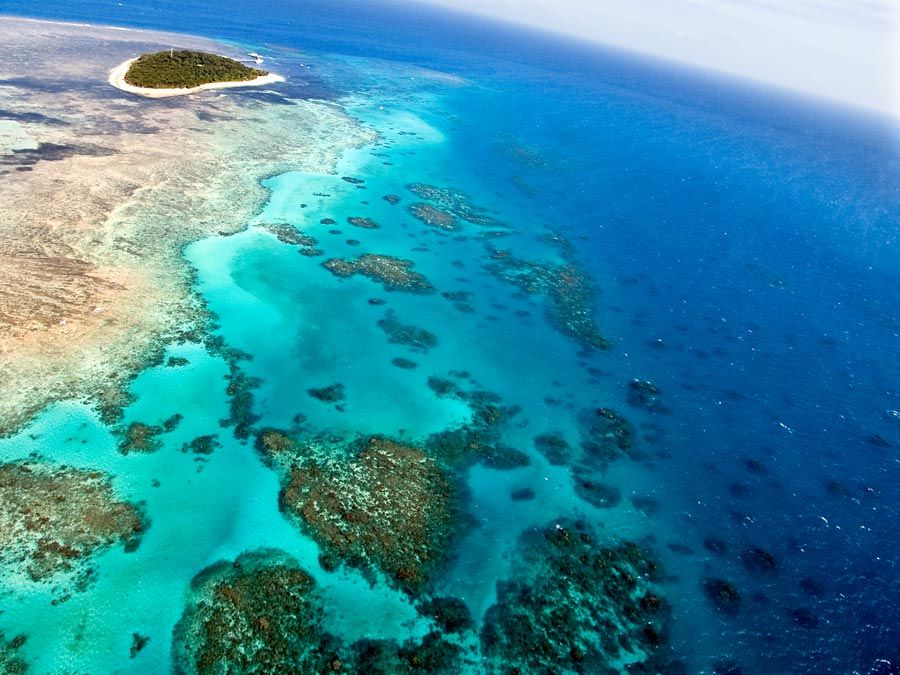
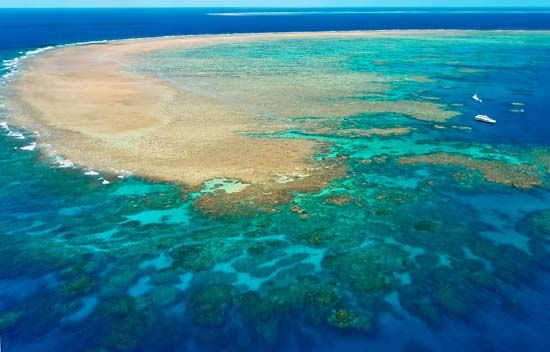
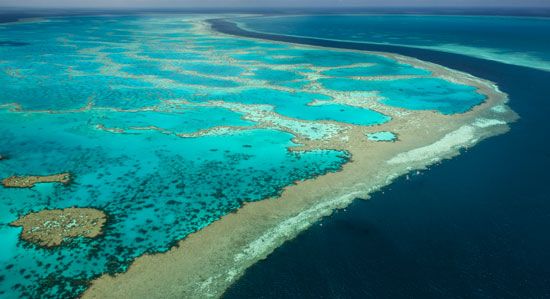
- Barrier reefs: Located further offshore, these reefs are separated from the land by a deep lagoon or channel. They often form complex, linear chains, such as Australia’s Great Barrier Reef5.7
- Atolls: These are circular or closed-loop reefs that enclose a central lagoon but lack a central landmass. They represent the final stage of reef development, where the original volcanic island has completely subsided below the surface.62
- Platform (or patch) reefs: These are isolated, irregular, table-like, or pinnacle-shaped reefs. They can occur within the lagoons of other reef types or as independent developments.6
Geologically, these types represent progressive stages of development. As an island subsides, a fringing reef may evolve into a barrier reef and eventually an atoll.52
How do coral reefs contribute to the formation of islands and atolls?
Coral reefs play a fundamental role in the creation of islands and atolls through two primary mechanisms: the gradual subsidence of volcanic foundations and the physical accumulation of reef-derived material.
The Subsidence Model
As proposed by Charles Darwin, reefs often form around volcanic islands. As the island slowly subsides—due to plate-tectonic movement or the cooling of the ocean floor—the coral continues to grow upward to remain in the sunlit, shallow waters it requires. This process transforms a fringing reef into a barrier reef and, eventually, an atoll once the original volcanic landmass has completely submerged, leaving only the circular reef structure enclosing a lagoon.92
Island Formation via Accretion and Uplift
Beyond the reef structure itself, islands (often called cays) form on top of these reefs through:
- Accretion: Storms and waves break off pieces of limestone and coral skeletons, which accumulate as detritus on the reef flat. Over time, this material is cemented together by dissolved lime, creating stable land that can be colonized by plants.6
- Uplift: Crustal movements can raise a reef system above sea level, turning a previously submarine reef top into a rocky, plateau-like island.6
How do human activities impact the geological integrity of coral reefs?
Human activities significantly compromise the geological integrity of coral reefs through both direct physical destruction and broader environmental changes that hinder the reef’s ability to build and maintain its structure.
Physical Damage and Habitat Destruction
Direct human interference often results in immediate structural degradation:
- Destructive Fishing: The use of explosives and dragnets in commercial fishing scours and breaks apart sections of the reef, destroying the complex habitats that corals provide.11
- Tourism Impacts: Physical contact by visitors can disturb community dynamics, while chemicals from sunscreens and personal care products accumulate in high-traffic areas, promoting viral infections in hard corals.1112
- Sedimentation: Terrestrial erosion caused by human land use leads to excess sediment that “smothers” reefs, blocking sunlight necessary for reef plants and promoting harmful algal blooms.11
Chemical and Climatic Alteration
Anthropogenic climate change and industrial processes alter seawater chemistry, threatening the reef’s foundation:
- Ocean Acidification: The absorption of carbon dioxide from industrial and vehicle emissions reduces the pH of seawater. This lowers the availability of carbonate ions, making it difficult for corals to obtain the raw materials needed to build and maintain their calcium carbonate skeletons.13
- Coral Bleaching: Rising ocean temperatures, linked to global warming, cause corals to expel their symbiotic zooxanthellae. If these algae do not return, the coral colony may die, leading to a loss of structural complexity and leaving the reef vulnerable to invasive species that can permanently alter its structure.1214
We could dive deeper into how specific conservation strategies aim to mitigate these structural threats.
Sources
- coral reef - Corals and other reef-building organisms — Encyclopædia Britannica
- coral reef - Origin and development of reefs — Encyclopædia Britannica
- coral reef - Tropical water conditions — Encyclopædia Britannica
- coral reef - Winds , currents, temperature, and salinity — Encyclopædia Britannica
- coral reef - Types of coral reefs — Encyclopædia Britannica
- atoll — Encyclopædia Britannica
- barrier reef — Encyclopædia Britannica
- lagoon - Coral lagoons — Encyclopædia Britannica
- coral island — Encyclopædia Britannica
- Darwin Rise — Encyclopædia Britannica
- coral reef - Other threats — Encyclopædia Britannica
- Coral bleaching — Encyclopædia Britannica
- coral reef - Coral bleaching — Encyclopædia Britannica
- ocean acidification — Encyclopædia Britannica
- coral reef - Threats to coral reefs — Encyclopædia Britannica
Published on · 4 min read