Cebu
Cebu Island is a destination rich in history and natural beauty. While the island offers diverse landscapes, its most prominent tourist attractions are…
What are some of the most popular tourist attractions on Cebu island?
Cebu Island is a destination rich in history and natural beauty. While the island offers diverse landscapes, its most prominent tourist attractions are centered around its deep-rooted Spanish colonial heritage and its unique geography.
Historical Landmarks
As the site of the first Spanish settlement in the Philippines, Cebu City serves as the primary hub for historical tourism. Visitors can explore:
- Fort San Pedro: Located near the harbour, these ruins are a significant remnant of the Spanish colonial era.1
- Magellan’s Relics: The city houses numerous artifacts and sites commemorating the 1521 arrival of Ferdinand Magellan, who introduced Christianity to the region.21
Natural Attractions
For those interested in the island’s environment, the following areas are notable:
- Central Cebu National Park: Established in 1937, this park protects the island’s last remaining forest area, spanning the region between Balamban, Toledo, and Cebu City.2
- Sanctuaries: The island also features a dedicated game and bird sanctuary for wildlife enthusiasts.2
How does Cebu’s economy contribute to the Philippines’ overall economic landscape?
Cebu serves as a vital economic pillar for the Philippines, functioning as the primary commercial and cultural hub of the central Visayan region. Its economic contributions are multifaceted, spanning trade, manufacturing, and services.2
Trade and Logistics
Cebu City is a bustling port and a major collection center for interisland commodities, including copra, abaca, sugar, timber, and fishaca](https://www.britannica.com/plant/abaca), sugar, timber, and fish. As a key node for both air and sea passenger traffic, the island facilitates significant domestic and international movement, supported by an international airport located on Mactan Island international airport located on Mactan Island.2
Manufacturing and Industry
The island hosts numerous branches of Manila-based commercial and industrial firms. Key manufacturing sectors include:2
- Consumer Goods: Textiles, footwear, processed foods, vegetable oil, furniture, and chemicals.2
- Specialized Products: Cosmetics, candles, jewelry, and musical instruments like guitars and ukuleles.2
- Mining: The central hill country contributes to the national economy through the extraction of coal, copper, gold, silver, and limestone.1
Services and Tourism
Cebu is a central destination for the country’s growing tourism industry, attracting international visitors and contributing to the service sector, which is the largest component of the Philippine GDP.3
What are the main languages spoken in Cebu, and how do they relate to other Filipino languages?
The primary language spoken on Cebu island is Cebuano, which is a member of the Western, or Indonesian, branch of the Austronesian (Malayo-Polynesian) language family. With approximately 18.5 million speakers, it is the second-largest ethnolinguistic group in the Philippines, representing about one-fifth of the country’s population.45
Relationship to Other Filipino Languages
Cebuano is closely related to Hiligaynon (Ilongo) and Waray-Waray. Because of these linguistic similarities, these three are often grouped together as dialects of the Visayan (Bisayan) language group.45
While Cebuano is the dominant language of the central Visayan Islands, its speakers are also spread across eastern Negros, Bohol, western Leyte, the Camotes Islands, and parts of Mindanao. Despite its widespread use in daily life, media, and film, it is less frequently utilized as a formal literary language compared to other major Philippine languages like Tagalog.45
What is the geographical location and size of Cebu island?
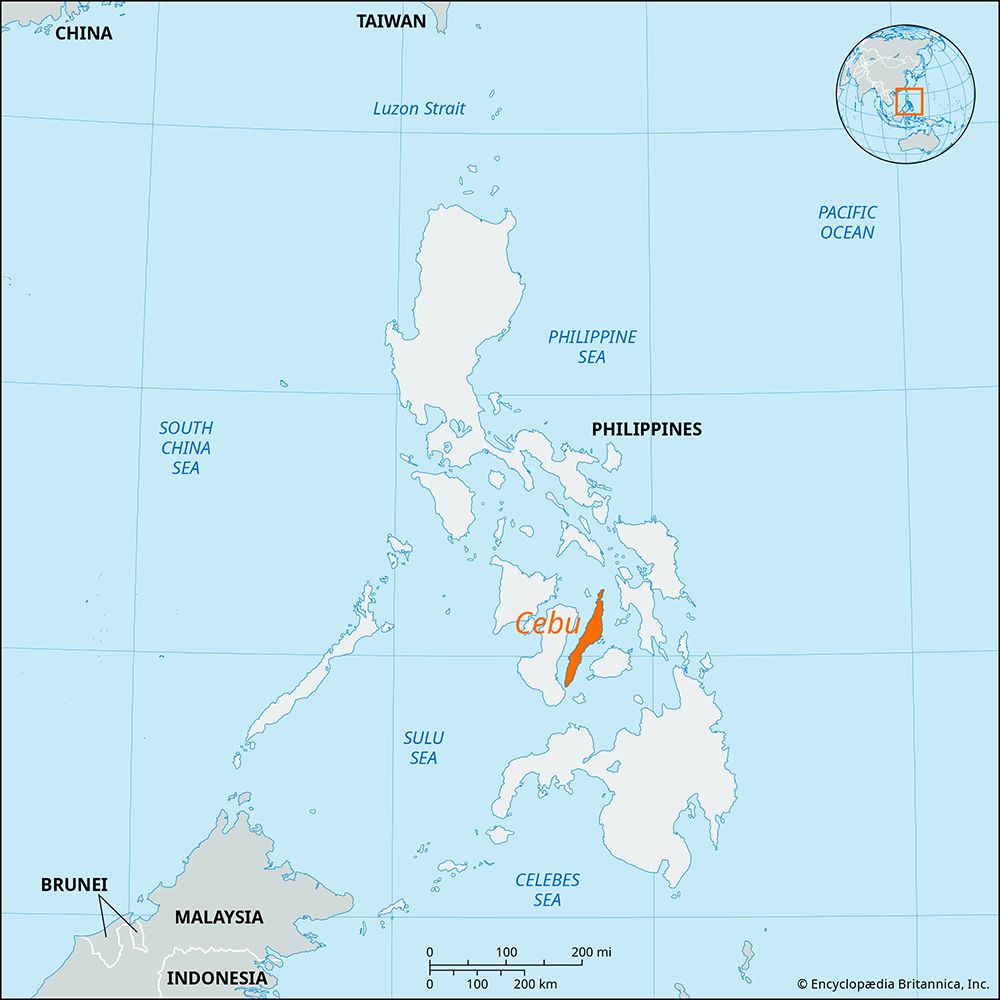
Cebu is an island located in the central Philippines. It is surrounded by several bodies of water: the Visayan Sea to the north, the Tanon Strait to the west, the Bohol Strait to the southeast, and the Camotes Sea to the east.1
Regarding its dimensions and size, the island is 122 miles (196 km) long and does not exceed 20 miles (32 km) in width at any point. The total area of the island is 1,707 square miles (4,422 square km).1
Sources
- Cebu — Encyclopædia Britannica
- Cebu City — Encyclopædia Britannica
- Philippines - Services — Encyclopædia Britannica
- Cebuano language — Encyclopædia Britannica
- Visayan Islands — Encyclopædia Britannica
- Cebuano — Encyclopædia Britannica
Published on · 3 min read