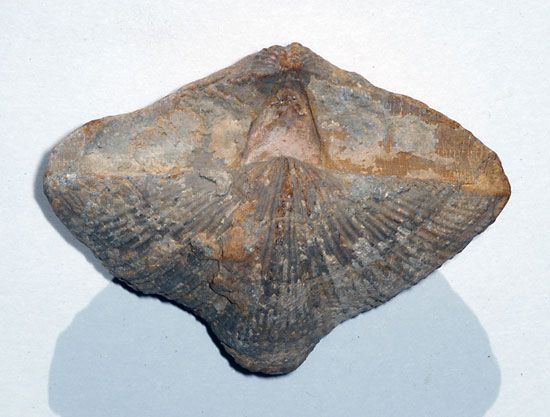
Agnostus
Agnostus is a genus of trilobites, which were extinct aquatic arthropods. These organisms lived from the Early Cambrian to the Late Ordovician periods…
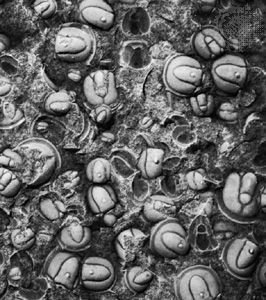
What is Agnostus?
Agnostus is a genus of trilobites, which were extinct aquatic arthropods. These organisms lived from the Early Cambrian to the Late Ordovician periods, approximately 540 to 438 million years ago.1
Key characteristics of Agnostus include:
- Size: They were very small, typically measuring about 6 millimeters (0.25 inch) in length.1
- Anatomy: They lacked eyes and possessed only two thoracic segments along with a large tail segment.1
- Appearance: The anterior (head) and posterior (tail) regions are so similar that they are often difficult to distinguish.1
The name is derived from the Greek word agnōstos, meaning “unknown.” These trilobites are part of the order Agnostida, a group of highly specialized forms.2
What are the main characteristics of trilobites?
Trilobites are a group of extinct, exclusively marine arthropods that first appeared approximately 521 million years ago during the Cambrian Period. They are characterized by several distinct features:
- Body Structure: They are easily recognized by their three-lobed, three-segmented form. The body is divided longitudinally into a central axial lobe with two side lobes, and segmented into three regions from head to tail: the cephalon (head), the thorax, and the pygidium (tail).3
- Exoskeleton: Like other arthropods, they possessed a hard exoskeleton made of chitinous material. Because this shell had to be shed for the animal to grow, fossilized molted exoskeletons are relatively common.3
- Appendages and Senses: Each body segment featured a pair of jointed appendages. The forwardmost appendages were modified for feeding and sensing. While many trilobites possessed compound eyes, some species were eyeless.3
- Diversity: Trilobites varied significantly in size, ranging from very small forms to large specimens exceeding 45–61 cm in length. Their lifestyles were equally diverse, including active predators, scavengers, and plankton feeders.34
How do scientists use fossils to date rock layers?
Scientists use fossils to date and correlate rock layers primarily through the law of faunal succession, which observes that groups of fossilized plants and animals appear in the rock record in a predictable, orderly sequence over time.67
Key Methods for Dating and Correlation
- Index Fossils: These are the most effective tools for dating. To be useful, an index fossil must be easily recognizable, abundant, widely distributed geographically, and have a short temporal range (meaning the species existed for only a brief period). Their presence in separated rock outcrops indicates that those layers were formed during the same interval of geologic time.87
- Biozones: Geologists refine these dates by identifying zones—intervals defined by the first and last appearances of specific species. By analyzing the overlapping ranges of various fossils, scientists can create a precise biochronology that allows for detailed correlation between different regions.9
- Calibration with Absolute Dating: While fossils provide relative ages, they are often calibrated using absolute dating techniques. By measuring the decay of radioactive isotopes in minerals found within or near fossiliferous rocks, scientists can assign specific numerical ages to the fossil record.10
What other types of creatures lived during the Cambrian Period?
The Cambrian Period (541 to 485.4 million years ago) was marked by the Cambrian explosion, an unparalleled emergence of diverse animal life. While trilobites were numerically dominant, the marine ecosystems of the time were home to a wide array of other creatures.1213
Diverse Cambrian Fauna
- Sponges: These were highly diverse, including the archaeocyathids, which were the first animals to build carbonate reefs.1213
- Mollusks: Early representatives appeared, including classes such as Gastropoda and Cephalopoda, though their shells are often rare in the fossil record.13
- Arthropods: Beyond trilobites, many other arthropods existed, including scavenging species and the relatively large carnivore Anomalocaris.1214
- Brachiopods: Often called lamp shells, these were common in continental-shelf deposits and are second only to trilobites in the number of described Cambrian species.13
- Echinoderms: This group underwent a major adaptive radiation, increasing from three to eight classes during the period.13
- Chordates: Rare, early chordates appeared, including primitive jawless fish.1213
- Unique Forms: Exceptional fossil sites like the Burgess Shale reveal unusual creatures such as the five-eyed Opabinia, the spiny Hallucigenia, and the plated Wiwaxia.15
Sources
- Agnostus — Encyclopædia Britannica
- Agnostus — Merriam-Webster
- trilobite — Encyclopædia Britannica
- Devonian Period - Invertebrates — Encyclopædia Britannica
- Deiphon — Encyclopædia Britannica
- index fossil — Encyclopædia Britannica
- law of faunal succession — Encyclopædia Britannica
- dating - Principles and techniques — Encyclopædia Britannica
- dating - Distinctions between relative-age and absolute-age measurements — Encyclopædia Britannica
- Cambrian Period - Correlation of Cambrian strata — Encyclopædia Britannica
- geochronology - Stages and zones — Encyclopædia Britannica
- Cambrian explosion — Encyclopædia Britannica
- Cambrian explosion — Merriam-Webster
- Burgess Shale — Encyclopædia Britannica
- Cambrian Period - Fossil record of the Precambrian-Cambrian transition — Encyclopædia Britannica
- A Journey Through Time Since the Precambrian - Cambrian Period: 541 million to 485.4 million years ago — Encyclopædia Britannica
- Cambrian Period - Fauna — Encyclopædia Britannica
Published on · 3 min read