Continental Slope
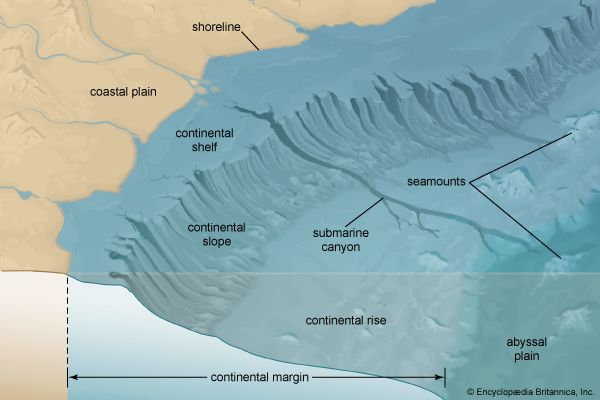
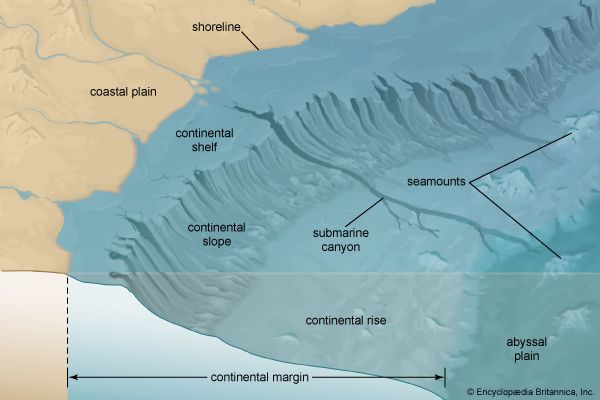
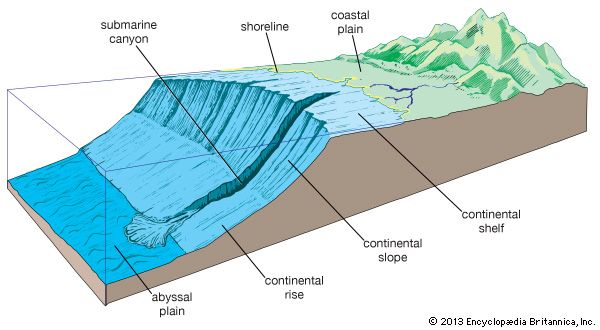
The continental slope serves as a primary site for the development of submarine canyons, which are steep-sided valleys that indent these slopes.
What role does the continental slope play in the formation of submarine canyons?
The continental slope serves as a primary site for the development of submarine canyons, which are steep-sided valleys that indent these slopes.12
The formation and maintenance of these canyons are driven by several key processes occurring along the slope:
- Sediment Instability: Continental slopes act as temporary depositional sites for sediments. As material accumulates, the slope can become unstable, causing the mass to slough off and move downslope, which contributes to the erosion and excavation of these features.2
- Turbidity Currents: The primary agents in forming and maintaining these canyons are turbidity currents—underwater flows of sediment-laden water. These currents are often triggered by the slumping of unconsolidated rock material near the canyon heads.13
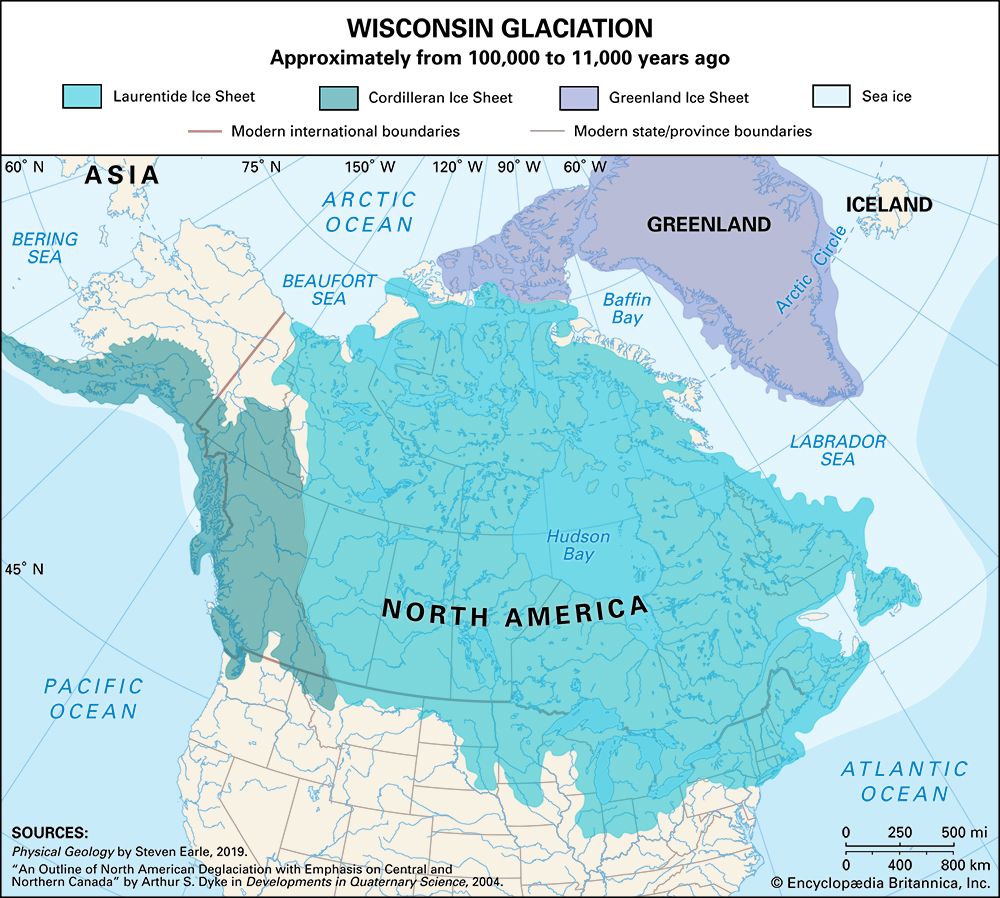
- Historical Erosion: Many canyons originated during the Pleistocene Epoch when lower sea levels allowed rivers to cut into the continental shelf and slope. Today, these systems continue to act as conduits, transporting sediment from the margins to the deep sea.13
What is the average depth range of the continental slope?
The continental slope typically begins at the shelf break—the edge of the continental shelf—and descends to the beginning of the ocean basins.
While depths can vary based on the specific geological setting, the continental slope generally spans a depth range of approximately 100 to 3,200 metres (330 to 10,500 feet). In many regions, this slope eventually merges with the continental rise at depths typically ranging from 4,000 to 5,000 metres (13,000 to 16,500 feet).24
How does the gradient of the continental slope compare to that of the continental shelf?
The continental shelf and the continental slope exhibit significantly different gradients, marking a distinct transition in the seafloor topography:
- Continental Shelf: This area is characterized by a very gentle incline, with an average slope of approximately 0.1°. It extends from the coast to the [shelf break], where the seafloor begins its more pronounced descent.25
- Continental Slope: In contrast, the continental slope is a much steeper zone that descends from the shelf break to the [ocean basins] contrast, the continental slope is a much steeper zone that descends from the shelf break to the [ocean basins]. On average, this slope descends at an angle exceeding 4°.56
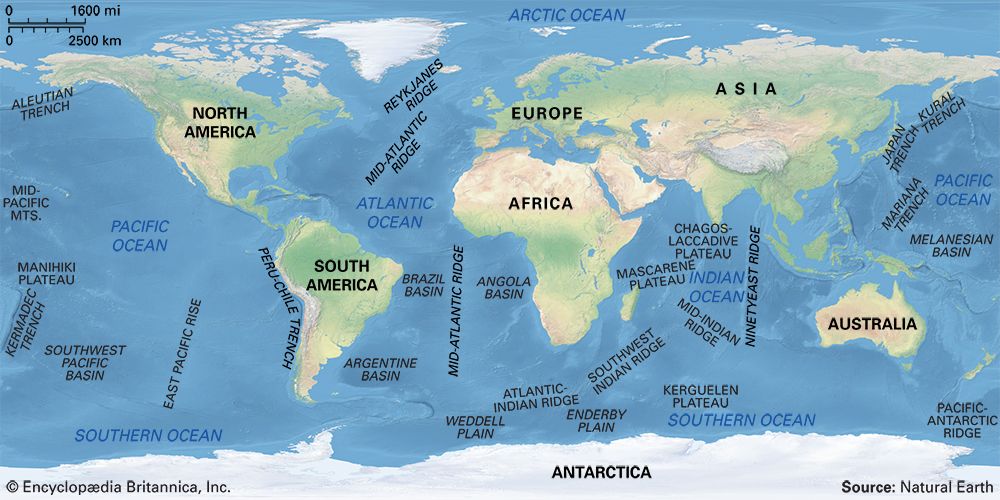
While 4° is the global average, the steepness of the continental slope can vary considerably based on the tectonic setting. It is generally lowest off stable coasts and highest off tectonically active margins, such as those found around the [Pacific Ocean], where the slope can approach vertical2. In such active regions, the slope may drop directly into a [deep-sea trench], whereas on passive margins, it typically transitions into a [continental rise].75
How might climate change and sea-level rise affect the continental slope in the future?
Climate change and sea-level rise significantly impact the continental slope by altering sediment transport, ocean chemistry, and physical stability.
Sedimentation and Sea-Level Fluctuations
The continental slope serves as a temporary site for marine sediment deposition. During periods of high sea level, such as the current Holocene Epoch, coastlines retreat landward, trapping most sediments in estuaries and lagoons. Consequently, the delivery of sediment to the slope slows down. Conversely, during sea-level lowstands, rivers deposit their sedimentary burden directly onto the slope, where it accumulates until the mass becomes unstable and sloughs off into the continental rise via turbidity currents.268
Ocean Warming and Acidification
- Ocean Warming: As the oceans absorb surplus heat, thermal expansion and melting ice contribute to sea-level rise. Warming also reduces dissolved oxygen levels and may destabilize frozen methane hydrates on the seafloor, potentially releasing this potent greenhouse gas into the atmosphere.9
- Ocean Acidification: The absorption of carbon dioxide increases acidity, which threatens marine calcifiers—organisms that build skeletons and shells. This process raises the “saturation horizon,” placing cold-water coral communities often found on continental slopes at risk of dissolution and habitat loss.10
Sources
- submarine canyon — Encyclopædia Britannica
- continental slope — Encyclopædia Britannica
- canyon — Encyclopædia Britannica
- ocean - Major subdivisions of the oceans — Encyclopædia Britannica
- continental shelf - Structure — Encyclopædia Britannica
- continental margin - Margin types — Encyclopædia Britannica
- continental slope — Merriam-Webster
- ocean acidification — Encyclopædia Britannica
- ocean warming — Encyclopædia Britannica
- continental margin — Encyclopædia Britannica
- seawater - The transition stage — Encyclopædia Britannica
- ocean basin - Sedimentation patterns — Encyclopædia Britannica
- Holocene Epoch - Deep oceanic deposits — Encyclopædia Britannica
Published on · 3 min read