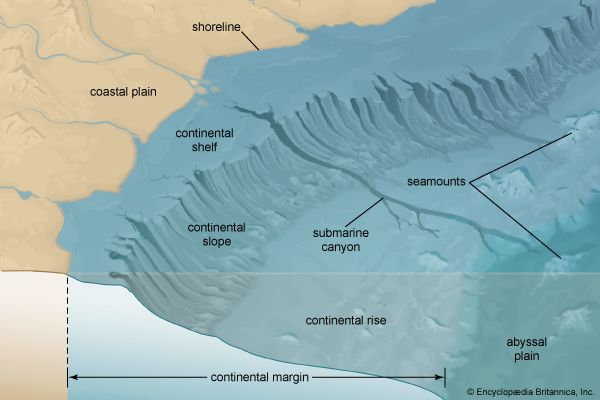
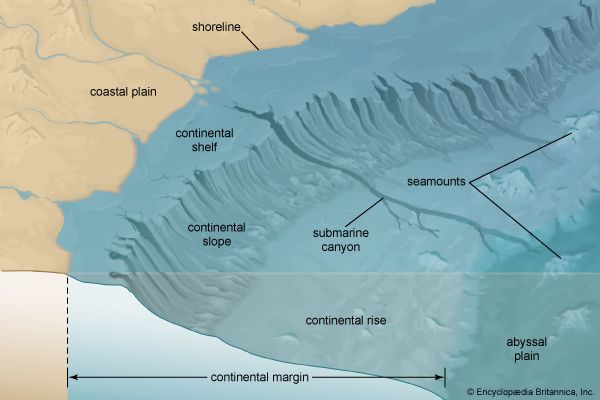
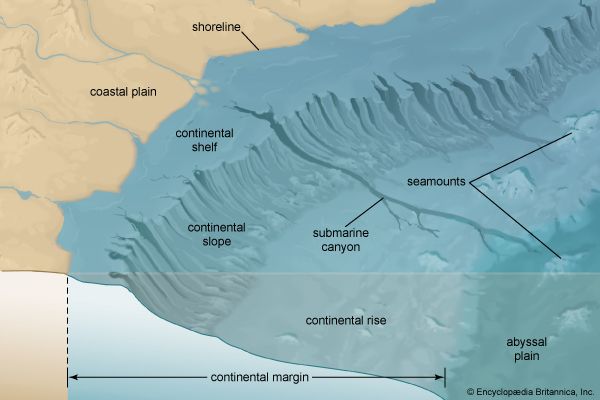
Continental Margin
Continental margins—comprising the continental shelf, continental slope, and continental rise—significantly influence both ocean circulation and marine life.
How do continental margins affect ocean currents and marine ecosystems?
Continental margins—comprising the continental shelf, continental slope, and continental rise—significantly influence both ocean circulation and marine life.1
Impact on Ocean Currents
Margins act as physical boundaries that interact with ocean currents through friction and topography. Dense, cold, or salty water originating in marginal seas or high-latitude shelves can flow downslope as “dense overflows,” which are deflected by the Coriolis force and seafloor drag. Furthermore, major currents like the Florida Current can scour the continental slope, while the interaction between river discharge and coastal currents creates plumes that transport sediments and nutrients across the margin.234
Impact on Marine Ecosystems
Continental margins are among the most productive marine environments. Coastal upwelling, often influenced by margin topography and atmospheric patterns, brings nutrient-rich water to the surface, fueling rapid phytoplankton growth and supporting major fisheries. Additionally, nearshore features like estuaries concentrate small organisms, creating high-activity zones that provide essential food supplies for diverse marine species.567
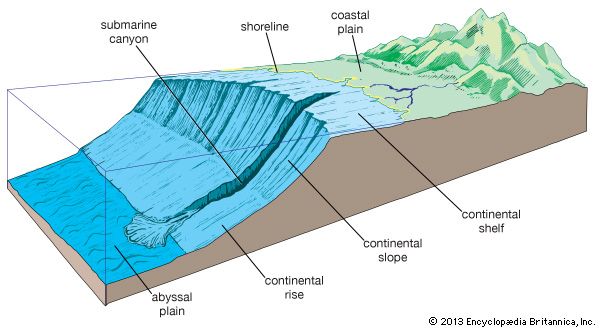
What are the main components of a continental margin?
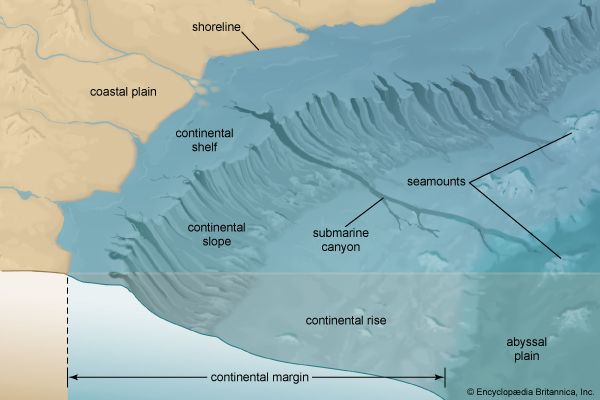
A continental margin is the collective area representing the submerged edge of the continental crust, which is distinguished from the adjacent oceanic crust by its relatively light and isostatically high-floating material. It consists of three primary components:1
- Continental Shelf: A broad, relatively shallow submarine terrace that extends from the coast to an average depth of 100–200 metres. It is gently inclined seaward and typically ends at an abrupt drop known as the shelf break.32
- Continental Slope: The steeper zone that begins at the shelf break and descends toward the deep ocean basins. It serves as the seaward border of the continental shelf and often features submarine canyons.62
- Continental Rise: A section of the ocean floor that typically merges with the base of the continental slope at depths of roughly 4,000 to 5,000 metres. It lies partly on continental crust and partly on oceanic crust.26
How might climate change impact continental margins in the future?
Climate change poses significant threats to continental margins, primarily through sea level rise, ocean warming, and ocean acidification. These processes interact to alter the physical and biological stability of these critical zones.
Physical Impacts
- Sea Level Rise: Models predict a rise of 30 to 100 cm in the next century, which threatens to inundate coastal communities and alter the morphology of continental shelves. Furthermore, the potential surge of marine-based ice sheets, such as the West Antarctic Ice Sheet, could cause a rise of over 6 metres, permanently flooding major coastal cities.11
- Sediment Dynamics: Changes in sea level affect how rivers deposit sediments. During highstands, sediments are often trapped in estuaries and lagoons, whereas lower sea levels allow rivers to dump their burden directly onto the continental slope, influencing the stability of these slopes.12
Ecological Impacts
- Acidification: As oceans absorb more carbon dioxide, the resulting increase in acidity reduces carbonate ions, making it difficult for calcifiers like corals and shellfish to build skeletons and shells. This threatens the biodiversity of coral reefs that serve as foundations for margin ecosystems.1314
- Warming and Productivity: Rising temperatures disrupt marine ecosystems by shifting species distributions toward the poles and causing coral bleaching. Additionally, changes in atmospheric circulation can disrupt upwelling, which is vital for the nutrient-rich waters that support major fisheries along continental margins.3147
What role do continental margins play in plate tectonics?
Continental margins play a fundamental role in plate tectonics, acting as the interface where the dynamics of Earth’s crust are most visibly expressed. Their characteristics and behavior are largely determined by their position relative to tectonic plate boundaries.2
Margin Types and Tectonic Activity
- Leading-Edge Margins: Located at the active boundaries of tectonic plates, these margins are typically narrow with steep continental slopes. They often feature deep-sea trenches and are frequently backed by mountain ranges. These areas are sites of intense geological activity, including subduction, where oceanic plates descend beneath continental crust.215
- Trailing-Edge Margins: Found on the passive sides of plates, such as those bordering the Atlantic Ocean, these margins are broad with gentle slopes and well-developed continental rises. They represent stable environments where the continental crust is not currently undergoing active tectonic deformation.2
Role in Crustal Evolution
Continental margins are critical to the growth and recycling of the continental crust. Through the process of subduction, rock is scraped off descending oceanic plates and added to the continental margin, contributing to lateral growth. Additionally, the Wilson cycle describes how continental margins can evolve from rifted zones into sites of ocean formation and, eventually, into mountain belts through continental collision.1615
Sources
- continental margin — Encyclopædia Britannica
- continental margin - Margin types — Encyclopædia Britannica
- continental slope — Encyclopædia Britannica
- continental margin - Economic importance of continental margins — Encyclopædia Britannica
- density current - Density currents originating from marginal seas — Encyclopædia Britannica
- continental shelf — Encyclopædia Britannica
- Marine ecosystem - Upwelling — Encyclopædia Britannica
- continental shelf - Origin — Encyclopædia Britannica
- Marine ecosystem - Ocean currents — Encyclopædia Britannica
- continental shelf - Structure — Encyclopædia Britannica
- ocean acidification — Encyclopædia Britannica
- Quaternary - Sea-level changes — Encyclopædia Britannica
- ocean warming — Encyclopædia Britannica
- Coral bleaching — Encyclopædia Britannica
- plate tectonics - Back-arc basins — Encyclopædia Britannica
- plate tectonics - Wilson cycle — Encyclopædia Britannica
- continental crust — Encyclopædia Britannica
- plate tectonics - Continental rifting — Encyclopædia Britannica
- plate tectonics - Divergent margins — Encyclopædia Britannica
Published on · 4 min read