Crinoid
A crinoid is a marine invertebrate belonging to the class Crinoidea and the phylum Echinodermata. These animals typically possess a cup-shaped body and five…
What is crinoid?
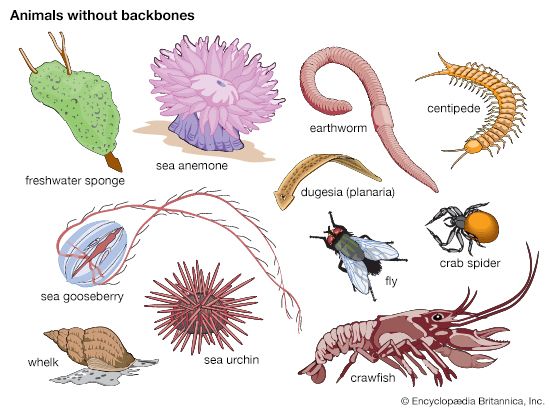
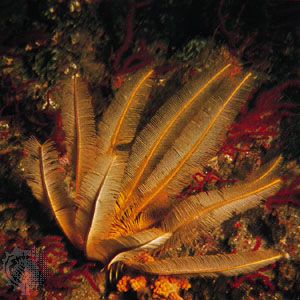
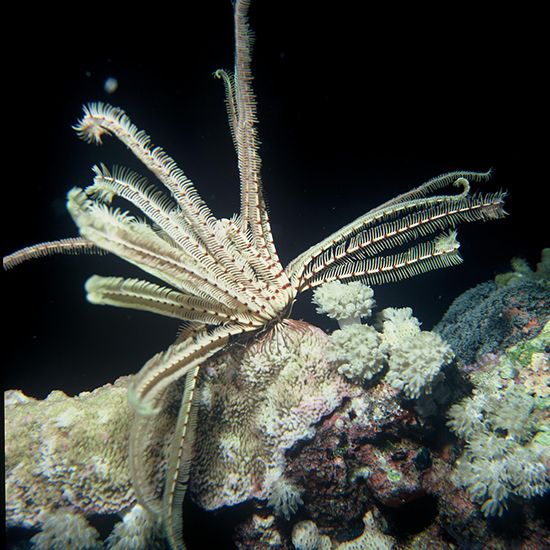
A crinoid is a marine invertebrate belonging to the class Crinoidea and the phylum Echinodermata. These animals typically possess a cup-shaped body and five or more flexible, feathery arms that contain reproductive organs and tube feet for sensory functions. Cilia along the arms sweep food particles toward the mouth.12
Crinoids are categorized into two main groups based on their mobility:
- Sea lilies: These are stalked crinoids that remain fixed to the sea floor as adults, often resembling plants.3
- Feather stars: These lack a stalk and are capable of moving from place to place.3
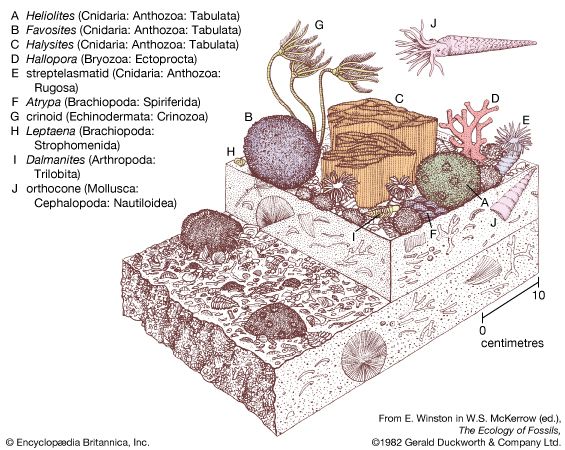
Because they possess internal skeletons made of calcium carbonate, crinoids are significant as Paleozoic index fossils. While there are about 700 living species, thousands of extinct species have been identified, such as those in the genus Cyathocrinites, which date back to the Paleozoic Era.134
What are the main differences between sea lilies and feather stars?
Sea lilies and feather stars are both members of the class Crinoidea, but they are distinguished primarily by their mobility and physical structure.
The main differences are:
- Attachment: The most significant difference is that adult sea lilies are permanently fixed to the sea floor by a stalk, which consists of a series of limy disks. In contrast, feather stars lack this stalk entirely.4
- Mobility: Because they are attached to the substrate, sea lilies are stationary. Feather stars are capable of moving from place to place.4
- Appearance: Due to their stalked structure, sea lilies often resemble plants. While both groups possess a cup-shaped body with flexible, feathery arms, the absence of a stalk gives feather stars a different profile.45
Both groups share the characteristic crinoid anatomy, including an internal skeleton of calcium carbonate and arms equipped with pinnules and cilia to capture food particles from the water.45
How do crinoids use their tube feet to feed?
Crinoids are suspension feeders that utilize their tube feet to capture food from the surrounding water. These tube feet are arranged in clumps of three along the animal’s arms and their feathery projections, known as pinnules.16
To feed, crinoids spread their arms into a fan-like shape at right angles to the prevailing current. The tube feet then secrete and spread a net of sticky mucus, which traps small planktonic organisms. Once prey is captured, the food particles are moved toward the mouth along open grooves on the arms. This transport is facilitated by the combined activity of the tube feet and minute, hairlike projections called cilia.671
Why are crinoid fossils useful for dating rock layers?
Crinoids are valuable for dating rock layers primarily because they possess distinctive internal skeletons made of calcium carbonate, known as limy tests, which are frequently preserved in the fossil record. These durable structures allow them to serve as index fossils, particularly for Paleozoic marine strata.9
To be considered a useful index fossil, an organism must be easily recognizable, abundant, and have a wide geographic distribution, as well as a relatively short range through time. Because many extinct species of crinoids meet these criteria, they are instrumental in biochronology—the process of dating rock strata based on the known succession of fossilized life-forms found within them.1910
While other groups like ammonites are often more widely employed for global correlation due to their free-swimming nature, crinoids remain a critical tool for geologists when defining boundaries in the geologic time scale and correlating sedimentary rocks on both local and regional scales.111
Sources
- crinoid — Encyclopædia Britannica
- crinoid — Merriam-Webster
- Cyathocrinites — Encyclopædia Britannica
- sea lily — Encyclopædia Britannica
- echinoderm — Encyclopædia Britannica
- echinoderm - Water-vascular system — Encyclopædia Britannica
- echinoderm - Food and feeding habits — Encyclopædia Britannica
- echinoderm - Symmetry and body form — Encyclopædia Britannica
- index fossil — Encyclopædia Britannica
- Cretaceous Period - Correlation — Encyclopædia Britannica
- Triassic Period - Correlation of Triassic strata — Encyclopædia Britannica
Published on · 3 min read