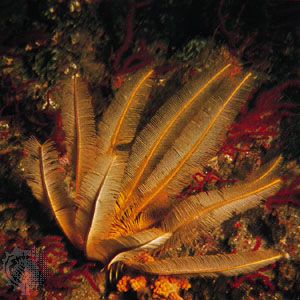
Sea Lily
Sea lilies are classified as echinoderms (phylum Echinodermata) because they share the fundamental anatomical and structural traits characteristic of this…
What are the main characteristics of sea lilies that classify them as echinoderms?
Sea lilies are classified as echinoderms (phylum Echinodermata) because they share the fundamental anatomical and structural traits characteristic of this group.
Key characteristics include:
- Internal Skeleton: Like other echinoderms, sea lilies possess an internal skeleton composed of calcium carbonate (calcite) plates5. In sea lilies, this consists of close-fitting limy plates in the body and a stem made of limy disks.1
- Pentamerous Symmetry: While they exhibit bilateral symmetry in their larval stages, adult echinoderms typically display a pentamerous (five-rayed) radial symmetry. In crinoids, this is evident in the arrangement of their arms and the water-vascular system, which radiates from the mouth.23
- Water-Vascular System: A defining feature of the phylum is the water-vascular system, a network of fluid-filled canals derived from the coelom that supports functions such as locomotion, feeding, and respiration.43
- Marine Habitat: Echinoderms are exclusively marine animals, as they lack the ability to regulate the osmotic pressure of their body fluids against non-seawater environments.4
What are some of the most common species of sea lilies, and how do they differ from each other?
While there are approximately 80 living species of sea lilies, they are generally distinguished by their distribution and specific morphological traits within the class Crinoidea.
Common examples include:
- Metacrinus: This genus is widely distributed across the deep waters stretching from Japan to Australia. These species are characterized by their stalked, plant-like appearance, which is typical of the group.1
- Neocrinus decorus: Often cited as a common species found in the West Indies, this species exemplifies the typical sea lily structure, featuring a bulbous body supported by a stalk composed of limy disks.1
Key Differences The primary distinction among crinoids is between sea lilies and feather stars. While both belong to the same class, sea lilies are permanently fixed to the sea floor by a stalk throughout their adult lives, whereas feather stars lack a stalk and possess the ability to move from place to place. All living species of sea lilies are relatively small, measuring no more than 60 cm (24 inches) in height, which contrasts sharply with extinct species that could reach lengths of up to 20 meters.1
How long have sea lilies existed on Earth, and what does the fossil record tell us about their evolution?
Sea lilies and other members of the class Crinoidea have a vast evolutionary history, with the fossil record documenting their presence throughout the Paleozoic Era, which spanned from 542 million to 251 million years ago.1
The fossil record is particularly significant for understanding these organisms because their internal skeletons, composed of calcium carbonate, are well-preserved in marine rocks. These remains serve as important index fossils, allowing scientists to date geological strata.19
Evolutionary insights from the fossil record include:
- Size Variation: While modern sea lilies are relatively small, reaching a maximum height of 60 cm (24 inches), extinct species were significantly larger, with some reaching lengths of up to 20 meters (65 feet).1
- Diversity: More than 5,000 extinct species have been identified, illustrating a much higher level of historical diversity compared to the approximately 80 living species of sea lilies.1
- Temporal Range: Specific genera, such as the extinct Cyathocrinites, appear in the fossil record from the Silurian to the Permian periods, showing a peak in abundance during the Early Carboniferous Epoch.10
How do sea lilies reproduce, and what strategies do they use to ensure successful reproduction?
The provided search results do not contain information regarding the reproductive strategies or life cycles of sea lilies. While the results offer detailed information on the reproduction of barnacles (cirripedes), they do not provide data on the class Crinoidea.
Sorry, the Britannica knowledge base does not contain this information.
Sources
- sea lily — Encyclopædia Britannica
- echinoderm — Encyclopædia Britannica
- echinoderm - Symmetry and body form — Encyclopædia Britannica
- Circulatory system - Echinodermata — Encyclopædia Britannica
- echinoderm - General features — Encyclopædia Britannica
- water-vascular system — Merriam-Webster
- sea lily — Merriam-Webster
- crinoid — Encyclopædia Britannica
- Crinoidea — Merriam-Webster
- Palaeocrinoidea — Merriam-Webster
- Cyathocrinites — Encyclopædia Britannica
- cirripede - Reproduction and life cycles — Encyclopædia Britannica
Published on · 3 min read