Diving Petrel
A diving petrel is any of the five species of small, heavy-bodied seabirds belonging to the family Pelecanoididae. These birds are primarily found in…
What is Diving petrel?
A diving petrel is any of the five species of small, heavy-bodied seabirds belonging to the family Pelecanoididae. These birds are primarily found in sub-Antarctic regions and are known for their sedentary, coast-dwelling nature.12
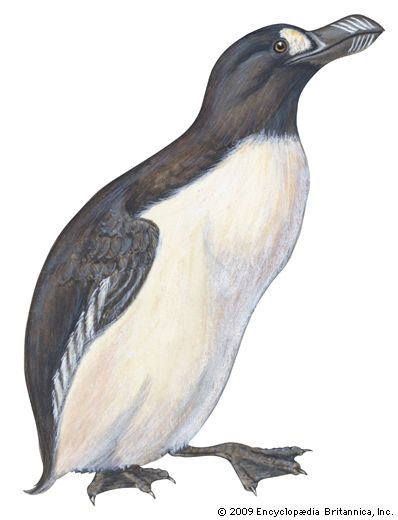
Unlike many of their relatives in the order Procellariiformes, such as albatrosses and shearwaters, diving petrels have short wings and use them for propulsion while swimming underwater. This physical adaptation is a classic example of convergent evolution, as they closely resemble the auks of the Northern Hemisphere in both appearance and behavior.12
Diving petrels feed by taking small fish and crustaceans near the surface, often making short dives to capture their prey. The smallest and most widespread species is the common diving petrel, while the largest is the Peruvian diving petrel, which is restricted to the west coast of South America.31
What is convergent evolution and how does it relate to auks and diving petrels?
Convergent evolution is the independent development of similar traits or features in unrelated or distantly related species that occupy similar ecological niches or environments. Because these species face comparable environmental pressures, natural selection shapes them to have analogous morphological, physiological, or behavioral characteristics, even though they do not share a recent common ancestor for those specific traits.456
The relationship between diving petrels and auks serves as a classic example of this phenomenon. Although they belong to different orders—diving petrels are Procellariiformes and auks are Charadriiformes—both have evolved into small, heavy-bodied seabirds with short wings.71
These physical adaptations allow both groups to use their wings for propulsion while swimming underwater, an ability they independently evolved to pursue prey in their respective aquatic environments. While they appear remarkably similar in both appearance and habits, these resemblances are due to analogy rather than common descent, illustrating how different lineages can converge upon the same functional solutions to survive in similar habitats.89371
How do diving petrels use their wings to swim underwater?
Diving petrels are specialized seabirds that utilize their wings for propulsion while swimming underwater, a behavior that allows them to pursue prey effectively beneath the surface.18
Unlike many of their relatives in the order Procellariiformes, which possess long wings for soaring, diving petrels have evolved short, heavy-bodied forms that are better suited for this aquatic “flight”. When submerged, these birds use their wings to generate the necessary thrust to move through the water column. While the specific mechanics of their underwater movement are similar to those of auks, it is noted that auks also employ their webbed feet to assist in swimming and steering, whereas the primary propulsion for diving petrels is derived from their wing strokes. This dual-purpose use of the wing—serving as both an aerial airfoil and an aquatic paddle—requires a balance between the wing size needed for flight and the efficiency required for underwater movement.189
What are some other types of birds in the order Procellariiformes?
The order Procellariiformes, often referred to as “tube-nosed” birds due to their conspicuous tubular nostrils, comprises approximately 117 living species of oceanic birds. Beyond the diving petrels, the order is divided into three other distinct families:1112
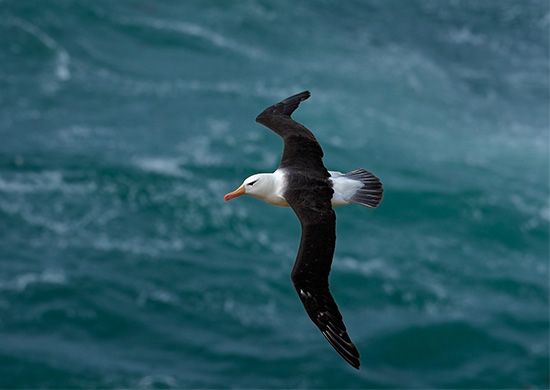
- Diomedeidae (Albatrosses): These are large birds known for their extremely long, narrow wings, which are highly adapted for efficient, fixed-wing gliding over the ocean. They are found primarily in the North Pacific and all southern oceans.1312
- Procellariidae (Large petrels, fulmars, prions, and shearwaters): This is the most diverse family within the order. Members are typically long-winged and short-tailed, with nostrils united on the top of the bill. They are found in all oceans, though they exhibit the greatest diversity in the Southern Hemisphere.12
- Hydrobatidae (Storm petrels): These are small, dark-colored birds, often featuring a white rump. They are known for their rounded wings and the unique behavior of appearing to “walk” on the surface of the water.12
Sources
- Diving petrel — Encyclopædia Britannica
- Procellariiform - Feeding habits — Encyclopædia Britannica
- Procellariiform - Distribution — Encyclopædia Britannica
- convergent evolution — Merriam-Webster
- The rodent that acts like a hippo — Encyclopædia Britannica
- evolution - Convergent and parallel evolution — Encyclopædia Britannica
- community ecology - Convergence — Encyclopædia Britannica
- Bird - Swimming and diving — Encyclopædia Britannica
- Charadriiform - Adaptations for flight — Encyclopædia Britannica
- Procellariiform - Annotated classification — Encyclopædia Britannica
- Procellariiform — Encyclopædia Britannica
- Procellariiform - General features — Encyclopædia Britannica
- Shearwater — Encyclopædia Britannica
Published on · 3 min read