Entoproct
While entoprocts were historically grouped with bryozoans due to their similar appearance as filter-feeding, tentaculated zooids, these similarities are…
How do entoprocts differ from other marine invertebrates like bryozoans?
While entoprocts were historically grouped with bryozoans due to their similar appearance as filter-feeding, tentaculated zooids, these similarities are considered superficial.1
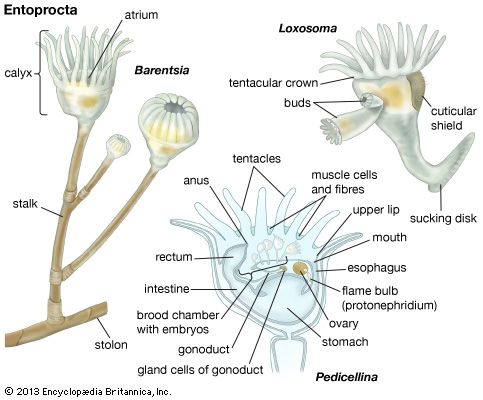
The primary anatomical distinction lies in the position of the anus. In entoprocts, the anus is located within the ring of ciliated tentacles. In contrast, the anus of a bryozoan opens outside the tentacular ring. Furthermore, the two groups differ fundamentally in their developmental patterns and the mechanics of water flow across their tentacles.1
Additionally, entoprocts are pseudocoelomate animals, meaning they lack a true coelom, a fluid-filled body cavity that is typically present in more complex invertebrates. While both groups form colonies, entoprocts are distinct in their body structure, which consists of a globular head (calyx) attached to a stalk, whereas bryozoans possess a specialized feeding structure known as a lophophore.213
What is the life cycle of entoprocts, including their reproductive strategies?
The life cycle of entoprocts involves both asexual and sexual reproduction, allowing these aquatic invertebrates to persist as solitary individuals or in colonies.
Reproductive Strategies
- Hermaphroditism: All studied entoproct species are simultaneous hermaphrodites, meaning each individual possesses both male and female reproductive organs.1
- Asexual Reproduction: Entoprocts frequently reproduce through budding. In colonial species, this process creates communicating members known as zooids. Solitary species produce daughter buds that eventually detach from the parent once they reach maturity.1
- Regeneration: In many colonial species, the globular head, or calyx, can be discarded and subsequently regenerated.1
Life Cycle and Development
The life cycle includes a free-swimming larval stage, which is essential for the dispersal of these otherwise sedentary animals. After a period of movement, these larvae settle on a substrate—such as shells, seaweed, or other animals—and undergo metamorphosis to develop into new individuals or colonies. This transition from a mobile larval form to a sessile adult is a common strategy among marine invertebrates to ensure the species can colonize new environments.145
What are some common species of entoprocts, and how do they vary?
The phylum Entoprocta comprises approximately 150 species, which are organized into four distinct families. While they share a basic body plan consisting of a calyx (head) and a stalk (peduncle), they exhibit significant variation in their habitat and colonial structure.
Common Variations
- Habitat: While the vast majority of entoprocts are marine, the genus Urnatella is a notable exception, as it is a freshwater form.1
- Colonial vs. Solitary: Entoprocts may exist as solitary individuals or form colonies of communicating zooids through budding. In colonial species, the stalk may be jointed, and the calyx is frequently discarded and regenerated.1
- Size: These organisms are quite small, typically measuring between 0.4 and 5 mm in height.1
Notable Genera
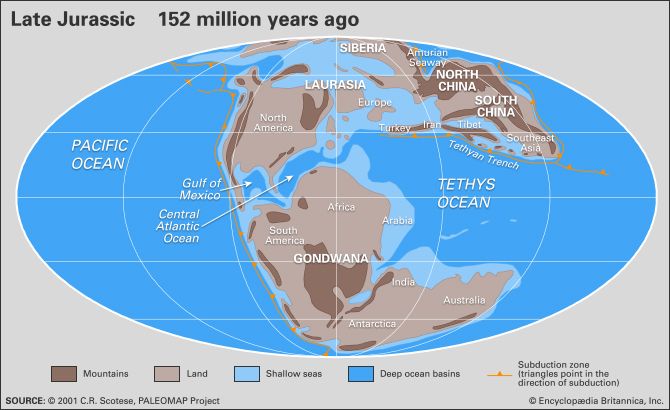
- Barentsia: This genus is significant in the fossil record, with specimens dating back to the Jurassic Period.1
- Urnatella: As mentioned, this is the primary genus representing the freshwater branch of the phylum.1
It is important to note that while some older sources or databases may categorize genera like Pedicellina under bryozoan classifications, entoprocts are recognized as a distinct phylum.189
What are the main characteristics that define entoprocts as invertebrates?
Entoprocts are defined as invertebrates primarily by their lack of a backbone and their distinct anatomical structure. As members of the phylum Entoprocta, they are characterized by the following features:
- Anatomical Structure: They possess a globular head, or calyx, which houses a U-shaped gut along with their nervous, excretory, and reproductive systems. A key defining trait is the location of the anus, which lies within the crown of ciliated tentacles used for filter feeding.
- Body Cavity: Unlike many other complex invertebrates, entoprocts lack a true coelom, a fluid-filled body cavity that typically surrounds the internal organs.
- Developmental Traits: They are classified as protostomes, a group of animals where the mouth develops from the first opening in the embryo. Their early development and larval stages suggest a potential evolutionary link to annelids and other protostome phyla.
- Sessile Nature: Most entoprocts are aquatic, sedentary animals that attach to substrates like shells or seaweed via a stalk, or peduncle.
Sources
- entoproct — Encyclopædia Britannica
- moss animal - Food and feeding — Encyclopædia Britannica
- Entoprocta — Merriam-Webster
- Animal development - The larval stage — Encyclopædia Britannica
- Animal development - The larval phase and metamorphosis — Encyclopædia Britannica
- entoproct — Merriam-Webster
- Reproductive behaviour - Protozoans and sponges — Encyclopædia Britannica
- Pedicellina — Merriam-Webster
- Pedicellinidae — Merriam-Webster
Published on · 3 min read