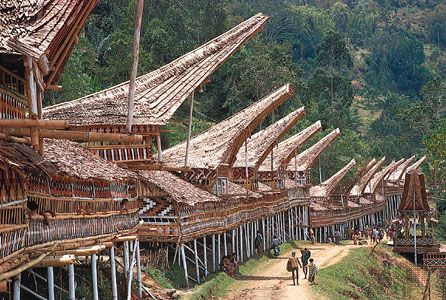
Flores
Flores is a long, narrow island located in Indonesia as part of the Nusa Tenggara Timur (East Nusa Tenggara) province. It serves as the easternmost major…
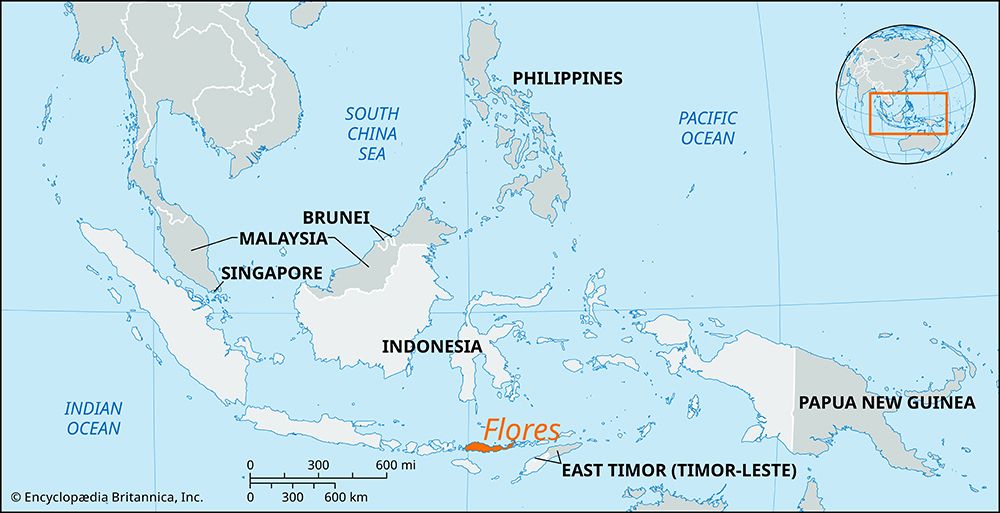
What is the geographical location of Flores island in Indonesia?
Flores is a long, narrow island located in Indonesia as part of the Nusa Tenggara Timur (East Nusa Tenggara) province. It serves as the easternmost major island in the Lesser Sunda Islands chain, which extends eastward from Java.1
Geographically, the island is situated south of the Flores Sea, which separates it from the island of Celebes (Sulawesi). The island is characterized by a mountainous interior, particularly in the west, and features numerous inlets and bays along its coastline.231
How has the discovery of Homo floresiensis impacted our understanding of human evolution?
The discovery of Homo floresiensis has significantly challenged traditional narratives of human evolution, which generally posit a trend toward increasing stature and brain size over time.
Found in the Liang Bua cave on Flores, this hominin—often nicknamed the “hobbit”—exhibited a small stature (approximately 100 cm) and a small cranial capacity comparable to a chimpanzee. These features led researchers to propose the theory of island dwarfing, a process previously unobserved in the human lineage, where isolated populations evolve smaller body sizes.4
The find has sparked intense scientific debate regarding:
- Taxonomic Classification: While some researchers classify it as a distinct species within the genus Homo, others argue the remains represent modern humans with specific pathologies, such as Down syndrome.4
- Evolutionary Origins: The dating of the fossils (100,000 to 60,000 years ago) suggests the species existed before modern humans arrived in the region, implying descent from a more primitive ancestor rather than H. sapiens.4
What is the historical significance of Flores island in Indonesian history?
The historical significance of Flores is defined by its role as a transitional cultural zone and its colonial history. Historically, the island was a tributary to the princes of Celebes, a power dynamic that shifted when the Dutch broke their influence in 1667. Despite this, the Dutch did not firmly establish a civil government on the island until 1909.1
A major aspect of the island’s history is its religious development. In the 16th century, Portuguese explorers and missionaries arrived, leaving a lasting legacy; today, Flores remains one of the few regions in Indonesia with a significant Christian population, alongside Muslim communities and those who continue to practice traditional animist religions. The island’s name itself reflects its colonial past, derived from the Portuguese Cabo de Flores (“Cape of Flowers”).13
Furthermore, the island has served as a crossroads for diverse ethnic groups, including Bimanese, Buginese, and Javanese-Chinese, who settled along its coasts, contributing to its complex social fabric.1
What are the Lesser Sunda Islands?
The Lesser Sunda Islands (also known as the Nusa Tenggara) are a group of islands in south-central Indonesia that extend eastward from Java toward the Banda Islands.67
The chain includes major islands such as Bali, Lombok, Sumbawa, Flores, Sumba, Timor, and Alor, along with various smaller adjacent islands. Geologically, the region is part of a zone of island arcs and submarine ridges that is volcanically active and unstable.67
The islands are characterized by their relatively recent geological origin, which has influenced their biodiversity. Because they have not historically been connected to larger landmasses, they are less species-rich than western Indonesian islands like Java, particularly regarding terrestrial animals that cannot fly. While the climate and vegetation are similar to eastern Java, the islands serve as a distinct biogeographic area, situated east of Wallace’s Line, which marks the transition between Asian and Australian faunal regions.89
Sources
- Flores — Encyclopædia Britannica
- Flores Sea — Encyclopædia Britannica
- Flores — Merriam-Webster
- Homo floresiensis — Encyclopædia Britannica
- Indonesia - Religions of Indonesia — Encyclopædia Britannica
- Sunda Islands — Encyclopædia Britannica
- Indonesia - Islands of the Sunda Shelf — Encyclopædia Britannica
- Indonesia - Plant and animal life — Encyclopædia Britannica
- biogeographic region - Components of species diversity: species richness and relative abundance — Encyclopædia Britannica
Published on · 3 min read