Hominin
Identifying the earliest members of the hominin tribe is complex, as early fossils often display a mix of human and apelike traits. Current research suggests…
Who are some of the earliest known hominins and when did they live?
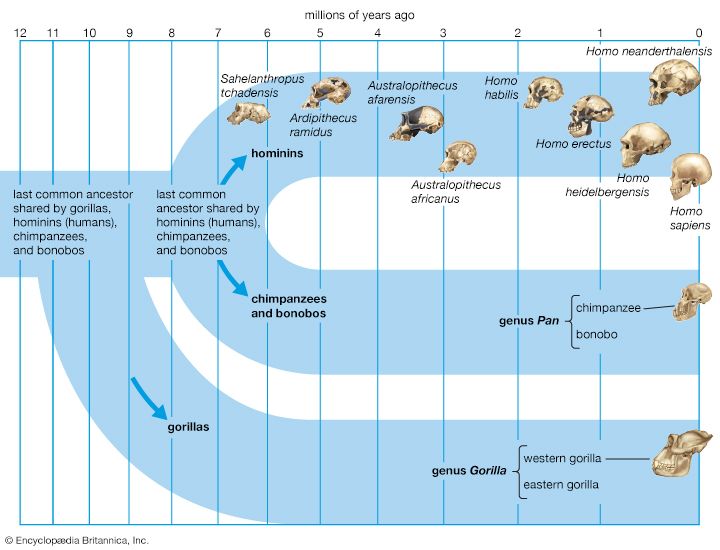
Identifying the earliest members of the hominin tribe is complex, as early fossils often display a mix of human and apelike traits. Current research suggests the earliest putative hominin ancestry dates back to approximately 8–6 million years ago (mya).12
Some of the earliest known candidates include:
- Sahelanthropus tchadensis: Dated to between 7 and 6 mya, this species is considered by many to be the earliest candidate for hominin status due to its reduced canine teeth and facial structure.13
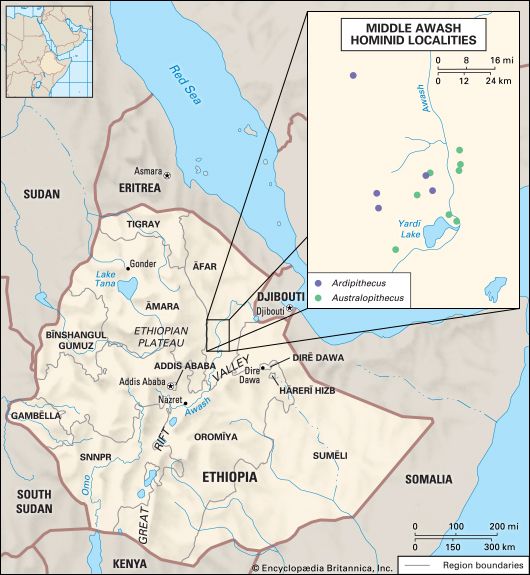
- Ardipithecus: This genus lived approximately 5.8–4.4 mya. It includes Ar. kadabba (5.8–5.2 mya) and Ar. ramidus (4.4 mya), the latter of which is known from a partial skeleton nicknamed “Ardi”.43
- Orrorin tugenensis: Found in Kenya and dating to about 6 mya, this species is notable for femoral features that suggest it practiced bipedalism.1
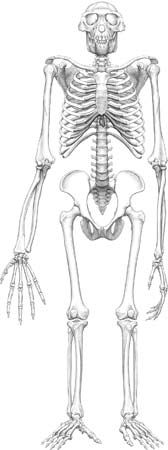
These early hominins are often described as “bipedal apes,” as they possessed small, ape-sized braincases while exhibiting anatomical adaptations for walking upright on the ground.3
How did bipedalism evolve in hominins and what advantages did it provide?
The evolution of bipedalism in hominins was a gradual process that likely began around 6 million years ago. While the exact ancestral locomotor pattern remains a subject of debate, it is widely accepted that bipedalism emerged from an arboreal primate body plan that already possessed the capacity for truncal uprightness.6789
Evolutionary Drivers and Advantages
Scientists have proposed several theories to explain the selective pressures favoring bipedalism, though no single explanation is universally accepted. Potential advantages include:107
- Energy Efficiency: Bipedalism can be more energy-efficient than quadrupedalism for covering long distances.107
- Thermoregulation: Standing upright may have reduced exposure to direct midday sunlight and allowed access to cooler air currents above the ground.10
- Resource Access: Freeing the hands allowed for carrying food, tools, or offspring. It also facilitated foraging for food in trees or overhanging branches.107
- Vigilance: An upright posture provided a better vantage point to spot predators or follow herds in open environments like the savanna.107
Anatomical Adaptations
The transition to habitual bipedalism required significant skeletal and muscular restructuring. Key changes included:811
- Pelvis and Spine: The pelvis became shorter and broader, with ilia curved forward to stabilize the trunk during movement. The spine developed a lumbar curve to position the torso over the center of mass.68
- Lower Limbs: Femurs became longer and angled toward the midline to keep the knees close together, while the knee joint evolved to support weight efficiently.6811
- Foot Structure: The foot evolved from a grasping organ into a rigid, heel-supported platform with an arch, providing the strength needed for propulsion.108
Despite these benefits, bipedalism introduced disadvantages, including increased vulnerability to lower back pain, hernias, and slower running speeds compared to quadrupedal predators.7
How did tool use and cognitive abilities evolve in hominins?
The evolution of tool use and cognitive abilities in hominins is a complex subject, as archaeological evidence and fossil records often provide only indirect clues about behavior and intelligence.1415
Development of Tool Technology
The earliest stone artifacts, such as those from the Oldowan industry (dating back to approximately 1.8–1.2 million years ago), consisted of simple choppers and flakes used for cutting, pounding, and crushing. Over time, technology became more sophisticated:16
- Acheulean Industry: Emerging around 1.4 million years ago, this period saw the development of bifacial hand axes and a wider variety of specialized tools, including scrapers and awls.16
- Refinement Techniques: Toolmakers progressed from using hard hammerstones to “soft-hammer” techniques (using bone or antler) and eventually pressure flaking, which allowed for greater precision and control.1716
- Late Paleolithic: Tools became highly complex, incorporating bone and antler handles for leverage, and eventually included artistic or ritualistic items.16
Cognitive Evolution and Brain Size
While brain size increased significantly throughout human evolution—from roughly 440 cc in Australopithecus to 1,350 cc in H. sapiens—linking this expansion directly to cognitive competence is difficult.18
- Interpretive Challenges: Some scholars argue that brain expansion tracks with technological refinement, but others note that hominins like H. floresiensis possessed small brains yet produced sophisticated tools.18
- Language and Symbolism: The origins of language remain an unsolved puzzle. While some point to endocranial casts as evidence of speech centers in H. habilis, others argue that symbolic behavior, such as the creation of jewelry or art, is a more reliable indicator of complex abstract thought.1415
- Anatomical Adaptations: The unique structure of the human hand, featuring an opposable thumb and sensitive fingertips, evolved in tandem with the production of increasingly complex tool kits, facilitating the precise manipulation required for advanced craftsmanship.19
How did brain size change throughout hominin evolution?
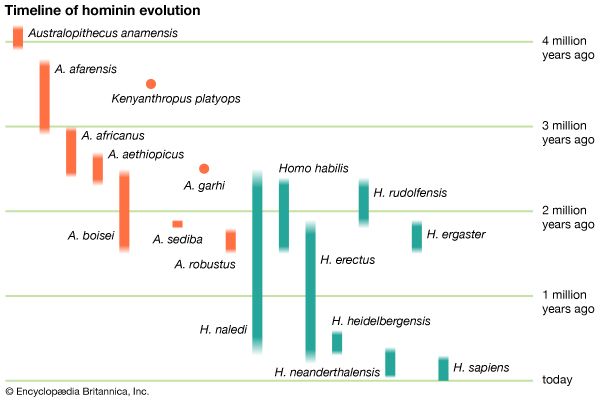
Throughout human evolution, the brain has undergone significant expansion, though this process was not uniform. Early hominins such as Australopithecus possessed brain sizes comparable to those of modern chimpanzees and gorillas. A notable increase in brain size began with Homo habilis and continued through species like H. rudolfensis and H. ergaster.18
Average Braincase Capacity
The following table illustrates the trend in average braincase capacity across various hominin groups:
Hominin
Average Capacity (cc)
Australopithecus
440
Paranthropus
519
Homo habilis
640
Javanese
Homo erectus
930
Chinese
Homo erectus
1,029
Homo sapiens
1,350
It is important to note that brain size alone is an unreliable predictor of cognitive competence. For instance, H. floresiensis possessed a brain size similar to that of an australopith yet produced sophisticated tools. Furthermore, when accounting for body mass, some earlier species were relatively “brainier” than their successors. Brain size relative to the body remained stagnant from 1.8 to 0.6 million years ago, increased until about 35,000 years ago, and subsequently began to decrease.18
Sources
- Australopithecus - Early species and Australopithecus anamensis — Encyclopædia Britannica
- Homo erectus - Dating the fossils — Encyclopædia Britannica
- Australopithecus - Ardipithecus kadabba and Ar. ramidus — Encyclopædia Britannica
- Homo sapiens - Origin — Encyclopædia Britannica
- Homo sapiens - Evolution — Encyclopædia Britannica
- human evolution - The fossil evidence — Encyclopædia Britannica
- human evolution - Theories of bipedalism — Encyclopædia Britannica
- Australopithecus - Bipedalism — Encyclopædia Britannica
- human evolution - The anatomy of bipedalism — Encyclopædia Britannica
- human muscle system - Changes in the muscles of the lower limb — Encyclopædia Britannica
- Ardipithecus - Anatomical features — Encyclopædia Britannica
- Ardipithecus - Habitat — Encyclopædia Britannica
- bipedalism — Encyclopædia Britannica
- Homo habilis - Behavioral inferences — Encyclopædia Britannica
- hand tool - Techniques for making stone tools — Encyclopædia Britannica
- human evolution - Refinements in hand structure — Encyclopædia Britannica
- Stone tool industry — Encyclopædia Britannica
- human evolution - Increasing brain size — Encyclopædia Britannica
- human evolution - Speech and symbolic intelligence — Encyclopædia Britannica
- human evolution - Reduction in tooth size — Encyclopædia Britannica
- human evolution - Background and beginnings in the Miocene — Encyclopædia Britannica
Published on · 4 min read