Glassfish
The term "glassfish" refers to any of several small fish belonging to the genus Ambassis within the family Centropomidae. These fish are characterized by…
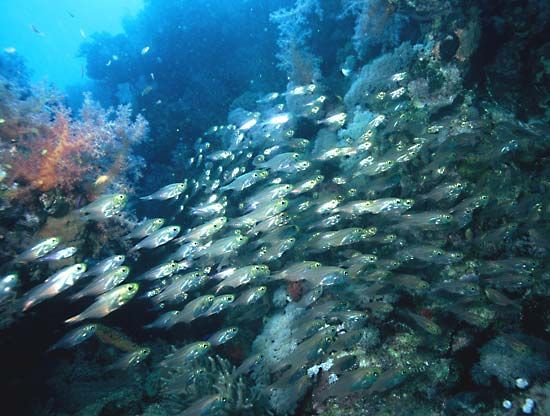
What is glassfish?
The term “glassfish” refers to any of several small fish belonging to the genus Ambassis within the family Centropomidae. These fish are characterized by their transparent bodies, which make their bones and internal organs clearly visible. Because of this unique appearance, they are frequently kept in tropical aquariums.1
Why do some fish have transparent bodies?
Some fish possess transparent bodies primarily as a form of camouflage, which serves as a vital survival strategy to avoid detection by predators. By allowing light to pass through their tissues, these fish become nearly invisible in the water column, effectively blending into their surroundings.
While the provided search results detail how many deep-sea fishes use bioluminescence or specific coloration to hide their shadows or match their environment, transparency is a distinct evolutionary adaptation that minimizes the silhouette of the animal. In many species, this lack of pigmentation and the presence of thin, translucent scales allow the fish to remain inconspicuous, providing a significant advantage in avoiding predation.
What are the best conditions for a tropical aquarium?
Maintaining a healthy tropical aquarium requires careful attention to water quality and environmental stability. The primary requirement is ensuring the water supply is free of pollutants, such as chlorine, which must be removed via carbon filtration or chemical treatment.4
Key factors for a successful setup include:
- Water Quality & Filtration: In closed systems, metabolic wastes like ammonia must be managed. Beneficial bacteria residing in filter materials convert harmful ammonia into less toxic compounds through the nitrogen cycle.45
- Waste Management: Regular maintenance is necessary to keep nitrate levels low, typically involving replacing 1 to 10 percent of the water monthly. Using charcoal can help slow the accumulation of nitrogenous wastes.4
- Environmental Stability: Maintaining proper temperature and acidity is vital. Carbonate compounds are often used to stabilize acidity, especially when water renewal is infrequent.4
- Aeration: Adequate oxygenation, often provided by air stones, is essential to prevent asphyxia.4
While “balanced” tanks with plants can sometimes function without mechanical filtration, achieving this stability is difficult in most home aquariums.4
What other types of fish are in the Centropomidae family?
The family Centropomidae is primarily defined by the genus Centropomus, which consists of approximately eight species of marine fishes commonly known as snook. These fishes are characterized by their long, silvery, pikelike bodies, two dorsal fins, and a large mouth with a projecting lower jaw.7
The provided search results do not list other genera or fish families within the Centropomidae family beyond the snooks. While there are many other fish families in existence, the specific classification of Centropomidae is centered on these species.78
Sources
- glassfish — Merriam-Webster
- Bioluminescence - The role of bioluminescence in behavior — Encyclopædia Britannica
- fish - The skin — Encyclopædia Britannica
- aquarium - Maintenance problems — Encyclopædia Britannica
- How the Nitrogen Cycle Works — Encyclopædia Britannica
- Why is nitrogen essential to life? — Encyclopædia Britannica
- snook — Encyclopædia Britannica
- Centropomidae — Merriam-Webster
- caddisfly - Annotated classification — Encyclopædia Britannica
Published on · 2 min read