Gnetophyte
Gnetophytes transport water and nutrients through specialized vascular tissues known as xylem and phloem, which are present in all vascular plants.
How do gnetophytes transport water and nutrients throughout their bodies?
Gnetophytes transport water and nutrients through specialized vascular tissues known as xylem and phloem, which are present in all vascular plants.1
A defining feature that distinguishes gnetophytes from other gymnosperms is the presence of vessels within their xylem. These vessels consist of longitudinal rows of cells called vessel members that contain perforations in their end walls, providing an efficient pathway for the movement of water throughout the plant body. While most gymnosperms rely on simpler conducting cells called tracheids, the inclusion of vessels in gnetophytes is a characteristic they share with angiosperms.234
In these plants, water and dissolved mineral nutrients are taken up from the soil by the roots and ascend through the xylem to the leaves and other above-ground parts. Meanwhile, the products of photosynthesis—primarily sugars—are transported from the leaves to other parts of the plant through the phloem.1
How have gnetophytes adapted to survive in harsh environments, particularly in the case of Welwitschia?
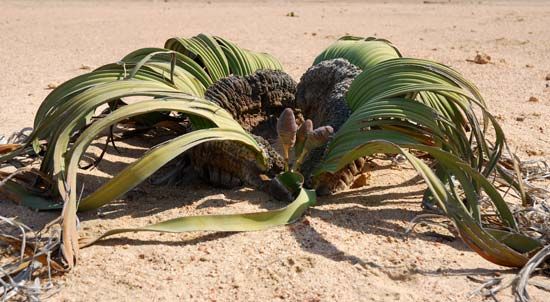
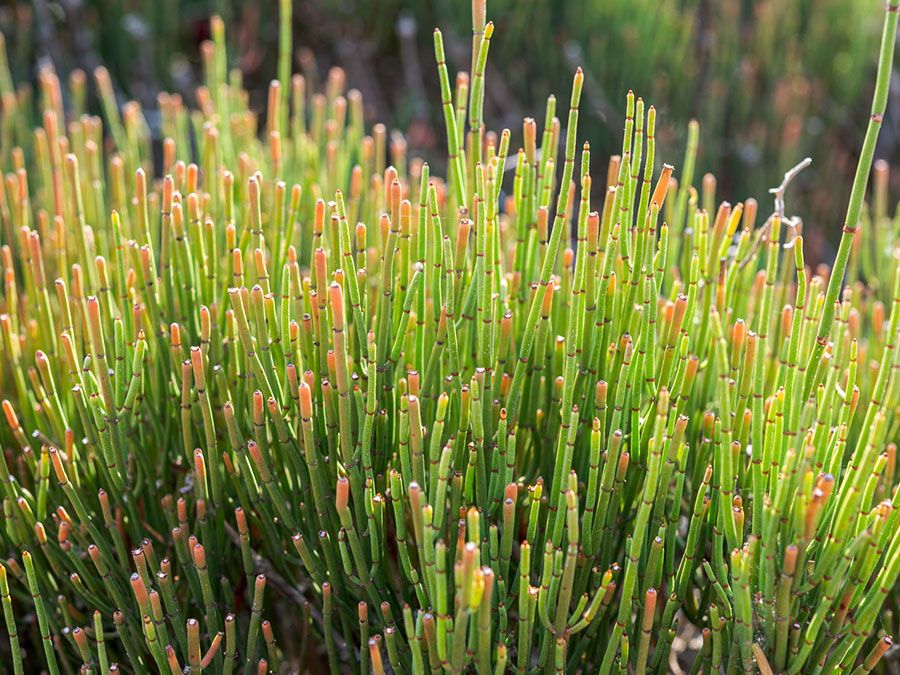
Gnetophytes exhibit remarkable adaptations to survive in diverse, often harsh environments. While species of Ephedra thrive in arid and cool regions—including high-altitude environments—the most specialized gnetophyte is Welwitschia mirabilis, native to the extremely arid Namib desert4.4
Welwitschia employs several strategies to survive in an environment with minimal rainfall:
- Deep Root System: The plant features a deep taproot that extends 1.5 meters or more underground, likely accessing water sources unavailable to other desert flora.84
- Unique Leaf Growth: It produces only two permanent, straplike leaves that grow continuously from a basal meristem. These leaves are kept at a manageable length by erosion from hot sand at the tips.4
- Fog Utilization: It is hypothesized that Welwitschia may absorb moisture from the frequent morning fog that occurs in the Namib, though this remains unproven.4
- Transpiration Cooling: To manage heat, the plant takes up carbon dioxide during the day, which involves significant transpiration to cool the leaf surface.4
What is the evolutionary history of gnetophytes, and how long have they existed on Earth?
The evolutionary history of gnetophytes (division Gnetophyta) remains somewhat obscure, and their precise origins are not fully clear. While they have historically been studied for potential links between gymnosperms and angiosperms due to shared characteristics like the presence of vessels in their xylem, modern molecular research indicates that flowering plants did not evolve directly from a gnetophyte ancestor.9105
The fossil record for this group is limited, but evidence suggests they have existed for a significant period:
- Permian Period: Pollen grains resembling those of the extant genera Ephedra and Welwitschia have been identified in deposits dating back to the Permian Period (approximately 298.9 million to 252.2 million years ago).109
- Cretaceous Period: Remains of plants that may be related to gnetophytes appear in Upper Cretaceous deposits (100.5 million to 66 million years ago). These fossils, while distinct from modern species, exhibit leaf venation similar to Welwitschia and contain pollen typical of the division.109
Are there any known uses of gnetophytes in traditional medicine or modern applications?
Gnetophytes, particularly those in the genus Ephedra, have a long history of use in both traditional and modern medicine.
Traditional and Medicinal Uses
- Ma Huang: The Asian species Ephedra sinica, known as ma huang, has been utilized in Chinese medicine for over 5,000 years to treat conditions such as asthma and hay fever.1213
- Ayurvedic Medicine: Several Ephedra species are recognized for their importance in Ayurvedic medicine.12
- Indigenous and Pioneer Use: In the southwestern United States and Mexico, indigenous peoples and pioneers used various Ephedra species as food and medicine. Stem fragments are still used to prepare a beverage known as Mormon tea, Mexican tea, or desert tea.124
Modern Applications
- Ephedrine: The primary medicinal compound derived from Ephedra is the alkaloid ephedrine. It is used as a decongestant, a bronchodilator, and for controlling urinary incontinence. While originally sourced from plants, it is now largely manufactured synthetically.12134
- Dietary Uses: Beyond medicinal applications, some species of the genus Gnetum are used as food; their seeds are eaten cooked or roasted, and their young leaves are also consumed.4
Sources
- Angiosperm - Evolution of the transport process — Encyclopædia Britannica
- gnetophyte - Stem — Encyclopædia Britannica
- lower vascular plant - Vascular system — Encyclopædia Britannica
- gnetophyte - General features — Encyclopædia Britannica
- Plant - Gymnosperms — Encyclopædia Britannica
- Angiosperm - General characteristics — Encyclopædia Britannica
- bryophyte - Nutrition — Encyclopædia Britannica
- welwitschia — Encyclopædia Britannica
- gnetophyte - Critical appraisal — Encyclopædia Britannica
- gymnosperm - Appearance of gymnosperm divisions — Encyclopædia Britannica
- gnetophyte — Encyclopædia Britannica
- ephedra — Encyclopædia Britannica
- ephedrine — Encyclopædia Britannica
Published on · 3 min read