Greenops
Greenops is a genus of trilobites, which are extinct arthropods that lived during the Middle and Upper Devonian Period.
What is Greenops?
Greenops is a genus of trilobites, which are extinct arthropods that lived during the Middle and Upper Devonian Period.1
These fossils are easily identified by their unique physical characteristics, including a well-developed head and a small tail featuring a fringe of extended segmental rays. Additionally, they possess long, spinous processes along the terminal margins of the head shield that reach back into the thoracic region.1
It is important to note that Greenops is a biological classification and should not be confused with green architecture, which is a design philosophy focused on environmental sustainability and the conservation of resources in building construction.2
What are trilobites?
Trilobites are a group of extinct fossil arthropods that lived exclusively in marine environments. They first appeared approximately 521 million years ago during the Cambrian Period and persisted until the Permian Period.3
These animals are named for their distinctive three-lobed, three-segmented body form. Their anatomy was divided into three regions: the cephalon (head), the thorax, and the pygidium (tail). They possessed a chitinous exoskeleton that they shed periodically to grow, which explains why their fossilized remains are relatively common.3
Trilobites varied significantly in size and behavior; some were active predators, while others were scavengers or fed on plankton. Most species featured compound eyes, though some were eyeless. Because they were widespread and evolved rapidly, they are frequently used by scientists for stratigraphic correlations.3
What was the Devonian Period like?
The Devonian Period (approximately 419.2 to 359 million years ago) is famously known as the “Age of Fishes” due to the remarkable diversification and abundance of fish species in both marine and freshwater environments.67
Environment and Geography
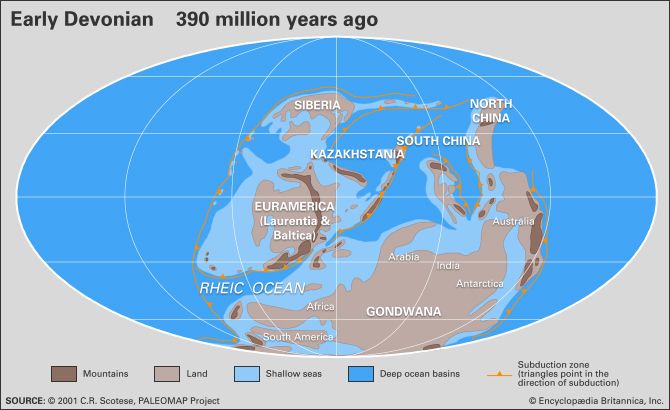
During this time, the Earth was warmer than it is today, with a climate generally described as warm and equitable. Approximately 85 percent of the globe was covered by oceans. The landmasses were largely divided into two major units: Laurussia (or Euramerica) in the north and the massive supercontinent Gondwana in the south. The collision of these landmasses triggered the Caledonian orogeny, a significant mountain-building event.689
Life and Evolution
The period marked a pivotal era for life on Earth:
- Terrestrial Colonization: Forests first appeared in the Middle Devonian, and by the end of the period, the first four-legged tetrapods (amphibians) emerged, signaling the colonization of land by vertebrates.67
- Marine Life: The seas were populated by diverse organisms, including ammonites and various corals.610
- Extinction Events: The period experienced several significant extinction episodes, such as the Taghanic and Kellwasser events9. These were often linked to periods of low oxygen (anoxia) in the oceans, potentially caused by climatic shifts or nutrient influxes from the rise of land plants.610
How do fossils help us understand extinct animals?
Fossils are the primary source of information regarding the history of life on Earth, providing essential data about extinct animals through several key methods.11
Understanding Evolution and Anatomy
By studying the fossil record, scientists can observe progressive morphological changes within animal groups, which helps describe their evolution over time. Through comparative anatomy, researchers compare the structures of extinct species with those of living animals to understand adaptive changes and evolutionary relationships. Modern techniques, such as cladistics, allow scientists to build phylogenetic trees that clarify how specific features evolved and functioned.11121314
Behavioral and Environmental Insights
Fossils offer glimpses into the lives of extinct creatures beyond their physical structure:
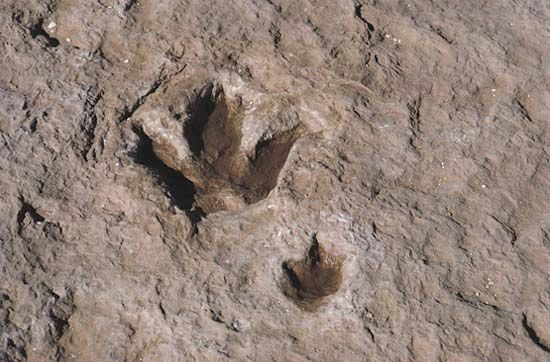
- Behavior: Trace fossils—such as footprints, trackways, and nesting sites—provide evidence of social behaviors like herding, migration, and nesting.1115
- Biomechanics: By analyzing trackways and limb joints, scientists can estimate movement speeds and feeding habits.14
- Environment: The presence of specific fossils helps geologists determine the climate and environmental conditions of the site where the organism lived.1112
Sources
- Greenops — Encyclopædia Britannica
- Green architecture — Encyclopædia Britannica
- trilobite — Encyclopædia Britannica
- Trilobita — Merriam-Webster
- Isotelus — Encyclopædia Britannica
- A Journey Through Time Since the Precambrian - Devonian Period: 419.2 million to about 359 million years ago — Encyclopædia Britannica
- Devonian Period - Paleoclimate — Encyclopædia Britannica
- Devonian Period - Significant geologic events — Encyclopædia Britannica
- Devonian Period - Extinction events — Encyclopædia Britannica
- Devonian Period - Devonian life — Encyclopædia Britannica
- fossil — Encyclopædia Britannica
- Denisova Cave — Encyclopædia Britannica
- dinosaur - Herding behaviour — Encyclopædia Britannica
- Comparative anatomy — Encyclopædia Britannica
- How are fossils formed? — Encyclopædia Britannica
- fossil record — Encyclopædia Britannica
- dinosaur - Modern studies — Encyclopædia Britannica
Published on · 3 min read