Isotelus
Isotelus is a genus of extinct trilobites—a group of marine arthropods—that lived during the Ordovician Period, approximately 488 million to 444 million…
What is Isotelus?
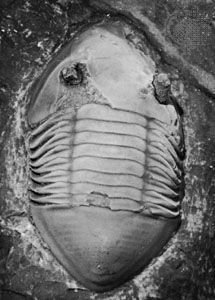
Isotelus is a genus of extinct trilobites—a group of marine arthropods—that lived during the Ordovician Period, approximately 488 million to 444 million years ago.1
These creatures were found in North America and Europe and were notably large for their kind. They are recognized by a distinctive flat body shape, large and well-developed head and tail sections, and large, crescent-shaped eyes. Additionally, they possessed a relatively small number of thoracic segments.1
What are the main characteristics of trilobites?
Trilobites are a group of extinct fossil arthropods that lived exclusively in marine environments. They first appeared approximately 521 million years ago during the Cambrian Period and persisted until the Permian Period.2
Key Characteristics
- Body Structure: They are defined by a distinctive three-lobed, three-segmented form. The body is divided longitudinally into a central axial lobe with two side lobes, and segmented into three regions: the cephalon (head), the thorax, and the pygidium (tail).2
- Exoskeleton: Like other arthropods, they possessed a chitinous exoskeleton. Because this shell had to be shed for the animal to grow, fossilized molted exoskeletons are relatively common.2
- Appendages and Senses: Each body segment featured a pair of jointed appendages. The forwardmost appendages were adapted for feeding and sensing. Most species possessed compound eyes, though some were eyeless.2
- Diversity: Trilobites varied significantly in size, ranging from small forms to large predators like Paradoxides harlani, which could exceed 45 cm in length. Their diets were equally diverse, including scavenging, predation, and filter-feeding on plankton.2
What was the environment like during the Ordovician Period?
The Ordovician Period (approximately 485.4 to 443.4 million years ago) was a time of profound environmental transformation characterized by significant tectonic activity, fluctuating sea levels, and a greenhouse climate.4
Paleogeography and Sea Levels
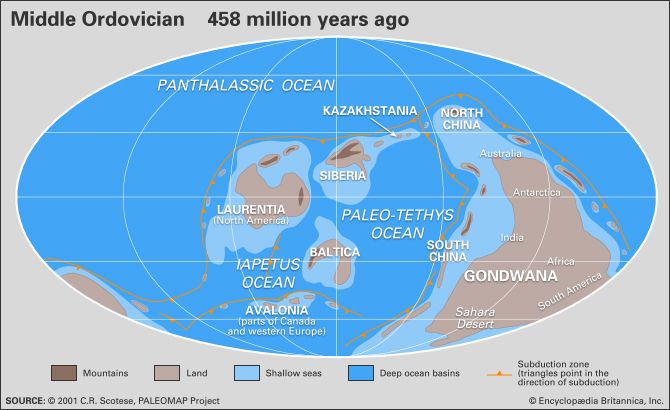
Following the breakup of the supercontinent Rodinia, rapid seafloor spreading created tall oceanic ridges, which displaced vast amounts of water. This led to some of the highest global sea levels in the Phanerozoic Eon, flooding continental interiors and creating expansive, shallow epicontinental seas. Tectonic plates were in constant motion, with continents like Laurentia, Baltica, and Gondwana shifting positions, often accompanied by intense volcanic activity and orogenic (mountain-building) events.564
Climate
The period was generally warm, with atmospheric carbon dioxide levels estimated to be 14–16 times higher than today. This greenhouse effect maintained warm temperatures from the Equator to the poles. However, the period ended with a dramatic shift; the movement of Africa over the South Pole and a drawdown of carbon dioxide triggered a major glaciation event. This caused sea levels to drop significantly, contributing to the second-largest mass extinction in Earth’s history.748
How do scientists determine the age of fossils?
Scientists determine the age of fossils and the rocks in which they are found using two primary approaches: relative dating and absolute dating.11
Relative Dating
Relative dating establishes the sequence of events rather than a specific numerical age. This method relies on the principle of faunal succession, which observes that fossils appear in a specific, predictable order within rock layers. By identifying index fossils—species that were abundant, widespread, and existed for a relatively short period—geologists can correlate rock units across different locations to determine their relative ages.1211
Absolute Dating
Absolute dating, or geochronology, provides a numerical age by measuring the decay of radioactive isotopes within minerals.1311
- Radiometric Dating: Scientists measure the ratio of “parent” radioactive atoms to “daughter” atoms produced by decay. Because radioactive decay occurs at a constant, known rate, this ratio reveals how much time has passed since a mineral formed. Common systems include uranium-lead, potassium-argon, and rubidium-strontium dating.13141115
- Carbon-14 Dating: Used for organic materials up to approximately 60,000 years old, this method measures the decay of the radioactive isotope carbon-14 in samples like bone or wood.1615
While fossils provide the relative framework, absolute dating is essential for calibrating the fossil record and determining the precise timing of Earth’s history.11
Sources
- Isotelus — Encyclopædia Britannica
- trilobite — Encyclopædia Britannica
- Devonian Period - Invertebrates — Encyclopædia Britannica
- A Journey Through Time Since the Precambrian - Ordovician Period: 485.4 million to 443.4 million years ago — Encyclopædia Britannica
- Ordovician Period - Invertebrates — Encyclopædia Britannica
- Ordovician Period - Sea level — Encyclopædia Britannica
- Ordovician Period - Causes — Encyclopædia Britannica
- Ordovician Period - Mass extinction at the end of the Ordovician — Encyclopædia Britannica
- Ordovician Period - Paleoclimate — Encyclopædia Britannica
- Ordovician Period - Plate tectonics — Encyclopædia Britannica
- dating: Top Questions — Encyclopædia Britannica
- dating - Carbon-14 dating and other cosmogenic methods — Encyclopædia Britannica
- dating - Principles of isotopic dating — Encyclopædia Britannica
- dating - Distinctions between relative-age and absolute-age measurements — Encyclopædia Britannica
- dating - Principles and techniques — Encyclopædia Britannica
- dating - Origin of radioactive elements used — Encyclopædia Britannica
Published on · 3 min read