Growth Ring
Growth rings are not present in all plants; they are primarily a feature of woody plants that undergo secondary growth.
Are growth rings present in all types of plants, or only in certain species?
Growth rings are not present in all plants; they are primarily a feature of woody plants that undergo secondary growth.12
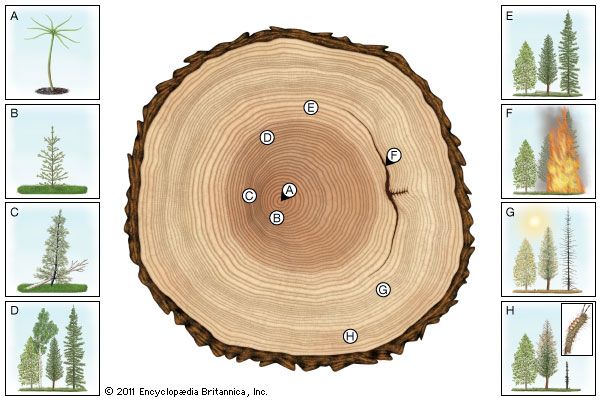
Growth rings form in the stems of woody species as a result of the activity of the cambium, a layer of actively dividing cells that produces new wood. This process is most distinct in temperate regions, where seasonal changes lead to the formation of annual rings. In contrast, herbaceous plants—which lack true woody tissues—typically undergo little or no secondary growth and therefore do not form these rings.132
Even among woody plants, the visibility and regularity of growth rings vary significantly:
- Temperate species: Often display clear annual rings due to distinct seasonal growth patterns.12
- Tropical and subtropical species: May form rings in response to cyclic environmental conditions rather than on an annual basis, and these rings are often less discernible.12
- Variations: Factors such as drought, insect defoliation, or other environmental stresses can cause “false rings” or result in missing rings, complicating their use in dating.12
Can growth rings be used to date archaeological wooden artifacts?
Yes, growth rings are a valuable tool for dating archaeological wooden artifacts through a scientific discipline known as dendrochronology.45
This method relies on the fact that many tree species produce annual growth rings, the width of which varies based on environmental factors like precipitation and temperature. By analyzing the sequence of these rings in wooden beams from ancient structures, old paving blocks, or other wooden artifacts, researchers can create a “signature” of growth patterns. When these sequences are matched against established master chronologies—which have been extended back thousands of years by comparing living trees with deadwood—archaeologists can determine the precise year the wood was harvested.467
This technique has been successfully used to date prehistoric sites, such as those in the American Southwest, reaching back to the 3rd and 4th centuries BCE. Beyond providing absolute dates, dendrochronology also serves as a critical tool for verifying and calibrating carbon-14 dating results, helping to resolve potential discrepancies in historical timelines.576
What are growth rings and how do they form in plants?
Growth rings, also known as growth increments, are layers of wood produced in the stems of woody plants through the activity of the vascular cambium, a lateral meristem that generates new xylem and phloem.18
How They Form
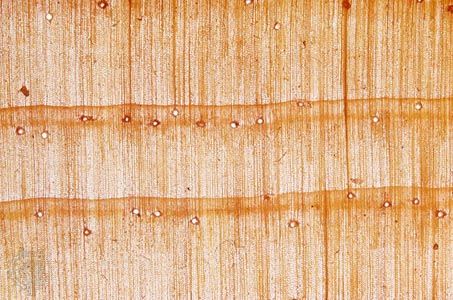
Growth rings form due to variations in the density, cell size, and wall thickness of the wood produced throughout a growing season.18
- Earlywood: Produced at the start of the growing season, these cells are typically larger with thinner walls, making the wood less dense.189
- Latewood: Produced later in the season, these cells generally have thicker walls and smaller diameters, resulting in higher density and often a darker appearance.189
The visible demarcation between the dense latewood of one cycle and the large-celled earlywood of the next creates the distinct boundary of a growth ring. While these are often annual in temperate regions, many trees in tropical or subtropical climates form rings in response to cyclic environmental conditions rather than strictly annual ones. Factors such as drought or stress can also lead to “false rings” or missing rings, which provide valuable data for dendroclimatology.18
How do scientists use growth rings to determine a plant’s age?
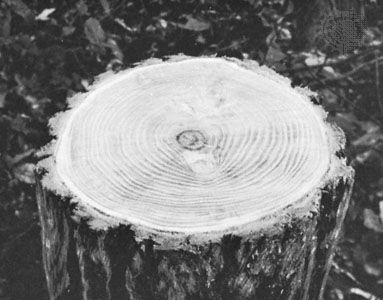
Scientists determine the age of a tree by counting its growth rings, which are layers of wood added to the stem during a single growth period. In temperate regions, where trees experience distinct seasonal changes, these are typically referred to as annual rings.61
To establish a tree’s age, researchers count the number of these rings at the base of the trunk or, if the trunk is hollow, at the base of a large root. This process is a fundamental component of dendrochronology, a scientific discipline that uses these patterns to date not only living trees but also deadwood and wooden artifacts from archaeological sites.6459
While counting rings is a standard method, scientists must account for potential complications. For instance, some trees may fail to form a ring during a severe season, or they may produce a “false ring” due to environmental stress, such as drought or insect defoliation. By comparing ring sequences from multiple trees with overlapping ages, researchers can create a reliable, long-term chronology that extends back thousands of years.19645
Sources
- Tree - Growth ring formation — Encyclopædia Britannica
- Herbaceous plant — Encyclopædia Britannica
- Growth ring — Encyclopædia Britannica
- dendrochronology — Encyclopædia Britannica
- Holocene Epoch - Chronology and correlation — Encyclopædia Britannica
- geochronology - Tree-ring growth — Encyclopædia Britannica
- Archaeology - Dating — Encyclopædia Britannica
- Angiosperm - Secondary vascular system — Encyclopædia Britannica
- wood - Earlywood , latewood , and pores — Encyclopædia Britannica
Published on · 4 min read