Grunt
Grunts, which belong to the family Haemulidae, are considered edible and are valued as food sources. While many species are relatively small, certain…
Are grunt fish important for commercial or recreational fishing?
Grunts, which belong to the family Haemulidae, are considered edible and are valued as food sources. While many species are relatively small, certain varieties—such as the pigfish (Orthopristis chrysoptera)—are specifically recognized as food fish in the western Atlantic. Their presence in warm and tropical coastal waters makes them accessible for various types of fishing, though their commercial or recreational significance is primarily tied to their status as a food resource.1
How do different species of grunt fish vary in appearance and behavior?
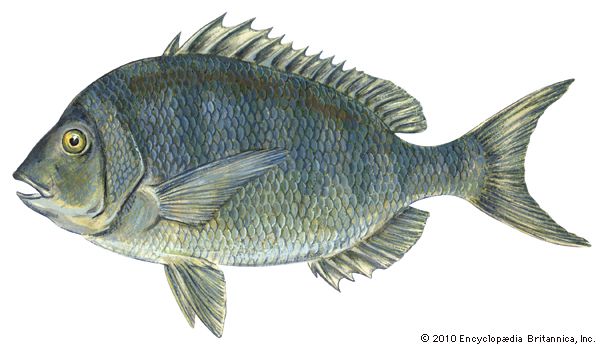
Grunts, members of the family Haemulidae, are a diverse group of approximately 150 species of marine fish. While they share a general snapper-like body shape, they lack canine teeth and are distinguished by their ability to produce pig-like grunting sounds using their pharyngeal (throat) teeth.1
Variations in Appearance
Species vary significantly in size and coloration:
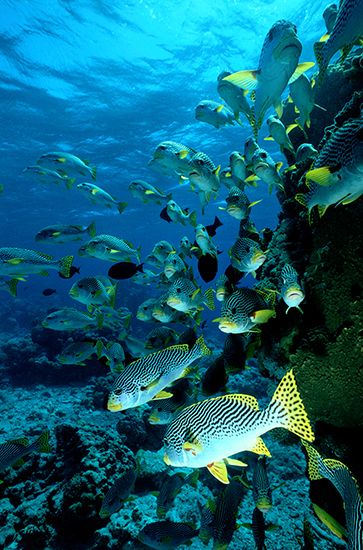
- Coloration: Many species are brightly colored or striped. For example, the blue-striped grunt is blue and yellow, the French grunt is silvery blue with yellow stripes, and the pigfish is striped in silver and blue. Others, such as the margate, are typically pearl gray, while some species are noted for dark coloration.12
- Mouths: Certain species in the genus Haemulon are characterized by bright, reddish mouth linings.1
- Size: Most grunts are relatively small, though some reach lengths of up to 46 cm (18 inches), such as the blue-striped grunt.1
Behavioral Traits
- Sound Production: The family is named for the distinct grunting noises they emit.1
- Social Interaction: Some species exhibit a unique “kissing” behavior, where two individuals approach and press their mouths together, though the exact purpose of this interaction remains unknown.1
- Ecological Roles: The porkfish serves as a “cleaner” when young, removing parasites from larger fish.1
What are grunt fish and where are they typically found?
Grunts are any of approximately 150 species of marine fish belonging to the family Haemulidae within the order Perciformes. These fish are typically found in warm and tropical coastal waters across the world’s major oceans.
They are characterized by a snapper-like body shape but are distinguished by their lack of canine teeth and their ability to produce pig-like sounds using their pharyngeal (throat) teeth. While many species are relatively small, they are generally valued as food, and some, such as the spotted grunter found in the Indian Ocean, are highly esteemed for both food and sport. Specific varieties include the tomtate, the sweetlips, and the porkfish, which is known for acting as a “cleaner” for other fish when young. Their distribution spans diverse regions, including the Atlantic Ocean and the West Indies.
How did grunt fish get their name, and what makes their sound unique?
Grunts, which belong to the family Haemulidae, derive their common name from the distinct, pig-like sounds they are capable of producing.1
This sound is unique because of the specific biological mechanism used to create it. Unlike some other fish that vibrate muscles against an air bladder, grunts produce their characteristic noise by grinding their upper and lower pharyngeal (throat) teeth together. These sounds are then amplified by the fish’s swim bladder, which acts as a resonator to project the noise. While the exact purpose of this acoustic activity is not fully understood, it is generally believed that such sounds in perciform fishes are often linked to feeding or spawning behaviors.15
Sources
- grunt — Encyclopædia Britannica
- black grunt — Merriam-Webster
- Haemulidae — Merriam-Webster
- spotted grunter — Merriam-Webster
- perciform - Sound production — Encyclopædia Britannica
Published on · 3 min read