What’s the Difference Between Seals and Sea Lions?
While seals and sea lions are both pinnipeds, they belong to different families and possess distinct anatomical and behavioral traits.
What’s the Difference Between Seals and Sea Lions?
While seals and sea lions are both pinnipeds, they belong to different families and possess distinct anatomical and behavioral traits.
Key Differences
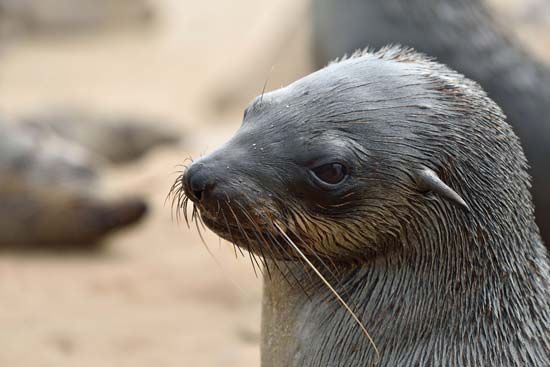
- Ears: Sea lions (family Otariidae) have visible external ear flaps, whereas “true” seals (family Phocidae) have only small ear holes.1
- Locomotion: Sea lions have long front flippers and can rotate their hind flippers forward to walk on land. In contrast, seals have short front flippers and cannot rotate their hind flippers, forcing them to “flop” or crawl on their bellies when onshore.12
- Swimming: Seals propel themselves by moving their hind flippers side to side like a fish tail, while sea lions use their long front flippers like oars.1
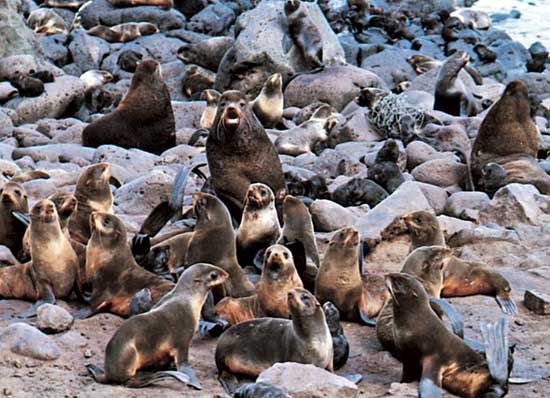
- Social Behavior: Sea lions are highly social, congregate in large groups, and are notably noisy, communicating through loud barks and bellows. Seals are generally quieter, preferring to communicate with soft grunts, and spend more time in the water.1
What are the main characteristics of walruses?
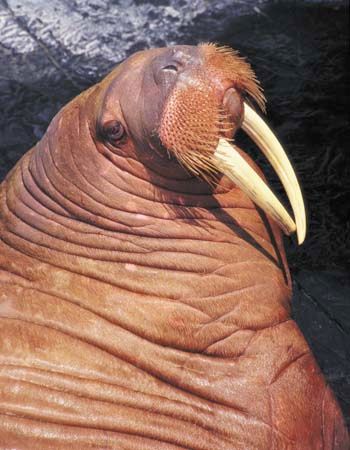
The walrus (Odobenus rosmarus) is a massive pinniped and the sole living member of the family Odobenidae. Found in Arctic seas, these gregarious animals are characterized by several distinct features:
- Physical Appearance: They have thick, grayish skin covered in short reddish hair, giving them a cinnamon hue. They possess a rounded head, no external ears, and a broad muzzle featuring a prominent mustache of stiff, quill-like whiskers used to identify prey along the ocean floor.
- Tusks: Both sexes have long tusks—elongated upper canine teeth—which are primarily used for mating displays and defense rather than digging for food.
- Locomotion: Like sea lions, walruses can rotate their hind flippers forward to walk on land using all four limbs.
- Diet and Habitat: They feed mainly on mollusks such as clams and mussels at depths of 10–80 meters. They inhabit coastal areas and ice floes, living in groups that can number over 100 individuals.
How do fur seals differ from true seals?
Fur seals are often confused with true seals, but they belong to different families and exhibit distinct physical and behavioral traits. While fur seals are members of the family Otariidae, true seals belong to the family Phocidae.1
Key Differences
- Ears: Fur seals possess visible external ear flaps, which is why they are often called “eared seals.” True seals lack these flaps and have only small ear holes.1
- Locomotion: Fur seals have long front flippers and can rotate their hind flippers forward to walk on land. True seals have short front flippers and cannot rotate their hind flippers, forcing them to move by flopping on their bellies.1
- Swimming: Fur seals propel themselves through the water using their long front flippers like oars. True seals swim by moving their hind flippers side to side like a fish tail.1
- Social Behavior: Fur seals are highly social, congregate in large groups, and communicate with loud barks or bellows. True seals are generally less social and communicate with soft grunts.1
What do seals and sea lions eat in the wild?
Seals and sea lions, which are both classified as pinnipeds, are strictly carnivorous animals that rely on a variety of marine prey to survive. While their specific diets can vary by species and habitat, they generally consume the following:2
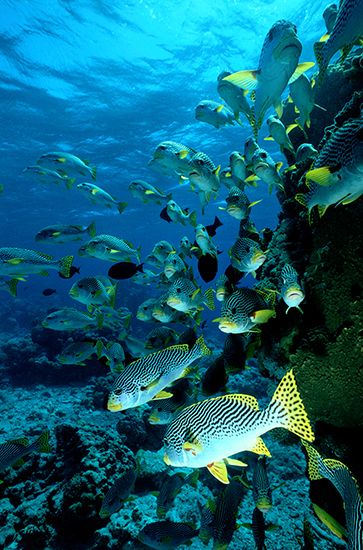
- Fish: This is the primary food source for most seals and sea lions. Species such as the hooded seal specifically target deepwater fish like halibut and redfish.524
- Cephalopods: Squid and octopus are common components of the diet for many species, including sea lions and various seals.652
- Crustaceans and Mollusks: Many pinnipeds consume crustaceans (such as crabs, lobsters, and shrimp) and mollusks (shellfish). Some, like the northern sea lion, also eat bivalves.62
- Other Prey: Some species have more specialized or opportunistic diets. For example, the leopard seal is known to hunt penguins, seabirds, and even other pinnipeds. Similarly, South American sea lions occasionally consume other seals.526
Pinnipeds are visual predators that use their sensitive whiskers to help detect prey in the water.2
Sources
- What’s the Difference Between Seals and Sea Lions? — Encyclopædia Britannica
- sea lion — Encyclopædia Britannica
- walrus — Encyclopædia Britannica
- pinniped — Encyclopædia Britannica
- seal — Encyclopædia Britannica
- hooded seal — Encyclopædia Britannica
Published on · 3 min read