Guiana Highlands
The Guiana Highlands are characterized by unique tabular plateaus known as tepuis, which are capped with resistant sandstone. Among the most famous of these…
What are some of the most famous tepuis (table-top mountains) in the Guiana Highlands?
The Guiana Highlands are characterized by unique tabular plateaus known as tepuis, which are capped with resistant sandstone. Among the most famous of these geological formations are:1
- Mount Roraima: Standing at 9,094 feet (2,772 meters), this giant flat-topped mountain is the highest point in Guyana and serves as the meeting point for the borders of Brazil, Venezuela, and Guyana. It is a significant source for several major river systems, including those of the Amazon and Orinoco.12
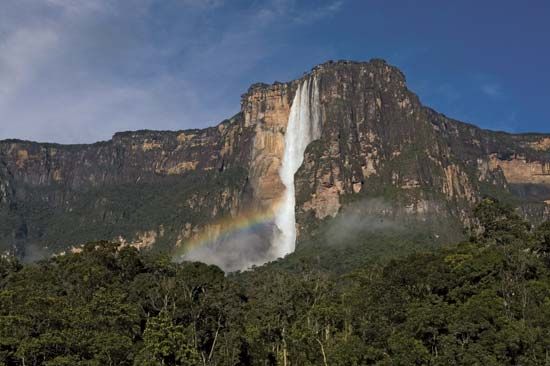
- Auyán-Tepuí: Known as “Devil’s Mountain,” this massive plateau is famous for being the source of Angel Falls, the world’s highest waterfall. Located in Venezuela’s Canaima National Park, the falls drop 3,212 feet (979 meters) from the edge of this tepui.13
What natural resources are found in the Guiana Highlands, and how are they being used?
The Guiana Highlands are a region of immense natural wealth, characterized by extensive mineral deposits and vast biological resources. The exploitation of these assets serves as a cornerstone for the economies of the surrounding nations, particularly Guyana, Suriname, and Venezuela.516
Mineral Resources
The region is rich in a variety of minerals, which are extracted through both small-scale and industrial operations:
- Bauxite: Guyana and Suriname are among the world’s leading producers of bauxite, the primary ore used to create aluminum.56
- Precious Metals and Stones: Gold and diamonds are found in alluvial and subsurface deposits throughout the region. These are often mined by independent prospectors or through small-to-medium-scale mining operations.571
- Industrial Minerals: The highlands contain significant deposits of iron ore—notably in Venezuela’s Serranía Imataca and at Cerro Bolívar—as well as manganese, nickel, copper, vanadium, chrome, molybdenite, kaolin, and graphite.51
Biological and Energy Resources
- Forestry: The dense tropical rainforests provide valuable hardwoods, such as the greenheart tree, which is highly prized for its resistance to decay and marine erosion. Other forest products include balata, chicle, vanilla, medicinal plants, and various cabinet woods.576
- Hydroelectric Power: The region’s numerous rivers possess significant hydroelectric potential. Major projects, such as the Guri and Macagua dams on the Caroní River, have been constructed to harness this energy for industrial use, including steel and aluminum production.16
- Petroleum and Gas: While primarily located in the adjacent lowlands and river basins, oil and natural gas reserves are critical to the regional economy, with ongoing exploration and extraction efforts in areas like the Guyana-Suriname Basin and the Orinoco Belt.51
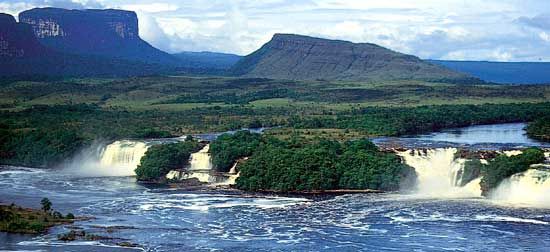
Where are the Guiana Highlands located in South America?
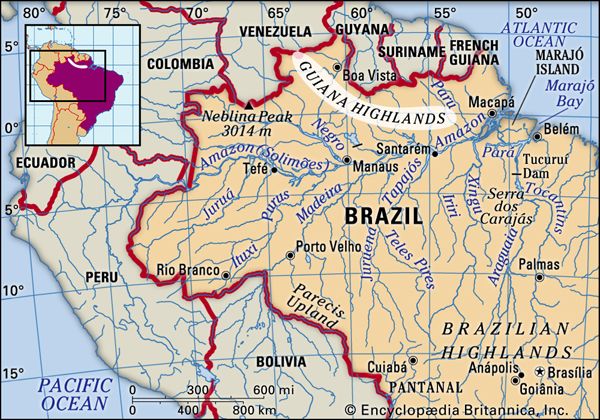
The Guiana Highlands are a vast plateau and low-mountain region located in northern South America. Geographically, the region is situated north of the Amazon River and south of the Orinoco River.1
The highlands span across several countries, covering:
- The southern half of Venezuela.
- The northern part of Brazil.
- A portion of southeastern Colombia.
- The entirety of the Guianas, excluding the low Atlantic coastal plain.1
Geologically, the region is part of the Guiana Shield, a stable area of ancient Precambrian crystalline rocks that forms a continental nucleus. The terrain is characterized by a mix of rolling hilly uplands, low mountains, and dramatic tabular plateaus capped with resistant sandstone.18
What unique flora and fauna can be found in the Guiana Highlands?
The Guiana Highlands are characterized by a diverse range of biological life, largely shaped by the region’s dense tropical rainforest cover and interspersed savanna patches.19
Flora
The region supports a vast array of plant species, particularly within the upper Orinoco valley, which contains hundreds of tree varieties. Notable botanical features include:9
- Hardwoods: The forests are a source of valuable timber, including the greenheart tree.110
- Economic and Medicinal Plants: The vegetation provides various resources such as balata, chicle, vanilla, insecticides, and numerous medicinal plants.1
- Savanna Vegetation: In areas where the forest is interrupted by savanna, one can find the moriche (or miriti) palm, which typically grows along water courses in gallery forests.9
Fauna
The highlands and their surrounding ecosystems host a variety of wildlife adapted to the tropical environment. Common species found in the broader region include:
- Mammals: Tapirs, ocelots, sloths, great anteaters, and armadillos.10
- Reptiles: Caimans are frequently found in the region’s river systems.10
Note: Please be aware that the “Guinea Highlands” in West Africa are a distinct geographical region from the “Guiana Highlands” of South America; ensure you are referencing the correct location when researching specific endemic species.
Sources
- Guiana Highlands — Encyclopædia Britannica
- Mount Roraima — Encyclopædia Britannica
- Angel Falls — Encyclopædia Britannica
- mountain - The Caribbean chains — Encyclopædia Britannica
- Guyana - Resources and power — Encyclopædia Britannica
- Orinoco River - Resource exploitation — Encyclopædia Britannica
- The Guianas — Encyclopædia Britannica
- continental shield — Encyclopædia Britannica
- French Guiana - Land — Encyclopædia Britannica
- Orinoco River - Plant life — Encyclopædia Britannica
- Guinea Highlands — Encyclopædia Britannica
Published on · 4 min read