Heliophyllum
Heliophyllum is a genus of extinct, solitary coral that lived during the Devonian Period, which began approximately 416 million years ago. These organisms…
What is Heliophyllum?
Heliophyllum is a genus of extinct, solitary coral that lived during the Devonian Period, which began approximately 416 million years ago. These organisms are categorized as a type of horn coral, a group belonging to the order Rugosa1.12
The structure of Heliophyllum is characterized by distinct, periodic laminations. Because this growth pattern is a function of time, scientists have utilized these fossils as biological clocks to estimate the length of days and years during the Devonian era. It is important to distinguish this genus from Heliophila, which refers to a genus of flowering plants in the family Cruciferae.123
How do scientists use fossils as biological clocks?
Scientists use certain fossil corals as biological clocks by analyzing their growth patterns to determine the length of days and years in the distant past. This method relies on the fact that the Earth’s rotation has gradually slowed over time, meaning there were more days in a year millions of years ago than there are today.4
Specifically, horn corals like Heliophyllum exhibit fine external ridges of calcium carbonate, where each ridge is believed to represent a single day’s growth. By counting these ridges within a cluster that corresponds to one annual growth cycle, researchers can estimate the number of days per year during the period the coral lived. For instance, Middle Devonian corals typically show between 385 and 410 ridges, suggesting a year was significantly longer during that era.41
While this technique is elegant in concept, it requires exceptionally well-preserved specimens to accurately count the ridges. It serves as a nonradiometric method for understanding historical changes in the Earth’s rotation.4
What defines the Devonian Period?
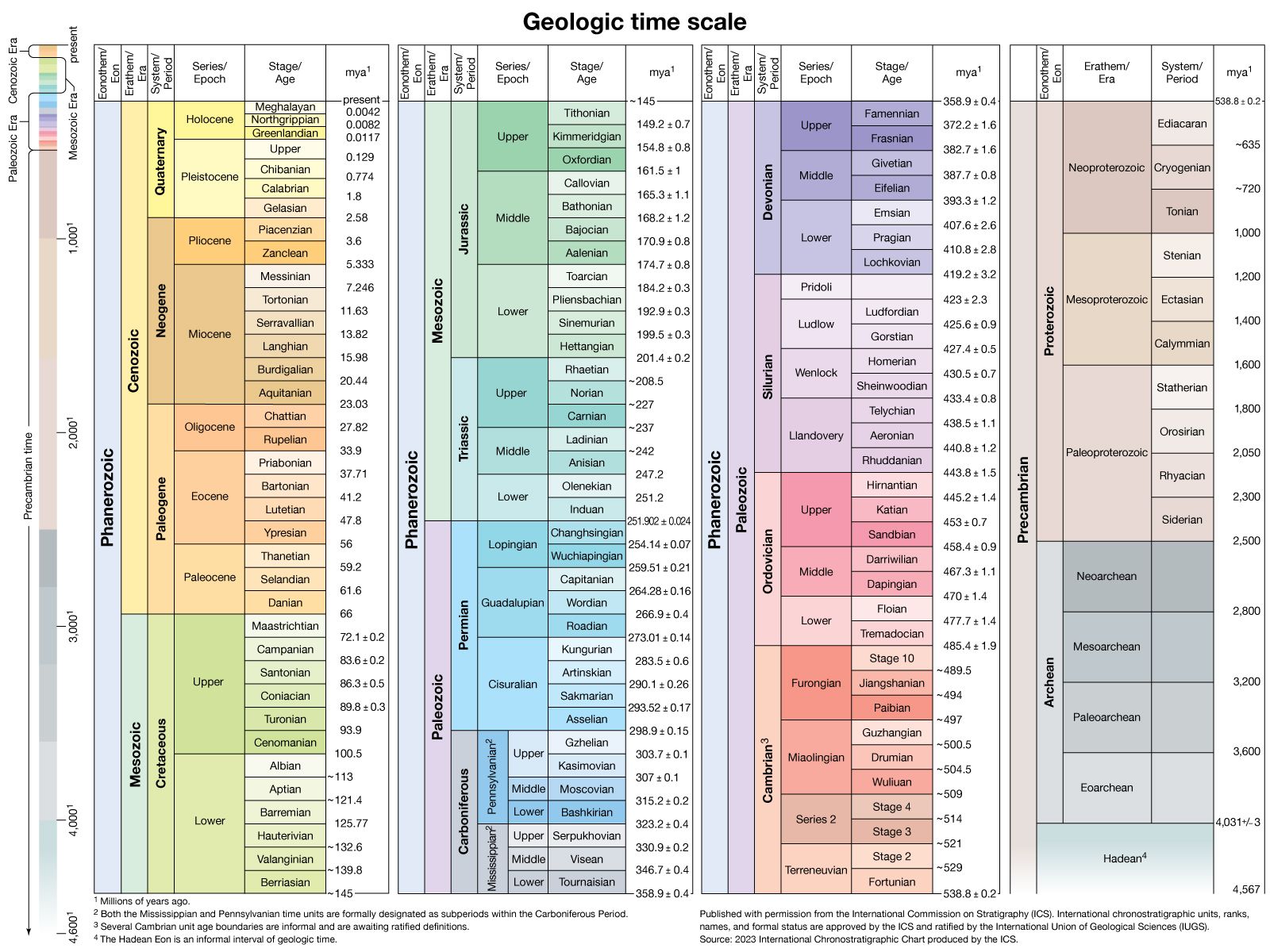
The Devonian Period is an interval of the Paleozoic Era that occurred between approximately 419.2 million and 358.9 million years ago, following the Silurian Period and preceding the Carboniferous Period.6
Often called the “Age of Fishes,” the period is defined by the following key characteristics:
- Biological Evolution: The era saw the first appearance of ammonites and forests. It is particularly noted for the extensive evolutionary radiation of fish and the emergence of the first four-legged amphibians toward the end of the period, marking the colonization of land by vertebrates.786
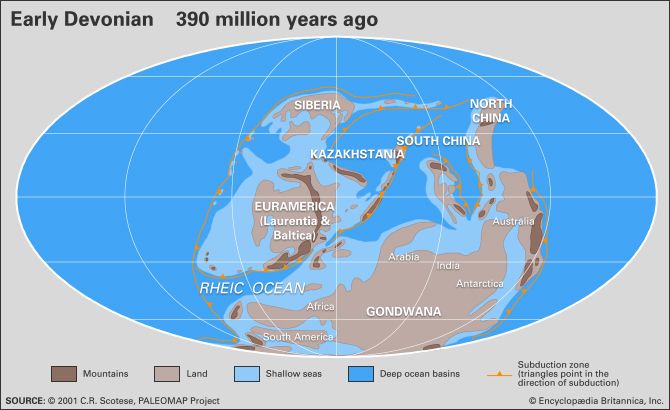
- Geology and Geography: Early in the period, the paleocontinents of Laurentia and Baltica collided to form the supercontinent Laurussia (or Euramerica). This event, linked to the Caledonian orogeny, created vast terrestrial deposits known as the Old Red Sandstone.86
- Climate and Extinction: The climate was generally warm and equitable, though the period experienced significant extinction events linked to episodes of ocean anoxia (reduced oxygen levels) and fluctuating sea levels.796
What are the main differences between solitary and colonial corals?
The primary distinction between solitary and colonial corals lies in their growth habits and structural organization.
- Colonial Corals: These organisms grow through a process of budding, where new polyps remain attached to the original individual. Over time, these polyps divide into daughter polyps, forming large, continuous colonies held together by a shared, rigid calcium carbonate skeleton. These colonies can reach several meters in diameter and are the primary architects of coral reefs.1011
- Solitary Corals: In contrast, solitary corals exist as individual polyps rather than as part of a connected group. While they also possess a skeleton, they do not form the large, integrated structures characteristic of reef-building species. Solitary forms are often found in deeper, colder waters, such as the abyssal floors of the oceans.1011
While many stony corals exhibit both habits, colonial forms are essential for reef construction, whereas solitary corals generally do not contribute to reef building.101112
Sources
- Heliophyllum — Encyclopædia Britannica
- horn coral — Encyclopædia Britannica
- Heliophila — Merriam-Webster
- geochronology - Coral growth — Encyclopædia Britannica
- geochronology - Accumulational processes — Encyclopædia Britannica
- A Journey Through Time Since the Precambrian - Devonian Period: 419.2 million to about 359 million years ago — Encyclopædia Britannica
- Devonian Period - Extinction events — Encyclopædia Britannica
- Devonian Period - Significant geologic events — Encyclopædia Britannica
- Devonian Period — Encyclopædia Britannica
- coral — Encyclopædia Britannica
- coral reef - Corals and other reef-building organisms — Encyclopædia Britannica
- ahermatypic — Merriam-Webster
Published on · 3 min read