Horn Fly
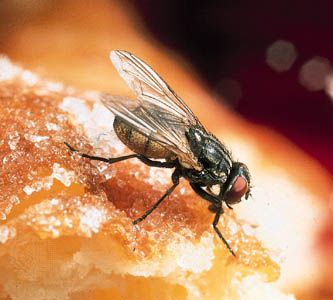
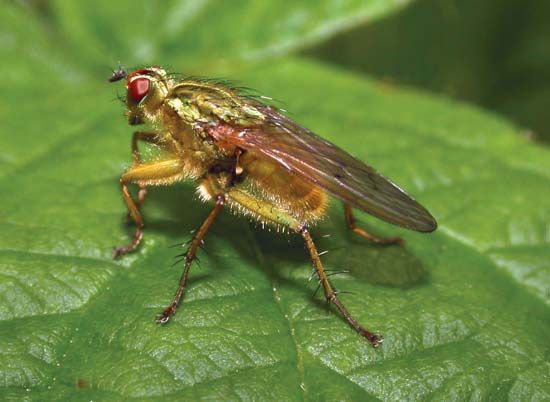
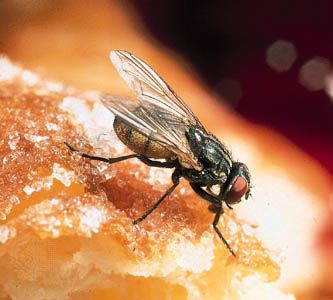
The horn fly (Haematobia irritans) is a small, blood-sucking insect belonging to the family Muscidae. Roughly half the size of a common housefly, this…
What is horn fly?
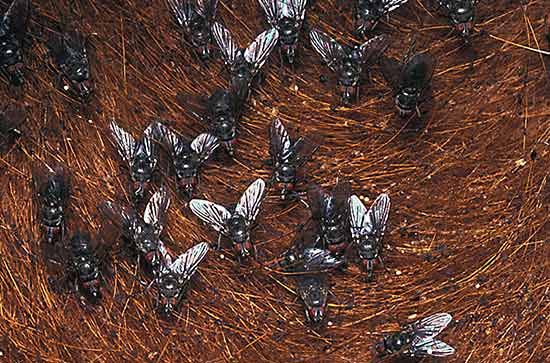
The horn fly (Haematobia irritans) is a small, blood-sucking insect belonging to the family Muscidae. Roughly half the size of a common housefly, this species is a significant pest for cattle1.12
Adult horn flies typically cluster on the neck, rump, and the base of the horns of cattle to feed on blood. These persistent attacks can lead to reduced milk production and weight loss in the animals. Originally from Europe, the fly was introduced to North America around 1887.1
The life cycle of the horn fly is completed in 10 to 12 days, with the flies breeding exclusively in fresh cow dung. Management strategies to control populations include the application of chemical sprays and the administration of feed-through chemicals to cattle to prevent larvae from developing in their waste.1
How do farmers protect their cattle from horn flies?
Farmers protect their cattle from the horn fly by employing several targeted control strategies to mitigate the economic impact of these pests on livestock health and productivity.
Because horn flies breed exclusively in fresh cow dung, management focuses on breaking their 10-to-12-day life cycle. Common methods include:
- Chemical Sprays: Direct application of insecticides to the cattle to kill adult flies and reduce the frequency of blood-feeding attacks.1
- Feed-through Chemicals: Adding specific chemicals to the cattle’s diet that pass through the digestive system into the manure, preventing larvae from successfully developing in the dung.1
By reducing the population of these pests, farmers help prevent the weight loss and decreased milk production associated with horn fly infestations.1
What are the four stages of a fly’s life cycle?
Flies undergo a process known as holometabolous (complete) metamorphosis, which consists of four distinct stages:3
- Egg: The life cycle begins when the female deposits eggs, which typically hatch within a short period (e.g., 12 to 24 hours for the housefly).4
- Larva: Often referred to as a maggot, this stage is wingless and specifically adapted for growth and development rather than reproduction. Larvae may undergo several molts, known as instars, as they grow.345
- Pupa: During this inactive, nonfeeding stage, the insect undergoes a dramatic transformation. Larval tissues are broken down, and adult structures—such as wings, legs, and eyes—are developed. The pupa may be protected by a cocoon or a hardened larval skin called a puparium.36
- Adult: The final stage, in which the insect emerges to reproduce and distribute the species.73
Why do some flies feed on blood while others do not?
The primary reason some flies feed on blood is to compensate for nutritional deficiencies in their larval diet. While larval development is the main stage for growth, adult females of many species—such as mosquitoes, black flies, and biting midges—require the protein-rich meal provided by blood to mature their eggs.89
Flies that cannot produce eggs without a blood meal are termed anautogenous, while those that can lay at least one batch without blood are called autogenous. In contrast, many other flies do not feed on blood because they obtain necessary nutrients—such as carbohydrates from nectar and proteins from pollen—by visiting flowers or consuming decaying organic matter.8
The ability to feed on blood is also linked to specialized mouthparts. Bloodsucking flies have evolved structures like serrated blades or needlelike stylets to pierce skin and access blood vessels. Conversely, flies like the housefly lack these piercing tools and are restricted to feeding on exposed fluids.3
Sources
- horn fly — Encyclopædia Britannica
- horn fly — Merriam-Webster
- Diptera - General features — Encyclopædia Britannica
- Metamorphosis — Encyclopædia Britannica
- housefly — Encyclopædia Britannica
- Diptera - Pupa — Encyclopædia Britannica
- Diptera - Molts and larval stages — Encyclopædia Britannica
- Diptera - Adults — Encyclopædia Britannica
- insect - Head — Encyclopædia Britannica
- Chemoreception - Blood-feeding insects — Encyclopædia Britannica
- Diptera — Encyclopædia Britannica
Published on · 3 min read