Horsehair Worm
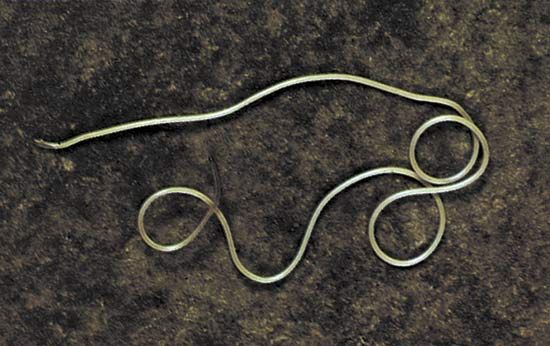
A horsehair worm—also known as a hairworm—is any of the approximately 250 to 300 species belonging to the class Nematomorpha.
What is horsehair worm?
A horsehair worm—also known as a hairworm—is any of the approximately 250 to 300 species belonging to the class Nematomorpha.12
These organisms are characterized by their long, thin, hairlike bodies, which can reach lengths of up to 1 meter (about 39 inches). Their life cycle involves two distinct stages:1
- Larval stage: They are parasitic, living inside arthropods.12
- Adult stage: They are free-living, inhabiting either freshwater or marine environments.12
While most are classified under the phylum Nematomorpha, the term “hairworm” can sometimes refer to the genus Capillaria, which includes parasitic nematodes that affect the digestive tracts of fowls and the tissues of mammals. Marine species, such as those in the order Nectonematoidea, are notable for having natatory bristles and a parasitic stage within crustaceans.23
How do horsehair worms influence the behavior of their hosts?
Sorry, the Britannica knowledge base does not contain information regarding how horsehair worms influence the behavior of their hosts. While the provided search results discuss how other types of parasitic worms, such as flukes, manipulate host behavior through aggressive mimicry, they do not provide specific details on the behavioral manipulation performed by horsehair worms.
What are the main differences between Nematomorpha and other parasitic worms?
The classification of Nematomorpha (horsehair worms) and other wormlike invertebrates has evolved significantly. While they were historically grouped within the obsolete phylum Aschelminthes due to their shared possession of a pseudocoel—a body cavity lacking a mesodermal lining—modern taxonomy treats these groups as distinct phyla.1
The primary differences between Nematomorpha and other parasitic worms, such as Nematoda or Acanthocephala, involve their life cycles and developmental traits:
- Life Cycle: Unlike many other parasitic worms that remain parasitic throughout their lives, Nematomorpha exhibit a dual life cycle. The young are parasitic within arthropods, while the adults are free-living in freshwater or marine environments.35
- Evolutionary Relationships: While the former aschelminths do not share close evolutionary linkages, Nematomorpha and other former aschelminths are thought to be potentially related to arthropods because they all exhibit molting during development.1
- Classification: Scientific consensus on their placement remains fluid; some systems group Nematomorpha within the phylum Nematoda, while others maintain them as a separate phylum entirely.16
Do horsehair worms pose any danger to humans or pets?
It is a common misconception to conflate horsehair worms (phylum Nematomorpha) with other parasitic worms that affect mammals. Horsehair worms are not dangerous to humans or pets. Their larval stage is exclusively parasitic to arthropods, and the adults are free-living in aquatic environments, meaning they do not infect or inhabit the bodies of humans or domestic animals.12
Confusion often arises because the term “hairworm” is sometimes used to describe members of the genus Capillaria, which are nematode worms that can act as serious parasites in the digestive tracts and organs of mammals and fowls. However, these are biologically distinct from the Nematomorpha class.21
Sources
- horsehair worm — Encyclopædia Britannica
- hairworm — Merriam-Webster
- Nectonematoidea — Merriam-Webster
- mimicry - Parasitic worms — Encyclopædia Britannica
- aschelminth — Encyclopædia Britannica
- Animal - Critical appraisal — Encyclopædia Britannica
Published on · 2 min read