How Much Does a Falcon Eat Each Day?
An adult falcon typically consumes between 70 and 154 grams (2.5 to 5.4 ounces) of food each day. Generally, this amount equates to approximately 10 percent…
How Much Does a Falcon Eat Each Day?
An adult falcon typically consumes between 70 and 154 grams (2.5 to 5.4 ounces) of food each day. Generally, this amount equates to approximately 10 percent of the bird’s total body weight daily.1
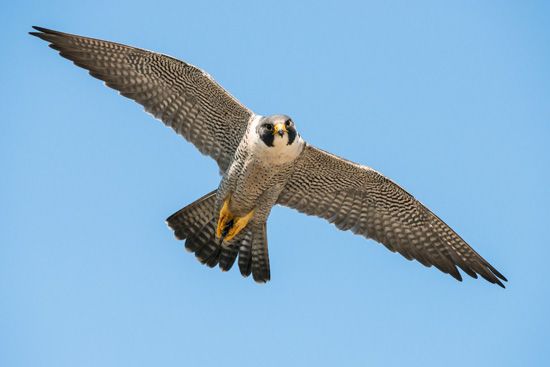
The exact quantity required can vary based on several factors, including the specific species, the individual’s size, and the local availability of prey. While falcons are highly skilled hunters that primarily target birds, their diet may also include bats, fish, large insects, and small mammals. Because these birds are efficient predators, they are able to capture the necessary amount of food to sustain their high-energy lifestyles, such as the peregrine falcon, which is capable of reaching speeds over 300 km (186 miles) per hour during a dive.1
When calculating the total impact on prey populations, researchers also account for the percentage of a kill that goes to waste, which can range from less than 5 percent to 20 percent depending on the type of prey consumed.2
How does the peregrine falcon reach such high speeds while diving?
The peregrine falcon achieves its remarkable diving speeds—which can exceed 320 km (200 miles) per hour—through a combination of specialized physical adaptations and the force of gravity.14
Key factors contributing to this speed include:
- Body Shape: Falcons possess heavy, bullet-shaped bodies that are aerodynamically designed to minimize drag during high-speed descents.4
- Wing Structure: They have long, pointed wings that are well-suited for high-velocity flight.4
- High Wing Loading: Unlike birds adapted for buoyant soaring, falcons have high wing loading—the ratio of body weight to wing area. This physical trait is essential for maintaining the momentum required for rapid, controlled dives.4
- Gravity: During a dive, the falcon utilizes gravity to accelerate, increasing its angle of descent to reach its maximum velocity before striking prey with its talons.14
By utilizing these traits, the peregrine falcon can overtake prey that would otherwise easily evade it in standard flapping flight.4
What physical adaptations help falcons hunt different types of prey?
Falcons possess a suite of specialized physical adaptations that allow them to thrive as predators across diverse environments and prey types. These adaptations are primarily focused on their vision, flight capabilities, and specialized appendages for capturing and consuming prey.67
Vision and Sensory Adaptations
Falcons rely heavily on their highly developed eyes, which feature two areas of high visual acuity (foveae) that provide resolving power up to eight times greater than that of the human eye. This allows them to track fast-moving prey with extreme precision. While their sense of smell is generally poor, some species, such as forest falcons and harriers, have evolved larger ear apertures surrounded by specialized feathers to enhance hearing, which is critical for locating prey in dense vegetation or tall grass.8
Flight and Body Structure
The physical build of a falcon is directly tied to its hunting strategy:
- Open-terrain hunters: Species like the peregrine falcon feature streamlined, bullet-shaped bodies and long, pointed wings. These traits minimize drag, enabling the high-speed, powerful flight necessary to capture other birds in mid-air.97
- Forest-dwelling species: Falcons that hunt in enclosed, wooded areas often possess shorter, rounded wings and longer tails, which provide the maneuverability required to navigate through trees.7
Killing and Feeding Appendages
The beak and feet are the primary tools for securing and processing food. Falcons have a hooked beak, often featuring a notch or toothlike structure on the cutting edge, which is specifically adapted for breaking the necks of their prey. Their feet are equipped with strong, curved talons designed for piercing and grasping. The structure of these feet varies by species; for example, some have needle-like talons for killing birds, while others have thicker, heavier toes capable of subduing larger mammals.63
Why are female falcons typically larger than males?
In many bird species, including falcons, females are typically larger than males, a phenomenon known as sexual dimorphism. Among bird-killing falcons and accipiters, females are often 20–100 percent larger than their male counterparts.11
While the provided search results confirm that this size difference is a common feature of falconiforms, they do not explicitly detail the specific evolutionary or ecological advantages—such as niche partitioning or reproductive roles—that drive this female-biased size dimorphism in these raptors. In contrast, the literature notes that in many other animal groups, such as mammals, males are often larger due to sexual selection and competition for mates.31213
Sources
- How Much Does a Falcon Eat Each Day? — Encyclopædia Britannica
- Falconiform - Feeding — Encyclopædia Britannica
- Falconiform - General features — Encyclopædia Britannica
- Peregrine falcon — Encyclopædia Britannica
- Falconiform - Flapping, soaring , and diving — Encyclopædia Britannica
- Falconiform - Form and function — Encyclopædia Britannica
- falconry - Types of birds used in falconry — Encyclopædia Britannica
- Falconiform - Feet and beak — Encyclopædia Britannica
- What are the differences between hawks and falcons? — Encyclopædia Britannica
- Falconiform - Vision, hearing, and smell — Encyclopædia Britannica
- Sexual dimorphism — Encyclopædia Britannica
- Did you know? — Merriam-Webster
- Falconiform - Life history — Encyclopædia Britannica
- sexual selection — Encyclopædia Britannica
- Falconiform - Reproduction — Encyclopædia Britannica
- evolution - Sexual selection — Encyclopædia Britannica
Published on · 3 min read