Hudson Strait
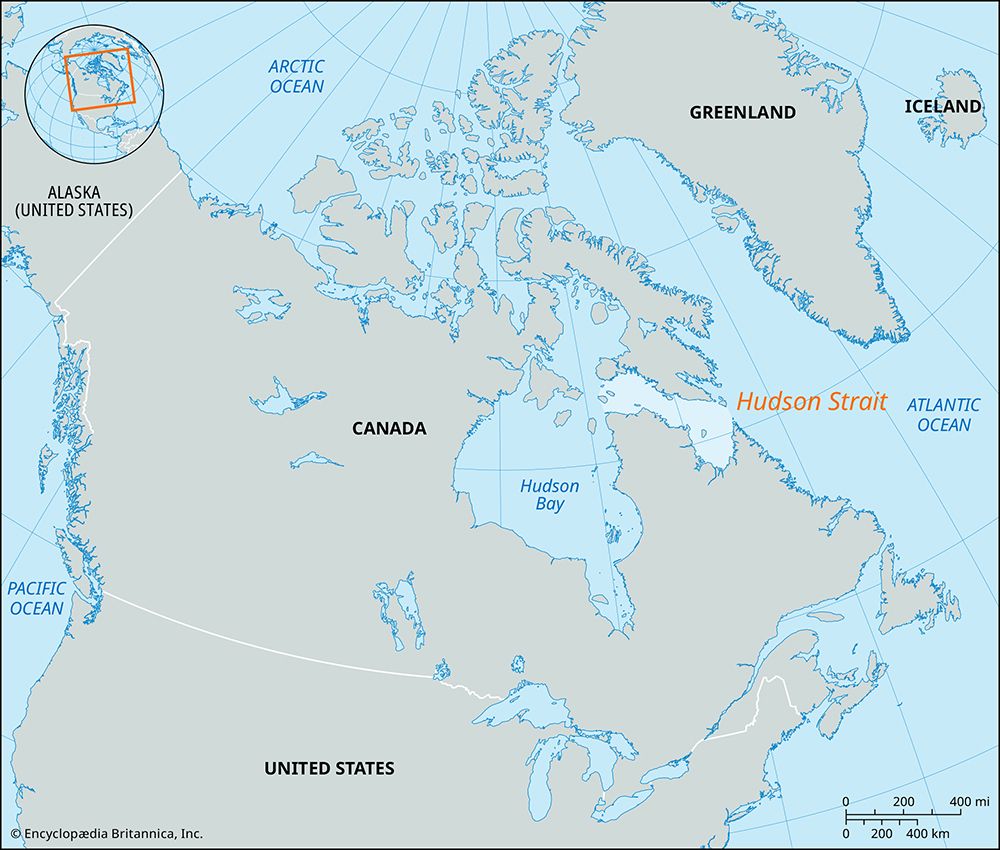
Hudson Strait is an arm of the Atlantic Ocean located in northeastern Canada. It serves as a vital waterway connecting Hudson Bay and the Foxe Basin to the…
What is Hudson Strait?
Hudson Strait is an arm of the Atlantic Ocean located in northeastern Canada. It serves as a vital waterway connecting Hudson Bay and the Foxe Basin to the Labrador Sea1.
Stretching approximately 450 to 500 miles in length and ranging from 40 to 150 miles in width, the strait separates Baffin Island in Nunavut from northern Quebec. It reaches a maximum depth of 3,090 feet. While the passage is naturally navigable only during late summer and early autumn, it remains accessible for much of the year with the assistance of icebreakers.12
Historically, the strait was partially explored by Sir Martin Frobisher in 1578 and fully navigated by Henry Hudson in 1610. Following Hudson’s voyage, it became a primary route for the Hudson’s Bay Company for the Hudson’s Bay Company.1
Who was Henry Hudson and what was he searching for?
Henry Hudson was an English navigator and explorer renowned for his efforts to discover a short maritime route from Europe to Asia through the Arctic Ocean.34
Throughout his career, Hudson undertook four major voyages with the primary goal of finding either a Northeast Passage by way of the North Pole or a Northwest Passage across North America.3 His search objectives included:4
- Northeast Passage: In 1607 and 1608, he attempted to reach Japan and China by sailing north and east, but he was repeatedly blocked by polar ice packs.4
- Northwest Passage: During his 1609 and 1610–11 voyages, he sought a western route to the Pacific Ocean. While exploring what is now the Hudson River and later Hudson Bay, he hoped to find a channel leading to the Pacific, though these efforts ultimately proved unsuccessful.4
Although he never found the passages he sought, his explorations significantly advanced geographical knowledge and established the basis for Dutch colonization of the Hudson River region and English claims to much of Canada.34
What role did the Hudson’s Bay Company play in Canadian history?
The Hudson’s Bay Company (HBC) is a cornerstone of Canadian history, serving as a dominant force in both the economic and political development of the nation. Incorporated in 1670, the company was granted proprietary control over Rupert’s Land—a vast territory stretching from Labrador to the Rocky Mountains—which it governed until 1870.56
Key roles in Canadian history include:
- Fur Trade Dominance: For two centuries, the HBC was the primary engine of the fur trade, establishing a network of trading posts that facilitated interaction between Europeans and Indigenous peoples, such as the Cree, Innu, and Inuit.56
- Territorial Expansion: The company’s operations were instrumental in mapping and claiming vast regions of North America for the British Empire.56
- Political Transition: In 1870, the HBC sold its remaining territories to the Canadian government, a pivotal event that paved the way for the expansion of the modern Canadian state.5
How do icebreakers help ships navigate frozen waters?
Icebreakers are specialized vessels designed to navigate frozen waters by overcoming the resistance of thick ice layers. They employ several key engineering features to clear a path:
- Hull Design: These ships are built with a strongly sloping bow profile, particularly near the waterline. This shape allows the vessel to wedge itself up onto the ice, using the ship’s static weight to crack the ice from above rather than simply pushing through it.7
- Reinforced Structure: To withstand the immense pressure of the ice, the hull is reinforced with heavy stiffeners and extra layers of plating along the waterline.7
- Propulsion and Power: Icebreakers possess high propulsive power to maintain momentum. They often utilize electric transmission between the engines and propellers, which provides precise control and allows power to be diverted away from a propeller if it becomes jammed by chunks of broken ice.7
- Propeller Protection: The hull geometry is specifically designed to divert ice away from the propellers. Additionally, propellers are frequently constructed with individually replaceable blades to facilitate easier repairs if damage occurs.7
Sources
- Hudson Strait — Encyclopædia Britannica
- Hudson Strait — Merriam-Webster
- Henry Hudson: Top Questions — Encyclopædia Britannica
- Henry Hudson — Encyclopædia Britannica
- Hudson’s Bay Company — Encyclopædia Britannica
- Native American - Subarctic and Arctic peoples — Encyclopædia Britannica
- iceberg - Iceberg detection, tracking, and management — Encyclopædia Britannica
- ship - Miscellaneous — Encyclopædia Britannica
- sea ice - Pack ice drift and thickness — Encyclopædia Britannica
- Bering Sea and Strait - Navigation — Encyclopædia Britannica
Published on · 3 min read