Jacaranda
Jacaranda refers to a genus of approximately 50 species of plants in the Bignoniaceae family, native to Central and South America and the West Indies. These…
What is Jacaranda?
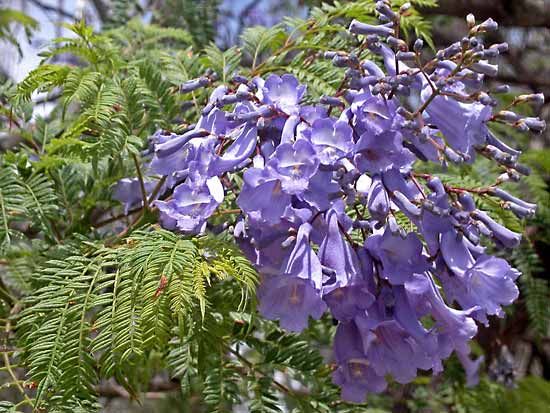
Jacaranda refers to a genus of approximately 50 species of plants in the Bignoniaceae family, native to Central and South America and the West Indies. These tropical trees are widely cultivated in warm climates for their showy blue or violet flowers and attractive, compound leaves. The most notable ornamental species include J. mimosifolia and J. cuspidifolia.12
It is important to note that the name “jacaranda” is sometimes inaccurately applied to unrelated trees. It is also used to describe certain species within the genus Machaerium of the pea family, which are sources of commercial rosewood. Additionally, the term “jacaranda cabinet wood” refers to a rosewood obtained from Dalbergia nigra, another member of the pea family, rather than the Jacaranda genus.1
What are some other trees known for their colorful flowers?
Beyond the Jacaranda genus, several other trees are celebrated for their vibrant and showy flowers:
- Royal Poinciana (Delonix regia): A striking member of the pea family, this tree is native to Madagascar. It is widely cultivated in frost-free regions for its large, brilliant scarlet to orange flowers and its dense, shade-providing canopy.3
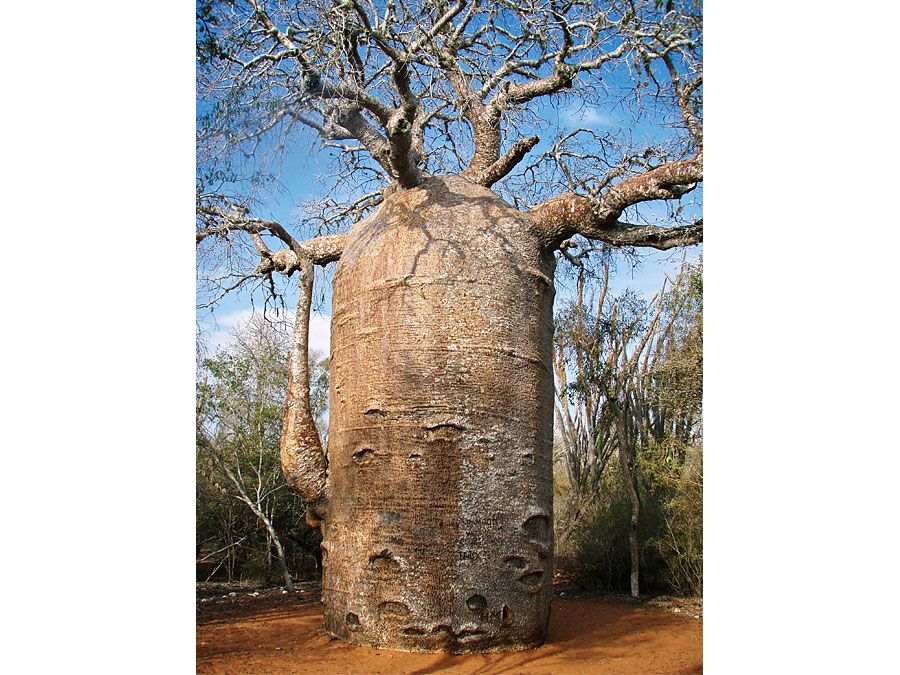
- Hibiscus and Related Genera: The Malvaceae family includes many species grown for their ornamental value. For example, baobabs (Adansonia) are noted for their distinctive appearance and flowers, while Dombeya species are frequently cultivated for their floral displays.4
- Linden (Tilia): Often planted along streets in temperate regions, these trees are valued for their beautifully scented flowers, in addition to their utility as a source of wood.4
- Thespesia: This genus includes trees such as the flor de maga (T. grandiflora), which is recognized as the national flower of Puerto Rico and produces flowers often compared to those of the Hibiscus.4
How do tropical trees adapt to different climates?
Tropical trees adapt to diverse climates through a combination of morphological, anatomical, and physiological strategies that allow them to manage resources like water, light, and nutrients.5
Leaf Adaptations
Leaves are highly responsive to environmental signals. In dry (xeric) conditions, trees often develop features to minimize water loss, such as smaller leaf areas, thicker cuticles, waxy coatings, and sunken stomates. Conversely, trees in supermoist (hydric) environments typically have larger leaves with thinner cuticles and larger stomates to facilitate gas exchange without the same pressure to conserve water.6
Root Systems and Structural Support
Tropical trees exhibit specialized root structures to survive in varying soil and moisture conditions:
- Buttress Roots: Common in wet lowland environments, these planklike extensions stabilize trees in shallow, saturated soils and help prevent nutrient-rich litter from washing away.7
- Pneumatophores: These specialized roots grow upward from the water surface to facilitate aeration in flooded or waterlogged soils, such as those found in mangrove forests.7
- Stilt Roots: Found in species like the red mangrove, these provide both structural support and aeration.7
Seasonal and Physiological Responses
In regions with distinct wet and dry seasons, such as tropical dry forests, many trees adapt by shedding their leaves during the dry season to reduce water loss, entering a state of dormancy until the rains return. Furthermore, trees may reallocate carbon resources to specific organs in response to environmental stress, such as prioritizing root growth or buttress development. These adaptations, combined with phenotypic plasticity, allow tropical species to maintain a dynamic equilibrium in their specific habitats.8957
What is the difference between a genus and a family in plant classification?
In biological classification, both genus and family are hierarchical ranks used to organize living things based on their resemblances and differences. They occupy different levels in the taxonomic hierarchy, which proceeds from the most inclusive (kingdom) to the most specific (species).1011
Genus
A genus is a rank situated between family and species. It consists of a group of structurally or phylogenetically related species, or sometimes a single isolated species that exhibits unusual differentiation, known as a monotypic genus. In binomial nomenclature, the genus name serves as the first part of an organism’s scientific name and is always capitalized (e.g., Pinus for pines).1210
Family
A family is a higher-level rank that encompasses one or more related genera. While a genus groups similar species together, a family groups similar genera together. For example, the family Pinaceae includes the genus Pinus along with other related genera.10
In summary, the primary difference is one of scale: a family is a broader category that contains one or more genera, while a genus is a more specific category that contains one or more species.1210
Sources
- Jacaranda — Encyclopædia Britannica
- jacaranda — Merriam-Webster
- royal poinciana — Encyclopædia Britannica
- Malvaceae — Encyclopædia Britannica
- Tropical rainforest - Environment — Encyclopædia Britannica
- Tree - Adaptations — Encyclopædia Britannica
- Tropical dry forest — Encyclopædia Britannica
- Tree - Leaf adaptations — Encyclopædia Britannica
- Tree - Tree roots — Encyclopædia Britannica
- Saxifragales - Major families — Encyclopædia Britannica
- genus — Encyclopædia Britannica
- taxonomy - Ranks — Encyclopædia Britannica
- Carolus Linnaeus - Classification by “ natural characters ” of Carolus Linnaeus — Encyclopædia Britannica
- taxonomy - The Linnaean system — Encyclopædia Britannica
- taxon — Encyclopædia Britannica
Published on · 3 min read